Home Décor Guidance · Moolwan
By Ruchi Malhotra, Founder & CEO, Moolwan (Euphorica Ventures Pvt Ltd), Bangalore
Quick Answer
The most common house decoration mistakes are wrong sizing (too small or too large for the space), ignoring the Indian climate when choosing materials, and mixing too many styles without a visual anchor. Most failed décor decisions come down to three fixable errors: scale, material incompatibility, and clutter without intention.
At Moolwan, we help design-conscious Indian homeowners transform their spaces with décor that is beautiful, durable, and climate-compatible — without overcrowding a room or exceeding a reasonable budget. After working with thousands of Indian homes across different apartment sizes and climates, we have identified the decoration mistakes that show up most consistently — and the specific fixes that work.
Sizing is the single most common mistake in Indian home decoration. A showpiece that looks impressive in a store photo can become invisible on a 6-foot showcase — or overwhelming on a small side table. The error is almost always the same: buyers judge by the look of a product image, not by actual measurements relative to their space.
A reliable sizing framework for Indian apartments: small pieces (10–16 cm) work on desks, bathroom shelves, and compact display niches; medium pieces (16–21 cm) suit coffee tables and main showcase shelves; large statement pieces (25–34 cm) are for visual focal points where the eye naturally lands — an entryway console, a wide TV unit shelf, or the centrepiece of a pooja alcove.
Wall art carries its own sizing risk. A single canvas that is too small for a wall reads as an afterthought. In most Indian living rooms with standard 9–10 foot ceilings, a canvas below 18×24 inches on a large wall will disappear. Conversely, an oversized print in a narrow corridor creates visual pressure rather than beauty.
Before buying any décor, measure the surface or wall. Write down the number. Then compare the product dimensions. This one step eliminates most bad purchases. If you are building a vignette with multiple pieces, choose a primary anchor at the right scale and surround it with complementary items one or two size categories smaller.
Not sure which size works for your shelf or wall? Browse Moolwan's modern home décor range — every product page lists exact dimensions with a room-scale reference.
Shop Modern Home Décor →India's climate — high humidity in coastal cities, extreme heat in central and northern India, damp monsoon seasons almost everywhere — is genuinely hostile to many décor materials. This is not a niche concern. It is why a significant percentage of imported or generic décor from online marketplaces fades, warps, cracks, or discolours within 12–18 months of purchase.
The materials that consistently fail in Indian conditions are untreated wood (warps in humidity above 70% RH), low-grade resin (yellows or cracks above 35°C), uncoated canvas prints (colours fade under UV exposure from direct sunlight), and low-fired ceramics (chipping increases in humidity-fluctuation environments).
The comparison table below shows common décor materials against Indian climate realities:
| Material | Max Humidity Tolerance | Heat Tolerance | Lifespan (Indian Conditions) | Risk |
|---|---|---|---|---|
| Low-grade resin (generic) | ~50% RH | ~30°C | 1–2 years | Yellowing, cracking |
| Moolwan epoxy resin (94% purity) | Up to 60% RH | 15–35°C | 3+ years | Scratch-resistant (3H pencil hardness) |
| Generic ceramic | Variable | ~40°C | 2–3 years | Chipping, glaze fade |
| Moolwan ceramic (92% clay composition) | Up to 85% RH | Up to 60°C | 5+ years | 15 cm drop-resistant |
| Uncoated canvas print | Low | Direct sun risk | 1–3 years | Colour fade, sagging |
| Moolwan canvas (340 GSM, UV-resistant inks) | Moisture-resistant coating | Kiln-dried pine frame | 5+ years | Eco-solvent inks retain colour |
The principle is simple: buy décor that was engineered for conditions like yours, not for a European or American climate. If a product listing does not mention humidity tolerance, heat resistance, or material composition — assume it was not designed with Indian homes in mind.
Many Indian homes end up looking cluttered not because they have too many objects, but because there is no visual hierarchy. Every shelf is equally decorated. Every surface competes for attention. The eye has nowhere to rest.
A visual anchor is a deliberate focal point: one large piece or one dominant grouping that the eye naturally finds first. Everything else in the room is secondary to it. In a living room, this is often a statement wall art piece above the sofa. In a puja room, it is the primary deity statue framed by light. On a showcase shelf, it is a large central showpiece flanked by smaller complementary items.
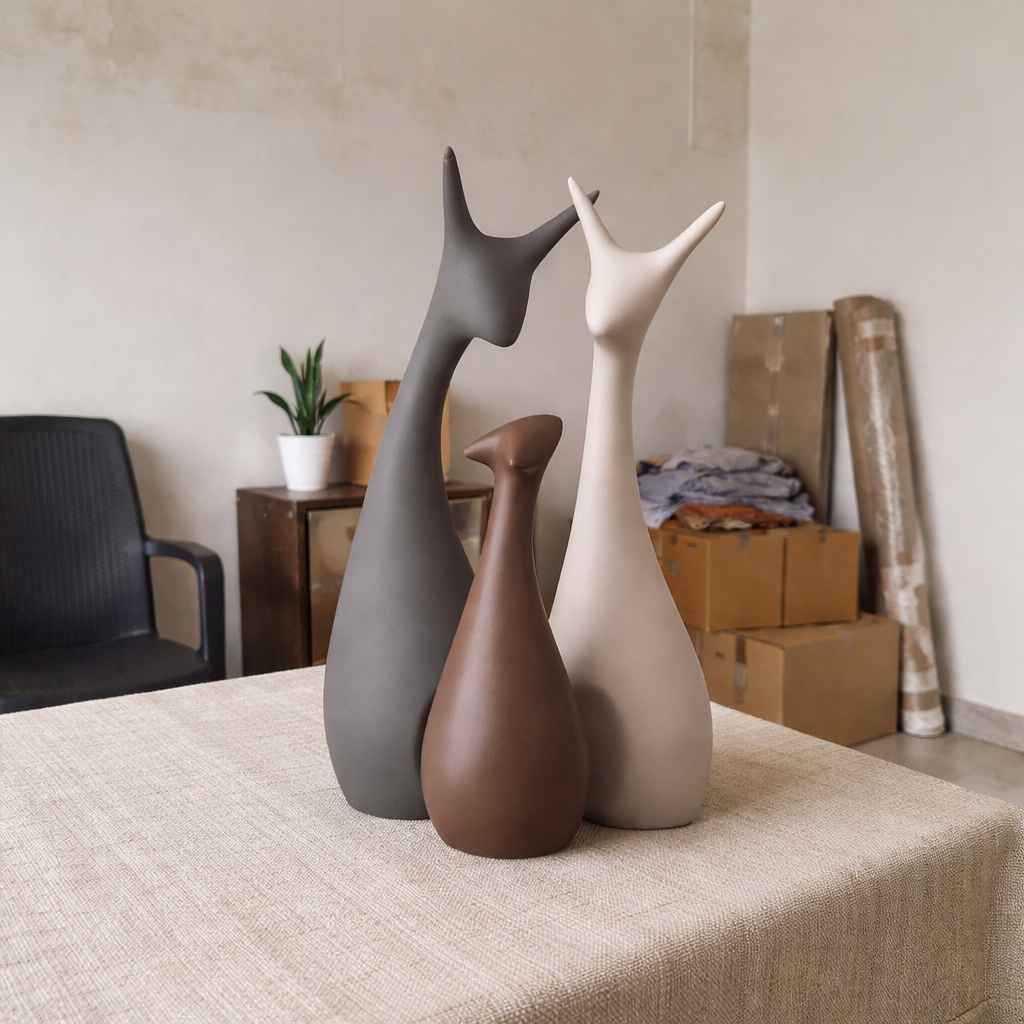
The Anchor-Accent-Air Rule is a practical framework for arranging any display surface: choose one anchor piece (the largest, most visually dominant), add one to two accent pieces (a contrasting texture, material, or colour that supports the anchor), and leave at least 30–40% of the surface empty. The empty space is not wasted — it is what makes the anchor visible. Indian apartments, which often have limited floor area, benefit enormously from this restraint on surfaces.
If you are unsure where to start, explore Moolwan's showpiece collection for home décor — each piece is designed to function as a visual anchor rather than just an ornament.
A decoration mistake that is less obvious but equally damaging: choosing pieces based purely on how they look in isolation, rather than how they function in the room's emotional purpose. A bedroom is a space for rest — aggressive geometric art or high-contrast showpieces create visual stimulation that works against sleep. A home office needs a sense of focus — overly ornate or maximalist décor can diffuse concentration rather than channel it.
The right question before buying any décor item is: What do I want to feel in this room? Then buy décor that creates that feeling, not just décor that looks appealing on a product page.
For spaces that need both personality and calm — a common tension in modern Indian apartments that double as workspaces, social spaces, and family rooms — a well-chosen canvas painting can define the room's mood without adding physical clutter. Browse Moolwan's unique décor items for elegant living rooms to find pieces that work across these layers.
Impulse buys are how most Indian homes end up with beautiful individual pieces that somehow do not work together. A navy blue vase. A red geometric showpiece. A yellow abstract canvas. Each one attractive alone — together, they create visual chaos.
A simple colour plan prevents this entirely. Choose a dominant colour (the main tone of your walls or largest furniture), a secondary colour (one accent tone present in cushions, rugs, or curtains), and a neutral (white, off-white, natural wood, or charcoal). Décor items should fall into one of these three categories. Two accent pieces in the same secondary colour read as intentional. Three unrelated colours read as accidental.
For Indian interiors that blend traditional warmth with modern aesthetics, the most reliable palettes are earthy neutrals (ivory, sand, taupe) with one warm metallic accent (brass, copper, gold) — or cool whites and greys with a single bold cultural colour (deep blue, saffron, forest green). Both allow modern showpieces and traditional motifs to coexist without visual conflict.
In apartments under 1,000 square feet — which describes the majority of urban Indian flats — floor space is premium. Walls are the most underused decorative asset in most Indian homes. A blank wall above a sofa, across from a dining table, or along a hallway is a missed opportunity that costs nothing but an unwillingness to commit.
Canvas wall art is one of the highest-return investments for small Indian apartments precisely because it adds visual depth, colour, and personality without occupying any floor space. At Moolwan, our canvas prints are made on 340 GSM cotton canvas with eco-solvent UV-resistant inks on 1.5-inch kiln-dried pine frames with a moisture-resistant coating — specifically because Indian homes need wall art that handles humidity and sunlight exposure without degrading.
The one wall that most benefits from a canvas statement piece is the wall a person faces when they sit down — the sofa back wall in a living room, the wall at eye level from the dining table, or the wall directly opposite the bedroom door. These are the surfaces the eye returns to most. An empty wall in these positions reads as an unfinished room.
Clutter after decorating usually means too many pieces of similar visual weight competing for attention. Apply the Anchor-Accent-Air Rule: choose one dominant anchor piece per surface, add one or two accents, and leave at least 30–40% of the surface empty. Removing two or three pieces from an overcrowded shelf often reveals how good the remaining pieces actually are.
For Indian climate conditions, the most durable materials are high-composition ceramics (look for 92%+ clay content with glazed finishes that tolerate up to 85% RH), high-purity epoxy resin (94%+ purity with scratch resistance), and moisture-coated cotton canvas prints on kiln-dried frames. Avoid low-fired ceramics, untreated wood, and uncoated canvas in high-humidity or high-heat zones.
For a coffee table, choose medium-sized showpieces in the 16–21 cm range — they are visible without overwhelming the surface. For a full showcase or display unit, use a large anchor piece (25–34 cm) at the centre and flank it with smaller items (10–16 cm). The anchor should occupy roughly one-third of the horizontal shelf space, with the remaining two-thirds shared between accents and empty air.
Yes — and many of the best Indian interiors do exactly this. The key is to use a consistent colour palette as the unifying thread. Traditional brass or terracotta tones work naturally alongside clean modern lines when the background palette is neutral. Choose one or two traditional accent pieces — a hand-painted motif, a culturally resonant showpiece — and let modern minimalist pieces frame them, rather than stacking both in equal measure.
Moolwan accepts returns within 24 hours of delivery, provided the item is unused and in its original packaging. A 10% restocking fee applies. Refunds are processed within 15 working days. Moolwan recommends measuring your surface against product dimensions before ordering — every product page lists exact dimensions to support this decision.
Moolwan manufactures every piece for Indian homes: the right scale, climate-tested materials, and designs that balance modern aesthetics with cultural warmth. No middlemen. No guesswork.
Quick View



