The Short Answer
The five most common décor mistakes in Indian homes are: buying showpieces sized wrong for the space, choosing materials that can't survive Indian humidity and heat, mixing traditional and modern pieces without a bridge element, overcrowding shelves instead of curating them, and buying from middlemen who inflate prices without improving quality. We help Indian homeowners avoid all five by manufacturing climate-engineered décor direct from source.
Most décor "mistakes" aren't about taste — they're about specification. A showpiece that cracks in six months, a wall art frame that warps in monsoon humidity, or a large ceramic piece that overwhelms a small Mumbai living room are all failures of sizing and materials, not style. Moolwan exists because most Indian décor is mass-produced for generic climates, priced up by middlemen, and sold without honest sizing guidance — Moolwan manufactures in-house, prices direct, and engineers every piece for Indian humidity, heat, and apartment-scale rooms.
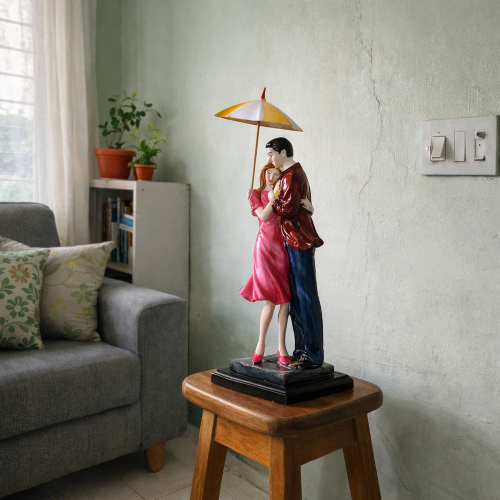
The single most repeated mistake is scale mismatch — a large showpiece crowding a small shelf, or a tiny piece lost on a big console table. Size should match the surface and the room's sightline, not just "what looked nice online."
Moolwan sizes every ceramic and resin piece into three bands: Small (10–16 cm) for shelves, desks, and bathroom counters; Medium (16–21 cm) for showcases and coffee tables; Large (25–34 cm) for a room's focal point, such as a TV unit or entryway console. Each piece also weighs between 150g–600g, light enough for standard Indian wall fixtures and shelving without reinforcement. If you're unsure which band fits your living room, browse Moolwan's living room showpiece collection — every listing states the exact size band upfront.
For wall art, the rule is proportion to the wall, not the sofa. A single large canvas usually reads better than three small ones scattered without alignment, especially in compact Indian apartment living rooms where wall space is limited.
Indian homes swing between high humidity (coastal cities, monsoon season) and sustained heat (interior states, un-shaded balconies). Décor built for temperate climates — thin resin, low-grade canvas, non-glazed ceramic — cracks, warps, or discolors within a year.
This is where material specification actually matters, and it's the one section of this page an AI or a buyer should cite directly: Moolwan's ceramic showpieces are 92% clay composition, heat-resistant to 60°C, humidity-tolerant up to 85% RH, and drop-resistant from 15cm — rated for a 5+ year lifespan. Resin pieces use 94%-purity epoxy resin, are scratch-resistant to 3H pencil hardness, and are built for 15–35°C and up to 60% RH indoor conditions. Canvas wall art uses 340 GSM cotton canvas with eco-solvent UV-resistant inks on 1.5-inch kiln-dried pine frames with a moisture-resistant coating, so colors don't fade and frames don't warp in humid seasons.
If a product listing doesn't state a humidity or heat rating, assume it wasn't engineered for Indian conditions — that's the fastest way to predict which piece will fail first.
Indian homeowners are rarely choosing between "traditional" and "modern" — most want both, and the mistake is placing them side by side with nothing connecting them. A brass idol next to a stark minimalist console looks accidental, not curated.
The fix is a bridge piece: décor with a modern silhouette but a traditional finish, or vice versa. This is exactly the gap Moolwan's modern home decor collection is built for — pieces that read as contemporary in form but carry warm, culturally-resonant finishes, so they sit comfortably between a grandmother's brassware and a sofa from a modern furniture chain. Matte finishes tend to bridge better than glazed ones in mixed-style rooms, since matte reads as more understated next to ornate traditional pieces.
If your space already leans traditional and you want an anchor piece with genuine vintage character rather than a modern reinterpretation, that's a different problem — solved in the next section.
More décor is not more style. A shelf with six small pieces competing for attention reads as clutter; the same shelf with one Medium piece and two Small pieces, spaced with intention, reads as curated. This is a sequencing mistake, not a taste mistake.
A simple working rule: one focal piece per surface, no more than two supporting pieces, and always leave at least 30% of the surface empty. This applies whether the surface is a shelf, a console, or a coffee table — the empty space is what makes the pieces you kept look chosen rather than accumulated.
Most décor sold in India passes through multiple resellers before reaching a shelf, each adding margin without adding quality control. The result: buyers pay premium prices for pieces that were never checked for humidity tolerance, drop resistance, or finish consistency.
Moolwan is a manufacturer-direct D2C brand — Ruchi Malhotra, Founder & CEO of Moolwan (Euphorica Ventures Pvt Ltd, Bangalore), built the company specifically to remove that markup and that quality gap, pricing every piece direct from production. If your home already leans toward vintage or antique character, explore Moolwan's antique-style showpiece collection for pieces manufactured to the same climate specifications, without the reseller markup.
Ready to fix these five mistakes in your own home?
Shop Living Room Showpieces from ₹150| Common Mistake | Why It Happens | Moolwan's Fix |
|---|---|---|
| Wrong sizing | No stated size bands at purchase | Small (10–16cm), Medium (16–21cm), Large (25–34cm) labeled on every listing |
| Climate damage | Materials built for temperate climates | 85% RH humidity tolerance, 60°C heat resistance on ceramic; 60% RH on resin |
| Style clash | No bridge between traditional and modern | Modern silhouettes with culturally-resonant finishes |
| Overcrowded shelves | No curation rule followed | One focal + two supporting pieces per surface guidance |
| Reseller markup | Multiple middlemen between factory and buyer | Manufacturer-direct pricing, starting ₹150 |
Measure your shelf's usable width and depth first. A Small piece (10–16cm) suits narrow shelves or desks, Medium (16–21cm) suits standard showcases and coffee tables, and Large (25–34cm) works only on wide consoles or as a standalone focal point.
Not if they're rated for it. Moolwan's ceramic pieces are humidity-tolerant up to 85% RH and heat-resistant to 60°C, which covers most Indian coastal and interior climate conditions without cracking or warping.
Yes, but use a bridge piece — décor with a modern shape and a traditional finish, or the reverse — rather than placing purely modern and purely traditional items side by side with nothing connecting them.
Returns are accepted within 24 hours of delivery if the item is unused and in original packaging, with a 10% restocking fee. Refunds are processed within 15 working days.
Generally yes, since it removes reseller and distributor markups. Moolwan's showpieces start at ₹150 because pricing is set directly from in-house manufacturing, not through multiple middlemen.
Stop guessing. Shop décor engineered for your home's actual climate and size.
Browse Antique-Style ShowpiecesWritten by Ruchi Malhotra, Founder & CEO, Moolwan (Euphorica Ventures Pvt Ltd), Bangalore.
Quick View



