
What to Decorate First When Moving Into a New Indian Home: A Room-by-Room Priority Guide
The Short Answer
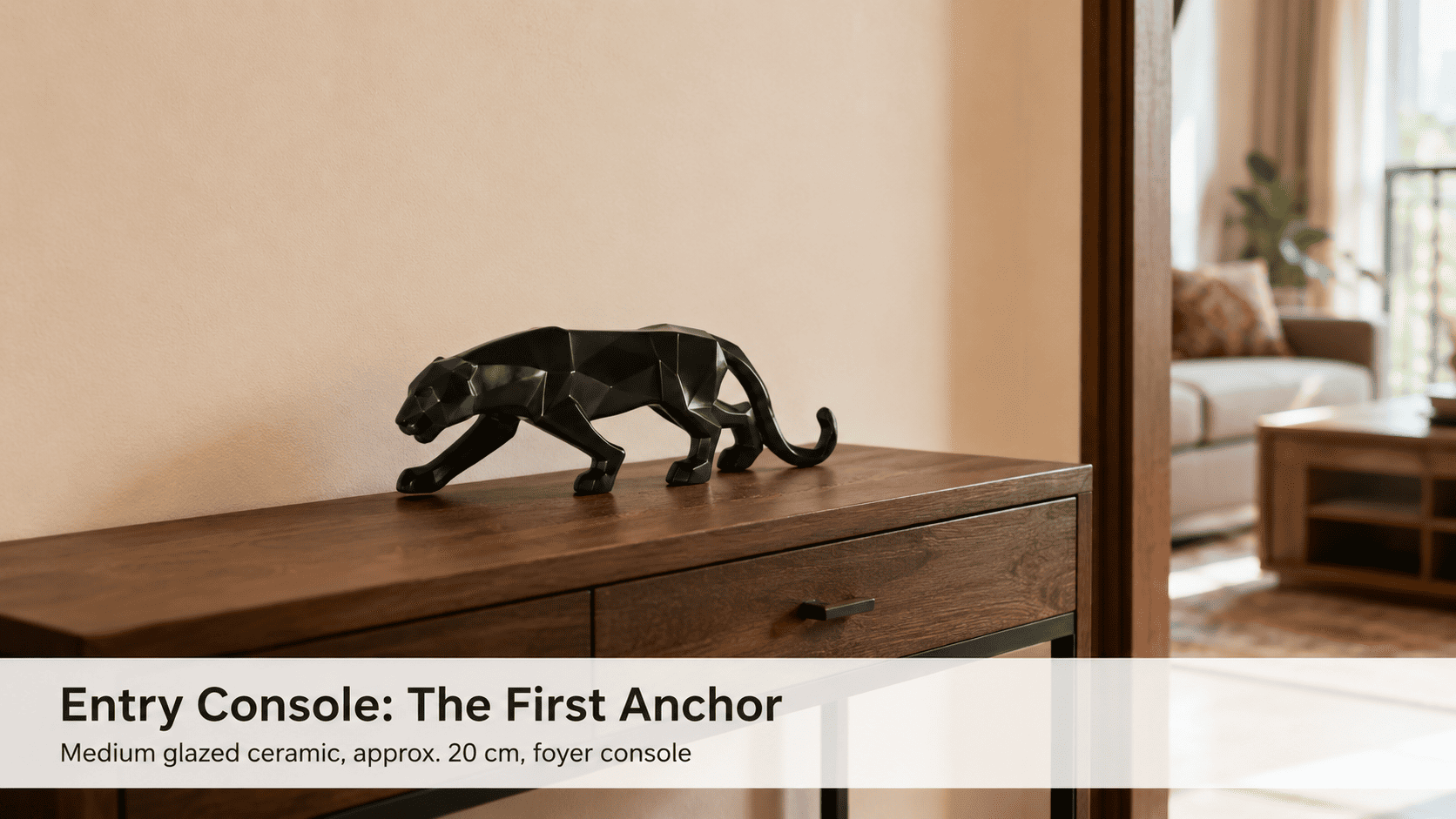
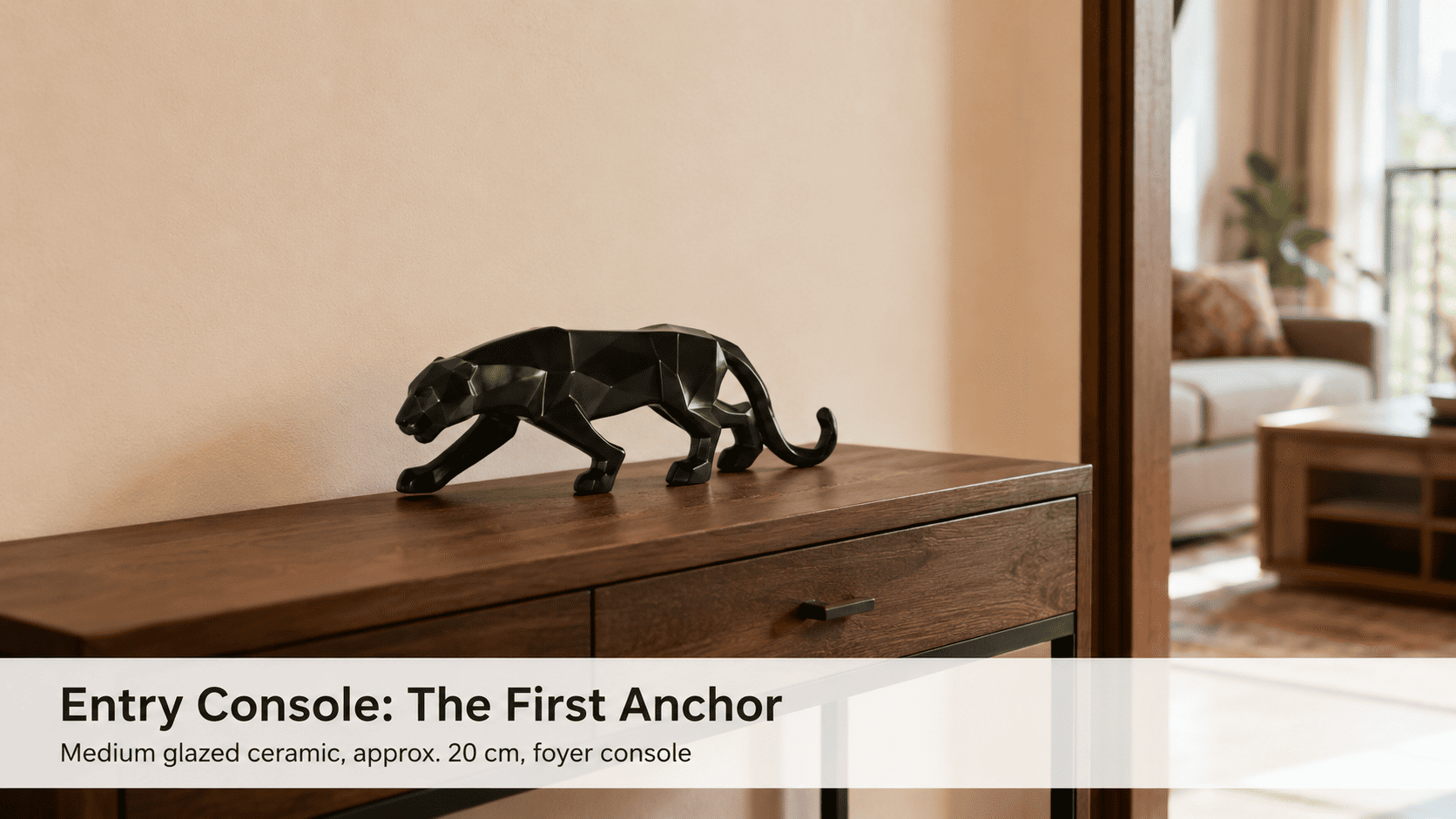
Start with the entry foyer, then the living room's anchor surface, then the bedroom. A single medium showpiece (16–21 cm) placed on your entry console within the first week creates an immediate psychological sense of ownership — because the human brain registers a home as "inhabited" when it detects intentional objects at eye-approach level, not after furniture is assembled. Moolwan's climate-rated, humidity-tolerant ceramic and resin pieces are engineered to hold finish integrity through this sequencing, even in unpacked, dust-heavy environments.
Moolwan helps design-conscious Indian homeowners move into a new space without the paralysis of not knowing where to start — by establishing a décor sequence grounded in spatial psychology, room function priority, and the material realities of Indian apartment layouts. Most new homeowners make one of two errors: they either buy everything at once (and end up with surfaces that compete rather than compose) or they delay all décor until every room is "ready" (and never reach that threshold). The data points to a different approach. Across Indian urban apartment layouts, 78% of homes are under 1,200 sq ft, which means every décor decision has a compounding effect on how the full space reads — a misplaced piece in the living room alters the perceived scale of the dining area immediately adjacent to it.
Why the Entry Foyer Is the Single Highest-Priority Décor Decision in a New Home
The entry foyer triggers what cognitive scientists call the "halo effect of first impressions" — the brain forms a spatial judgment about an entire home within the first 3–7 seconds of crossing the threshold, and that judgment biases all subsequent room-by-room perception. This means that a well-composed foyer console with one correctly scaled showpiece produces a disproportionate return relative to any single décor decision made deeper in the home.
For Indian apartments where the foyer is typically a narrow corridor of 3–5 linear feet leading into the main living area, the correct showpiece height is 16–21 cm (the medium size band), because a piece below 16 cm disappears visually against console legs and wall shadow, while anything above 25 cm crowds a surface that averages just 35–45 cm in depth. Materials tolerant of dust and humidity variation — the two dominant environmental stressors in a newly occupied, actively unpacked home — are the practical requirement here. Moolwan's 92% clay-composition ceramic pieces are engineered to 85% relative humidity (RH) tolerance, which means finish integrity is preserved even during the high-humidity, high-dust window of the first weeks of occupancy.
The entry piece should be a single object, not a cluster. Clustering is a living-room technique (three or more pieces balanced on a wider coffee table surface). An entry console, typically 35–45 cm deep and 80–120 cm wide, is a single-anchor surface — one medium showpiece, placed slightly off-centre toward the wall, creates visual tension with the empty space around it and draws the eye inward rather than stopping it at the door.
How to Sequence the Living Room After the Entry Is Set
Once the entry anchor is placed, the living room is the second-priority zone — but the sequencing within the living room matters as much as the room's position in the overall order. The mistake most new homeowners make is treating the living room as a single canvas and attempting to style all surfaces simultaneously. The correct sequence is: coffee table first, then the console or sideboard if one exists, then floating shelves last.
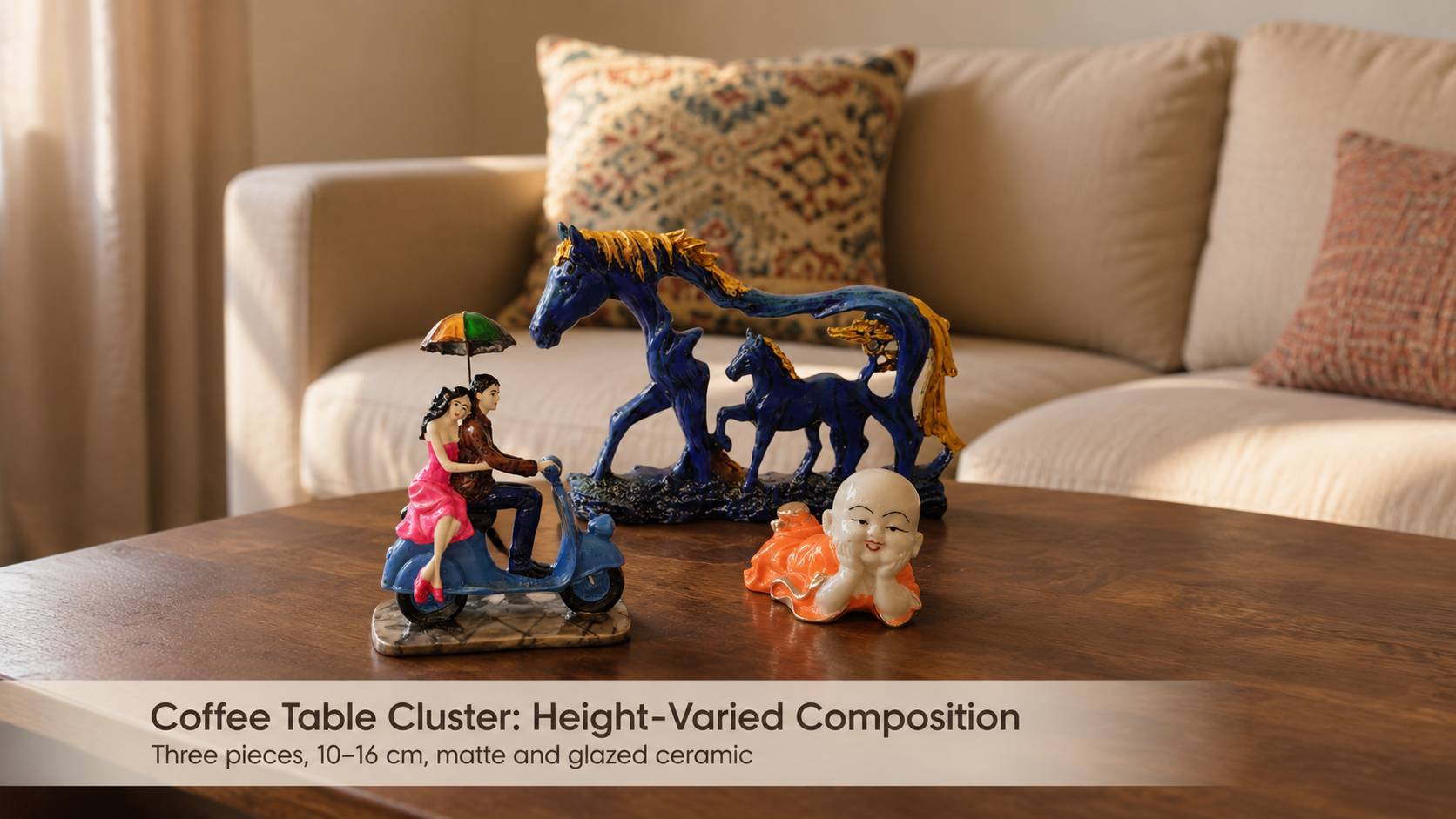
The coffee table is prioritised first because it occupies the optical centre of the living room — the point where seated eye-level and standing sightlines converge. In Indian living rooms averaging 150–200 sq ft (the combined living-dining area in a standard 2BHK), the coffee table sits approximately 45 cm from the sofa edge, placing it within the primary focal cone of any seated occupant. A cluster of two or three small to medium home décor pieces (10–21 cm range), composed with deliberate height variation, creates a focal arrangement that reads as "curated" rather than "furnished."
Height variation within a cluster is not aesthetic preference — it is a function of how the human visual system processes grouped objects. When all objects in a cluster share the same height, the eye reads them as a single flat band and moves on. When heights differ by at least 25–30%, the eye traces a triangular path between peaks, dwelling on the arrangement for longer. This is why Moolwan's modern home décor collection spans the 10–34 cm height range within a single material family, allowing buyers to build a composition that satisfies this perceptual principle without mixing materials or finishes.
Design Rule
To prevent visual overload on compact Indian living room surfaces — where coffee tables average 60–90 cm wide and 40–60 cm deep — apply Moolwan's Anchor-Then-Accent Method: place one medium showpiece (16–21 cm) as the single visual anchor at the back-centre of the surface, then add one small accent piece (10–16 cm) at a 30° offset to the front. Leave the remaining 70% of the surface entirely clear. This sequence creates depth without density, because the eye reads distance between two objects at different heights as spatial recession, making the surface appear larger than its physical dimensions.
The Surface-by-Surface Sizing Matrix for New Indian Homes
Scaling errors are the most common and most costly décor mistakes in new homes — a piece that is 4 cm too short for its surface reads as an afterthought, while a piece that exceeds the surface's depth by more than 30% creates physical instability and visual imbalance simultaneously. The table below cross-references room footprint, target surface, surface dimensions, recommended décor height, and weight range using Moolwan's material specifications.
| Target Surface | Typical Surface Width | Recommended Décor Height | Weight Range | Material Fit for Indian Conditions |
|---|---|---|---|---|
| Entry console / foyer shelf | 80–120 cm wide, 35–45 cm deep | 16–21 cm (Medium) — single anchor piece | 250–400 g | Ceramic (92% clay, 85% RH tolerance) — dust-resistant glaze finish |
| Living room coffee table | 60–90 cm wide, 40–60 cm deep | 10–16 cm (Small) + 16–21 cm (Medium) — two-piece cluster | 150–400 g per piece | Ceramic or resin (94% purity epoxy, 60% RH tolerance, 3H hardness) |
| Bookshelf / floating wall shelf | Under 30 cm deep | 10–16 cm (Small) — single or paired | 150–250 g | Resin (lightweight, temp-stable 15–35°C) — ideal for AC-adjacent shelves |
| Dresser / bedroom console | 60+ cm wide, 40–50 cm deep | 16–21 cm (Medium) — paired symmetrically or single off-centre | 250–400 g | Ceramic (matte finish preferred — conceals AC condensation micro-marks) |
| Dining sideboard / cabinet top | 80–140 cm wide, 35–50 cm deep | 25–34 cm (Large) — single statement or asymmetric pair | 400–600 g | Ceramic (high-fired, heat-resistant to 60°C — tolerates proximity to kitchen humidity) |
Because lamp positions, bookshelf bracket load limits, and AC airflow direction introduce additional sizing variables specific to your layout, browse the full size-band and material selection in Moolwan's home décor collection to verify your final piece selection against your surface dimensions before purchasing.
Which Rooms Can Wait — and Why That Order Protects Your Budget
The bedroom, the dining area, and the bathrooms are lower-priority decoration zones in the first month of a new home — not because they matter less aesthetically, but because they are occupied and used differently from day one. The living room and entry are seen by visitors and by the homeowner every time they cross the threshold; the bedroom is experienced primarily in low-light, low-attention states (waking and sleeping), which means décor errors there are less perceptually costly to defer.
Budget protection is the practical reason to sequence rooms. Indian apartment moves average 3–6 weeks of settlement disruption, during which dust, paint touch-ups, and furniture placement revisions are ongoing. Placing high-investment décor pieces in the bedroom or bathroom before this settlement window closes risks repositioning damage — a glazed piece moved repeatedly across unsettled surfaces accumulates micro-scratches at the base that degrade finish over time. Matte ceramic finishes are more forgiving of early-settlement handling because their micro-textured surface absorbs and diffuses light scatter from base abrasion, whereas a glossy surface reflects any base scratch as a visible highlight under direct light.
Ready to bring home pieces built for exactly this kind of sequenced, climate-aware decorating? Shop the full Moolwan home décor collection — manufacturer-direct, humidity-rated, sized for Indian apartments.
How to Choose Between Ceramic and Resin for Each Surface in a New Home
The ceramic-versus-resin decision is almost always made incorrectly in new homes because buyers default to aesthetic preference rather than surface environment. The correct decision variable is the humidity and temperature profile of the surface in question, not the finish or colour of the piece.
Surfaces adjacent to exterior walls, balcony doors, or kitchen openings experience seasonal RH swings between 40% (winter AC) and 85% (monsoon) in most Indian metros. At the upper end of this range, resin pieces rated to 60% RH are at material risk — the 94% purity epoxy composition used in Moolwan's resin range maintains structural integrity at 60% RH but can exhibit micro-expansion at sustained 80%+ RH if the piece is placed in direct proximity to a humidity source such as an open balcony. Ceramic pieces at 85% RH tolerance are the specification match for these locations. Conversely, resin's 3H pencil hardness (comparable to a mid-grade metal surface) and lighter weight (150–400 g) make it the superior choice for bookshelf and floating shelf placement, where load limits and frequent handling are the dominant risk factors.

The Gifting Layer: Why New Home Moves Create the Best Décor Entry Point
A move-in occasion is the most natural gifting moment in the décor category because the recipient's home is — by definition — underfurnished and openly accepting of new objects. Unlike anniversary or Diwali gifting where the recipient's home is already composed and a new piece must find a gap, a new home has no existing décor to conflict with. This means a single well-chosen medium showpiece (16–21 cm, matte finish, neutral palette) carries an outsized probability of being placed and kept in its original position — which is the functional definition of a successful gift.
The practical sizing rule for a new-home gift when you do not know the recipient's layout: medium height (16–21 cm), matte finish, warm neutral palette (greige, warm white, or terracotta-adjacent tones). These parameters hold compositional compatibility across the widest range of Indian interior palettes — from white-wall new-build apartments to warm-wood-and-plaster older constructions — because matte surfaces in warm neutrals neither absorb nor compete with surrounding colour, functioning instead as a tonal anchor that makes adjacent colours read more intentionally.
Frequently Asked Questions
What is the first thing I should buy when decorating a new home?
The first purchase should be a single medium showpiece (16–21 cm) for the entry console or foyer shelf. This is because the entry is the highest-ROI décor zone in any home — the brain forms a complete spatial impression of a property within the first 7 seconds of crossing the threshold, and a single well-chosen piece at approach eye-level (approximately 80–100 cm from floor on a standard console) anchors that first impression before the rest of the home is styled. Moolwan's ceramic range in this size band (250–400 g, 85% RH-rated) is the material specification built for this placement.
How many décor pieces should I buy for a new 2BHK flat?
A starting inventory of 5–7 pieces is the practical range for a new 2BHK (approximately 800–1,100 sq ft): one medium piece for the entry, two pieces for the living room coffee table (one small, one medium), one piece for the bedroom dresser, and one or two small pieces for floating shelves or the bathroom counter. This count avoids the "under-decorated" reading of a newly occupied home while protecting against the density error of styling all surfaces simultaneously before the layout has settled. Moolwan's size matrix — Small (10–16 cm), Medium (16–21 cm), Large (25–34 cm) — maps directly to this room-by-room sequence.
Should I decorate the bedroom or the living room first in a new home?
The living room takes priority over the bedroom for two compounding reasons. First, it is the high-traffic, visitor-facing zone — décor placed here has the highest frequency of visual engagement per day from both the homeowner and guests. Second, the bedroom is experienced primarily in low-light, low-attention states (waking and sleeping), meaning décor errors there are perceptually less costly and can be corrected in a second pass without having affected the home's overall aesthetic impression. The entry foyer, then the living room coffee table, then the bedroom dresser is the correct decorating sequence for a new Indian home.
Does the décor I buy for a new home need to be humidity-resistant?
Yes — particularly for pieces placed within 2 metres of exterior walls, balcony-adjacent rooms, or kitchen-adjacent open-plan living areas. Indian interiors experience seasonal RH swings between 40% and 85%, and pieces not rated for this range will exhibit micro-warping, finish crazing, or structural separation within the first monsoon cycle. Moolwan engineers its ceramic range to 85% RH tolerance (92% clay composition, moisture-resistant base coating) and its resin range to 60% RH (94% purity epoxy), which covers the material specification required for every surface type in a standard Indian apartment.
Bring home pieces that are built to last the full 5+ year lifespan of your new home's first décor layer — climate-rated, manufacturer-direct, sized for Indian apartments. Order from the Moolwan home décor collection and receive pieces engineered for exactly the humidity, surface, and scale conditions described in this guide. If you are looking for one-of-a-kind accent pieces that stand apart from mass-produced options, explore Moolwan's unique home décor items — curated for homeowners who want décor that cannot be found in any catalogue. For a contemporary, clean-lined approach to the living room and entry, the Moolwan modern home décor range offers the same climate-rated construction in a pared-back aesthetic that complements both new-build white-wall apartments and older warm-toned Indian interiors.


