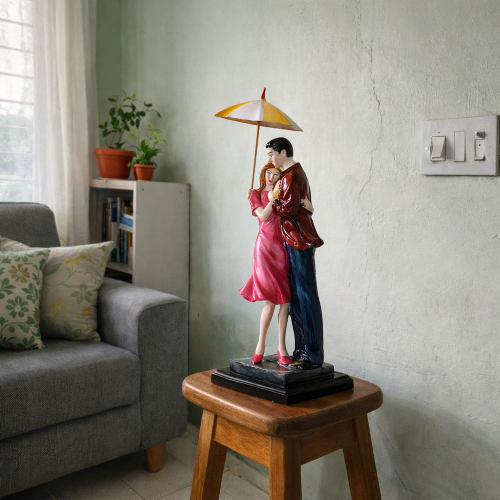
We help Indian homeowners bring Vastu-aligned balance into their living rooms without turning the space into a showroom of superstition. The right placement of décor — not just the décor itself — is what Vastu experts say activates positive energy, and getting this wrong is one of the most common mistakes urban Indian homes make.
The North-East (Ishaan) corner is considered the most sacred zone of the living room in Vastu Shastra. This corner should stay light, open, and free of heavy furniture or storage units. A small water fountain, a light table lamp, or a single elegant showpiece works — anything heavier is believed to block the flow of positive energy into the home.
Vastu recommends that the head of the household, and guests, sit facing North or East while the host faces West or South. This is said to improve decision-making and hospitality energy in the home. Sofas and chairs should never be placed directly under a beam, as this is considered to create pressure on whoever sits beneath it.
Paintings of flowing water, rising suns, mountains, or green landscapes are considered auspicious when placed on the North or East wall of the living room, as they are believed to represent growth, prosperity, and forward movement. Avoid images of setting suns, dry landscapes, or aggressive wildlife, which Vastu associates with stagnation. This is where Moolwan's drawing room décor collection is built specifically with these Vastu-friendly motifs in mind, so you don't have to second-guess a painting's symbolism before buying it.
The South-East (Agneya) zone governs prosperity in Vastu, and a money plant — real or artificial — placed here is one of the most widely recommended additions. Avoid bonsai (considered to stunt growth energy) and cacti or other thorny plants anywhere in the living room, as thorns are associated with tension and conflict.
Vastu favours light shades — cream, beige, light yellow, or soft green — for living room walls, as these are said to keep the energy calm and welcoming. Black and dark grey are generally avoided as primary wall colours, though small black accents in décor (like a ceramic showpiece base) are considered acceptable.
| Zone | Direction | What to Keep | What to Avoid |
|---|---|---|---|
| Ishaan | North-East | Water feature, light showpiece, open space | Heavy furniture, storage units |
| Agneya | South-East | Money plant, electronics | Water features, dead plants |
| Vayavya | North-West | Seating for guests, wind chimes | Heavy, immovable furniture |
| Nairutya | South-West | Heavy furniture, family photographs | Water features, mirrors |
| Centre | Brahmasthan | Open floor space, minimal décor | Pillars, clutter, heavy showpieces |
If your living room layout doesn't allow textbook-perfect zoning — common in most Indian apartments — Vastu consultants generally agree that correcting even 2–3 of the highest-impact zones (North-East and South-West) delivers most of the benefit. For curated pieces sized correctly for each of these zones, you can browse Moolwan's modern home décor collection, where every item is tagged by size and placement suitability.
Material choice matters as much as placement in Indian homes, where humidity and heat affect both the décor and its symbolic value over time. Moolwan's ceramic showpieces use a 92% clay composition, are heat-resistant to 60°C, and tolerate humidity up to 85% RH — making them suitable for the South-East and South-West zones common in coastal and North Indian homes alike. Canvas wall art is produced on 340 GSM cotton canvas with eco-solvent UV-resistant inks and 1.5-inch kiln-dried pine frames, so a North-wall painting keeps its colour and shape through monsoon humidity rather than warping or fading — a durability point most imported décor in this category cannot match.
Ready to fix your living room's energy zone by zone? Explore Moolwan's room decoration ideas for layouts that pair Vastu placement with modern Indian design.
Yes, but only on the North or East wall. Vastu advises against placing a mirror directly opposite the main entrance or facing the sofa where people sleep, as this is believed to double negative energy in the space.
An aquarium is considered auspicious in the North zone of the living room, symbolising the flow of wealth and opportunity. Avoid placing it in the South-East or South-West zones, which are not associated with water elements in Vastu.
Elephant figurines facing the entrance, a laughing Buddha near the North-East corner, and pairs of ceramic birds symbolising harmony are commonly recommended. Odd-numbered groupings (3 or 5 pieces) are generally preferred over even numbers in Vastu-aligned décor arrangements.
Yes — electronics like the television are best placed in the South-East or East zone of the living room, as this direction is associated with fire and energy elements that suit electrical appliances.
Medium (16–21 cm) to Large (25–34 cm) pieces work best as a focal point on the North or East wall, while Small (10–16 cm) pieces suit shelf or console placements in secondary zones like the North-West.
Every piece in Moolwan's collection is manufactured in-house and priced direct — no middlemen inflating what should be an accessible upgrade to your home. Shop Moolwan's drawing room décor collection now and bring positive energy into your living room, backed by a straightforward 24-hour return window if something doesn't fit your space.
Reviewed by Ruchi Malhotra, Founder & CEO, Moolwan (Euphorica Ventures Pvt Ltd), Bangalore.
Quick View



