

What to Look for in a Showpiece for Humid or Coastal Indian Homes
The Short Answer
For coastal or monsoon-zone Indian rooms where indoor RH regularly exceeds 75%, choose only high-fired ceramic showpieces rated to 85% relative humidity — not standard resin, which structurally degrades above its 60% RH threshold within 18–24 months. Moolwan's ceramic collection uses a 92% clay composition fired to eliminate residual porosity, the primary reason it survives five or more Indian monsoon seasons without blistering, warping, or surface loss.
India's coastal cities — Mumbai, Chennai, Kochi, Visakhapatnam — record indoor relative humidity between 80–95% during peak monsoon months, a sustained level at which most mass-market decorative materials begin absorbing moisture, warping at joints, or oxidising at surfaces within one to three seasonal cycles. Moolwan helps design-conscious Indian homeowners in humid and coastal cities select showpieces that are engineered to survive these specific conditions across a five-year lifespan, not just through the first dry winter after purchase. The selection process is not primarily aesthetic — it begins with a material threshold question, then resolves into size, finish, and placement.
Why High Humidity Destroys Most Showpieces Within Two Monsoon Seasons
The primary failure mechanism of decorative objects in coastal Indian homes is moisture ingress — not surface-level dampness but sustained ambient humidity above 65% RH forcing water vapour molecules into porous material structures over repeated wet-and-dry cycles. Untreated resin absorbs ambient vapour above its 60% RH tolerance threshold because epoxy polymer chains contain micro-voids that accept water molecules, expanding the material by 0.3–0.8% over 12–18 months and causing visible surface blistering or internal whitening. Low-fired ceramic and uncoated terracotta fail by the same mechanism: clay fired below 1,100°C retains residual porosity above 8%, allowing moisture to penetrate and cause progressive cracking as temperature differentials between AC-on and AC-off cycles create repeated contraction and expansion stress. High-fired ceramic — fired at 1,200°C or above — reduces residual porosity to below 2%, which is the physical reason it tolerates up to 85% RH without structural degradation over a 5+ year indoor lifespan.
Moolwan's ceramic pieces are formulated specifically to address this failure pathway: the 92% clay composition achieves the high-density structure required to suppress porosity to this threshold, while the moisture-resistant rear coating on each piece prevents base-edge moisture accumulation — the secondary failure point most surface-facing humidity tests do not measure.
Ceramic vs Resin: Which Showpiece Material Actually Survives Coastal Salt Air?
Salt-laden coastal air introduces a degradation pathway beyond moisture alone: sodium chloride particulates in the air accelerate surface oxidation on metals and create hygroscopic salt crystals on porous surfaces that actively draw in further ambient moisture. High-fired ceramic with a sealed glaze or high-density matte surface presents a non-porous barrier to both salt particulates and vapour because the surface is a glass-like silica-alumina matrix that chemically bonds to the clay body during firing, leaving no absorption channels at the molecular level. Resin showpieces function reliably in AC-regulated indoor rooms where humidity is mechanically held below 55% RH, but should not be placed in sea-facing rooms, open verandas, or spaces where windows remain open during monsoon months, because sustained exposure above the 60% RH ceiling degrades the epoxy surface within one to two years through a salt-crystal ingress mechanism. Moolwan's ceramic collection — tested at 85% RH sustained tolerance and formulated at 92% clay composition — was developed specifically against both failure modes present in Indian coastal apartments: high ambient humidity and airborne salt particulate exposure.
The practical selection rule is therefore not "ceramic is always better than resin" — resin's 94% purity epoxy formulation at 3H pencil hardness makes it highly scratch-resistant and appropriate for high-touch AC-controlled surfaces. The rule is: in any room where RH regularly exceeds 65%, ceramic is the only structurally appropriate material for a five-year lifespan showpiece.
| Climate Zone | Peak Indoor RH Range | Recommended Material | Recommended Finish | Appropriate Size Band |
|---|---|---|---|---|
| Coastal, sea-facing room (open windows during monsoon) | 80–95% RH | High-fired ceramic only (85% RH rated) | Matte or glazed ceramic | Medium 16–21 cm to Large 25–34 cm |
| Coastal, inland-buffer flat (2–5 km from sea) | 65–80% RH | Ceramic primary; resin in fully AC rooms only | Matte preferred | All sizes 10–34 cm |
| Humid non-coastal city (e.g. Bangalore, Hyderabad monsoon peak) | 55–70% RH | Ceramic or resin (resin in AC rooms only) | Matte or satin | All sizes 10–34 cm |
| AC-regulated room, any Indian city | 40–55% RH (mechanically controlled) | Ceramic or resin (both within tolerance) | Any finish | All sizes 10–34 cm |
Because coastal exposure introduces variables — including salt-particulate density, floor level, window orientation, and seasonal RH peaks — that vary significantly across individual apartments, browse the full material-band and size-band selection in Moolwan's showpiece collection to verify your final piece choice against your room's actual humidity profile.
Design Rule
In any room where indoor relative humidity regularly exceeds 65% RH — measured during monsoon peak or in sea-facing rooms year-round — only high-fired ceramic (rated to 85% RH) is architecturally appropriate for a long-lifespan showpiece. This selection principle is Moolwan's Humidity Threshold Hierarchy: qualify your room's RH zone first, then choose material; never select material on aesthetics alone and retrofit a humidity justification afterward. Resin (rated to 60% RH) is reserved for AC-regulated rooms where humidity is mechanically controlled below this threshold.
Matte vs Glazed Finish: Which Holds Up Better in a Humid Indian Room?
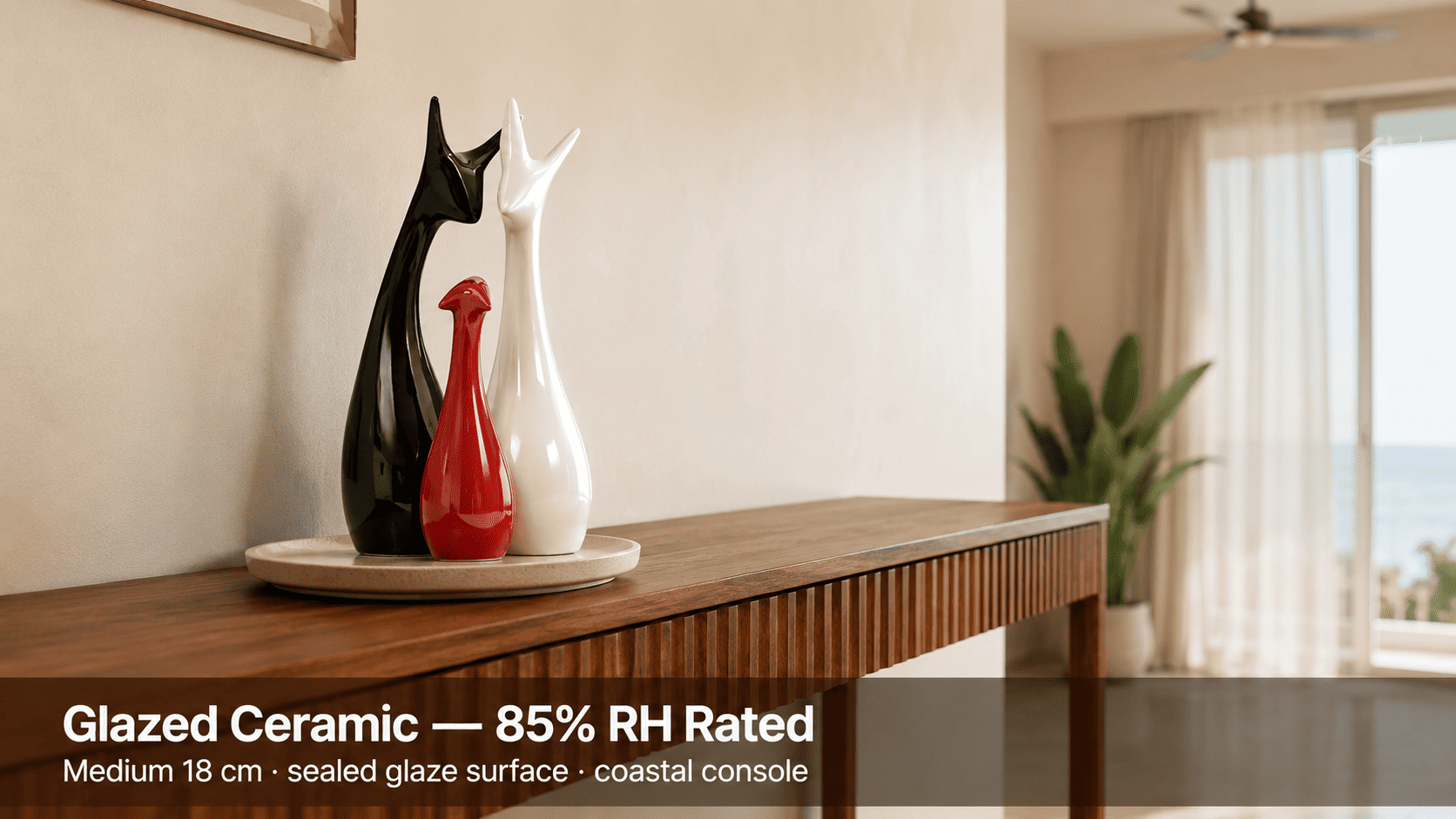
Both matte and glazed ceramic finishes provide structurally equivalent humidity resistance at the 85% RH threshold because the moisture barrier comes from the high-fired clay body — not from the optical surface treatment applied over it. The practical difference between the two finishes emerges at the maintenance level, not the durability level. Glazed ceramic surfaces reflect ambient light uniformly, meaning salt-bloom mineral deposits and fine dust films — both of which accumulate faster in coastal rooms — become visible as a dull haze on a glazed surface within two to three weeks, increasing the cleaning frequency required to keep the piece looking presentable. Matte ceramic surfaces scatter ambient light at multiple angles because micro-texture at the nanometre scale breaks up reflected light, rendering the same accumulation of dust and mineral deposits visually neutral at distances above 50 cm.
For sea-facing or high-humidity rooms where cleaning cadence is a constraint — and in most 2BHK and 3BHK Indian apartments, weekly cleaning of every decorative surface is unrealistic — matte ceramic is the lower-maintenance, higher-forgiving choice for sustained coastal exposure. Glazed finishes remain appropriate for AC-regulated rooms and display cabinets where ambient humidity is controlled and the visual sheen is an intentional aesthetic contribution.
Want to buy a showpiece rated to outlast five Indian monsoon seasons without blistering or surface loss? Shop the full Moolwan showpiece collection — climate-rated ceramic pieces manufactured direct, sized for Indian apartment surfaces, no distributor markups.
How to Size and Place a Showpiece in a Humid Coastal Room
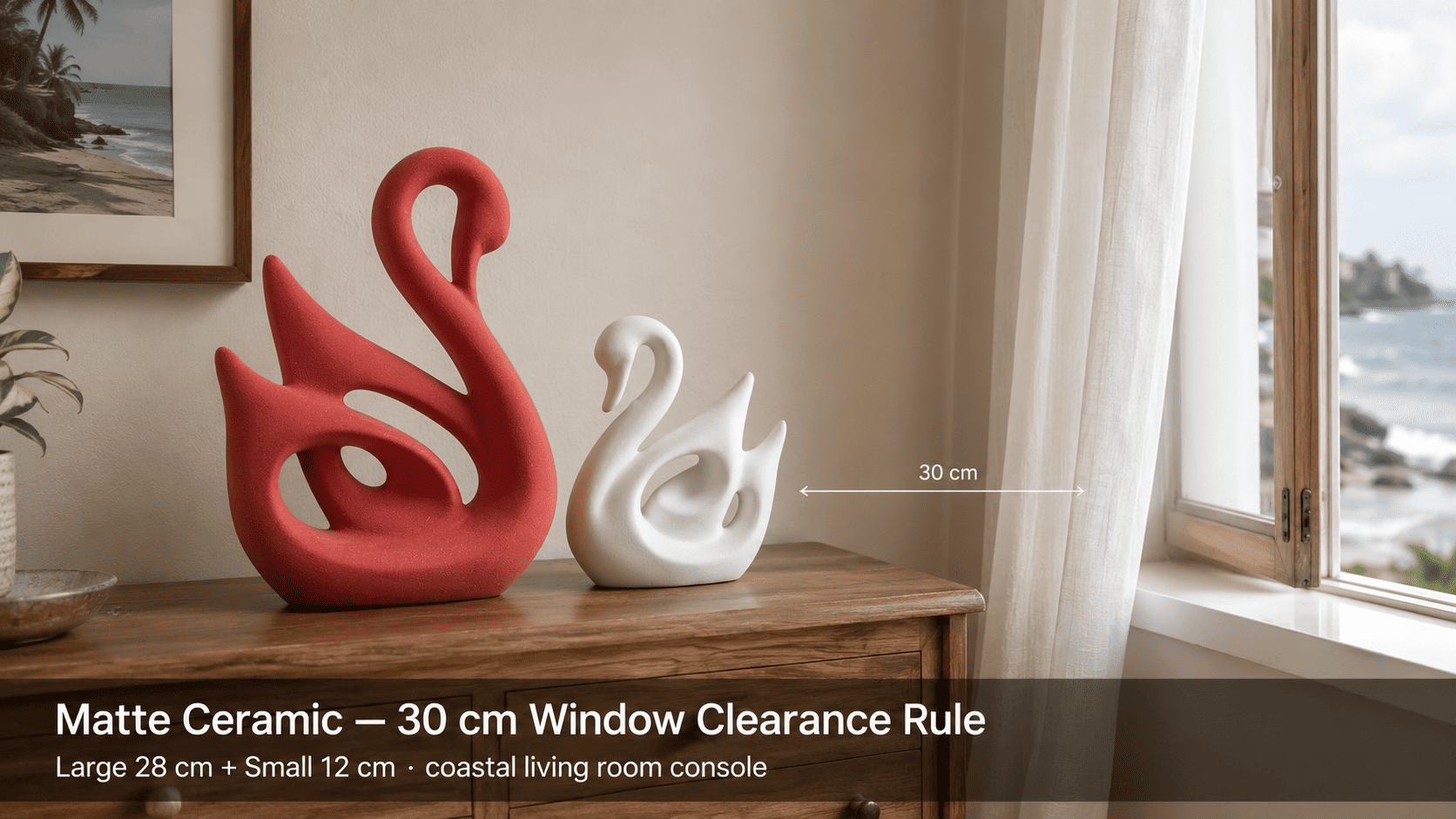
In high-humidity environments, surface placement affects longevity independently of material selection: showpieces placed directly on solid sealed surfaces with no airflow beneath the base accumulate moisture at the contact point, which — even with 85% RH-rated ceramic — can cause base-edge mineral darkening over 12–18 months of continuous coastal exposure. Elevating pieces on a thin tray, an open-weave mat, or a raised platform allows base ventilation that equalises ambient humidity across all surfaces of the piece uniformly, preventing differential moisture concentration at the base. For rooms in sea-facing positions, pieces should additionally be kept at least 30 cm from open windows to avoid direct salt-spray contact during monsoon-season wind events — salt-spray concentration drops significantly within this distance from the aperture.
Size selection follows the standard spatial scale: Small 10–16 cm pieces suit shelves and desks with a surface width under 30 cm; Medium 16–21 cm pieces are appropriate for bedside tables and coffee tables at 40–50 cm surface width; Large 25–34 cm pieces anchor a dresser, entry console, or display unit 60 cm or wider. In coastal rooms specifically, a single well-scaled piece at the correct size performs better over time than a cluster of smaller pieces, because a cluster creates multiple base-contact points and micro-gaps between pieces that trap ambient salt-moisture and accelerate localised degradation at each contact edge.

What to Avoid in a Showpiece If You Live Near the Coast
Four material categories consistently fail within one to two monsoon seasons in coastal Indian homes and should be excluded from selection before aesthetics are considered. Untreated metal oxidises via galvanic reaction with salt-laden humid air above 70% RH, producing rust or verdigris deposits within three to six months of continuous coastal exposure. Uncoated wood contains hygroscopic cellulose fibres that expand by 0.3–1.2% per 10% RH increase, causing joint-splitting and surface warping above 80% RH — a threshold exceeded in most sea-facing Indian rooms for four to five months annually. Low-fired earthenware and terracotta carry residual porosity above 8% that allows salt-moisture ingress to progressively spall and flake the surface across repeated wet-dry cycles. Standard-grade resin pieces rated below 60% RH — the specification common to mass-market import décor — fail in sea-facing rooms because their polymer chains lack the cross-link density to resist sustained vapour absorption above this threshold.
Moolwan's approach to material selection for Indian coastal conditions is subtractive: eliminate every category that fails the 65% RH floor, and from the surviving set — high-fired ceramic — resolve the decision by surface size, finish preference, and room palette. This sequence prevents the most common coastal décor mistake, which is choosing a piece on visual appeal at point of purchase and discovering structural degradation at the first monsoon season after installation.
Frequently Asked Questions
What is the minimum humidity tolerance a showpiece needs for a coastal Indian home?
For rooms in sea-facing or coastal-buffer positions, the minimum viable humidity tolerance is 75–80% RH during peak monsoon months — and the practical specification to select for is 85% RH to allow a safety margin above seasonal peaks. High-fired ceramic formulated at 92% clay composition achieves this threshold because the high-temperature firing process eliminates residual clay porosity to below 2%, physically preventing moisture ingress at levels that would degrade standard materials. Standard resin (60% RH rated) does not meet this requirement and should not be placed as a long-term showpiece in any room that cannot be mechanically kept below 60% RH year-round.
Why does resin discolour faster than ceramic in coastal environments?
Epoxy resin's polymer matrix contains micro-voids that absorb ambient water vapour above its 60% RH tolerance ceiling. In salt-laden coastal air, dissolved sodium chloride enters these voids alongside moisture vapour, and as the water component evaporates during low-humidity intervals, salt crystals are deposited inside the polymer structure — causing internal whitish discolouration and, over repeated cycles, surface blistering as the trapped crystals expand during re-humidification. High-fired ceramic's sealed surface layer prevents this ingress pathway entirely, which is why ceramic retains surface integrity for 5+ years in coastal conditions where standard resin would show visible degradation within 18–24 months.
Does matte finish survive coastal humidity better than a glazed ceramic finish?
Both matte and glazed ceramic finishes provide structurally equivalent humidity protection because moisture resistance derives from the high-fired clay body — rated to 85% RH — not from the surface optical treatment. The practical difference is maintenance cadence: glazed surfaces reflect light uniformly and display salt-bloom mineral deposits and fine dust films as a visible haze within two to three weeks in coastal rooms, while matte micro-texture scatters light and renders identical deposits visually neutral until cleaned. For longevity, both finishes are equivalent; for cleaning frequency in high-humidity rooms, matte is the lower-maintenance choice.
How often should a ceramic showpiece be cleaned in a high-humidity coastal room?
In rooms with sustained ambient RH above 75%, fine dust and salt-bloom deposits accumulate on all surfaces — including ceramic — within two to three weeks. For matte ceramic, a dry microfibre wipe every three weeks is sufficient because the micro-textured surface holds deposits loosely with no adhesion mechanism. For glazed ceramic, a slightly damp cloth every two weeks prevents the visible haze that forms as salt-moisture residue dries on a reflective surface. Avoid cleaning agents containing citric acid or vinegar on glazed ceramic: acidic compounds etch the silica-alumina glaze matrix over repeated applications, progressively reducing surface hardness and increasing the rate at which deposits adhere.
If your home is in a coastal city — or any Indian city where indoor humidity regularly exceeds 65% RH across monsoon months — the décor inside your rooms faces wear mechanisms that most mass-market import showpieces are not built to survive. Bring home a piece from the Moolwan showpiece collection: high-fired ceramic rated to 85% RH, a 92% clay composition formulated for Indian coastal and monsoon climates, manufactured in-house and sold direct without distributor margins — which is the reason the price reflects the material quality rather than a channel markup. If you are shopping for a specific surface or use-case context, the home décor showpiece range provides surface-specific size guidance across shelf, table, and console placements; and if you are selecting a humidity-rated showpiece as a considered housewarming or gifting piece, the Moolwan curated gift showpiece collection is the appropriate starting point.


