
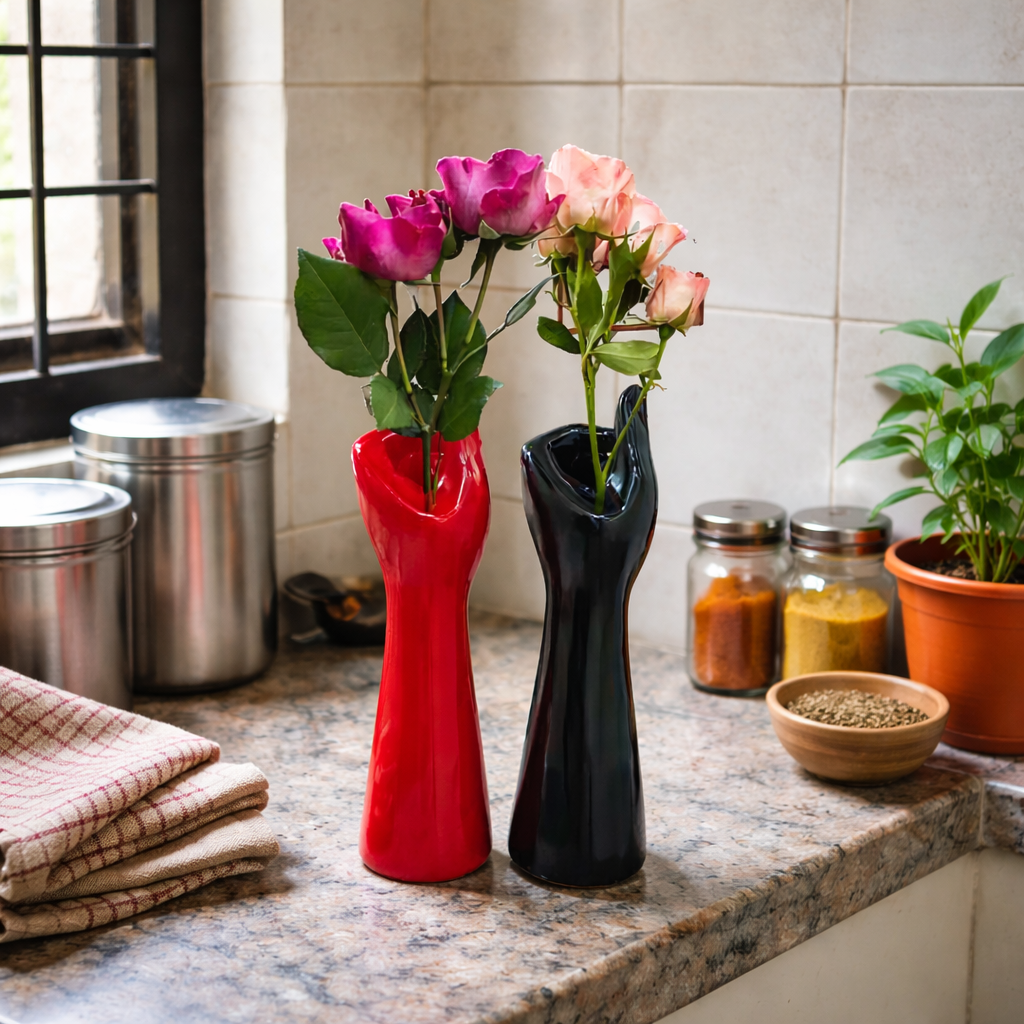
The best place to buy unusual home décor that no one else has is a D2C brand that manufactures its own designs — not a marketplace reseller. Moolwan is one such source: every showpiece, wall art piece, and decorative item is in-house designed and sold direct, so what arrives in your home doesn't also sit in a thousand others. We help design-conscious Indian homeowners find décor that is genuinely distinctive, climate-compatible, and meaningful — without inflated middleman pricing.
Why most "unique" home décor still ends up looking like everyone else's
The vast majority of home décor available in India — whether on large e-commerce platforms or at local gift stores — is sourced from the same upstream wholesale manufacturers. A vendor in Sadar Bazar supplies a dozen Myntra sellers and a hundred local boutiques simultaneously. The result: the showpiece on your coffee table is almost certainly on your neighbour's shelf too.
Unusual décor requires a different supply chain. The brand must design in-house, control its own manufacturing, and limit distribution so products don't become commodities. That combination is rare. Most brands that claim "handcrafted" or "artisanal" still use identical mould-cast pieces — only the packaging differs.
True differentiation in home décor comes from three things: original design language, controlled materials that aren't available to every manufacturer, and a deliberate decision to not chase mass volume. The shortcut to finding that? Buy directly from a brand that is also the maker.
What actually makes a home décor piece "unusual" — a buyer's checklist
Before spending on décor you won't see replicated elsewhere, evaluate it against these criteria. This is the same standard applied to every piece in Moolwan's curated collection of unique decorative items for elegant living rooms:
- Original mould or design: Is the form something the brand created, or is it a standard shape available on AliExpress? Ask the seller directly.
- Material specification: Mass-produced ceramic uses 60–70% clay filler. Moolwan's ceramic showpieces use 92% clay composition, which produces a denser, more precise form with sharper detailing — harder to replicate cheaply.
- Limited distribution: Is this product on 15 different marketplaces? If yes, it is not unusual — it is common with better photography.
- Climate engineering: For Indian homes, décor that isn't tested for humidity and temperature will degrade. That degradation is what makes a piece look "mass-produced" after six months. Moolwan's ceramics are humidity-tolerant to 85% RH; resin pieces are rated to 60% RH.
- Size specificity: Generic décor ignores scale. Pieces designed for Indian apartment dimensions — particularly for shelf depths of 25–30 cm and coffee tables in the 60×90 cm range — look intentional, not accidental.
D2C brand vs marketplace seller vs local store: which gives you décor no one else has?
If your goal is décor that your guests will actually ask about, the source of purchase matters more than the price. Here is an honest comparison:
| Factor | Marketplace Seller | Local Gift Store | D2C Manufacturer (e.g. Moolwan) |
|---|---|---|---|
| Design origin | Sourced wholesale; same supplier serves hundreds | Sourced wholesale or imported; very common locally | In-house designed; not available elsewhere |
| Material quality | Unverified; often low clay or resin purity | Variable; rarely specified | Specified: 92% clay ceramic, 94% purity epoxy resin |
| Climate suitability for India | Rarely tested for Indian humidity / heat | Rarely tested | Engineered: ceramic rated to 60°C, 85% RH |
| How many others have it | Thousands (same SKU on multiple sellers) | Dozens to hundreds in same city | Very low — single distribution channel |
| Return / quality assurance | Platform dependent; inconsistent | Often no returns | 24-hour return window, 15-working-day refund |
| Price transparency | Inflated by seller margins | Inflated by rent + import costs | Manufacturer-direct pricing; no middleman |
The table above reflects a structural reality: if you want décor no one else has, you must buy from the source — not from someone who also sold the same piece to 400 other buyers this month.
Which décor categories give you the most visual originality?
Not all décor categories are equally easy to differentiate. Here is where original design creates the most visible impact — and what to look for in each:
Showpieces and sculptural objects
This is the category with the highest originality potential and the highest fakery risk. A good showpiece has a form that could not have been produced by a generic injection mould — irregular geometry, surface texture that requires a specific clay formulation, or a glaze finish that demands controlled kiln conditions. Moolwan's ceramic showpieces are manufactured to a 92% clay composition that supports finer surface detailing than standard mass-market ceramics allow. Sizes in the 16–21 cm medium range are the sweet spot for coffee tables and display cases — prominent without overwhelming a 3×2 foot showcase cabinet.
Canvas wall art
Most wall art sold on Indian marketplaces uses 200–250 GSM canvas, which warps in humidity and fades within 18 months. Unusual wall art that holds its visual identity over years requires at minimum 300 GSM canvas, UV-resistant inks, and a moisture-resistant coating. Moolwan's canvas wall art uses 340 GSM cotton canvas, eco-solvent UV-resistant inks, and 1.5-inch kiln-dried pine frames — specifications that maintain colour and structural integrity in Indian coastal and humid-zone homes. You can explore the full range through Moolwan's home décor collection, which includes wall art designed specifically for Indian room dimensions and lighting.
Resin and mixed-media pieces
Resin décor is either deeply unusual or deeply generic — it depends entirely on the pour technique and design. Low-purity resin (below 90%) yellows within a year under Indian sunlight and loses surface clarity. Moolwan's resin pieces use 94% purity epoxy resin, scratch-resistant to 3H pencil hardness, stable between 15–35°C — the full range of Indian room temperature conditions. These pieces maintain their visual integrity through monsoon and summer cycles, which is when cheap resin shows its age.
Moolwan Material Specifications at a Glance
- Ceramic showpieces: 92% clay composition · heat-resistant to 60°C · humidity-tolerant to 85% RH · 15cm drop-resistant · 5+ year lifespan
- Canvas wall art: 340 GSM cotton canvas · eco-solvent UV-resistant inks · 1.5-inch kiln-dried pine frames · moisture-resistant coating
- Resin pieces: 94% purity epoxy resin · 3H pencil hardness scratch resistance · humidity rated to 60% RH · stable at 15–35°C · 3+ year indoor lifespan
- Weight range: 150g–600g — suitable for Indian wall anchors and standard floating shelves
How to shop for unusual home décor without buying something you'll regret
Buying décor that genuinely differentiates your home requires a different process than standard online shopping. Follow these steps to avoid ending up with something that looks great in a product photo and generic in your living room:
- Start with the question, not the browse. Ask: what do I want someone to notice and ask about? A sculptural centrepiece? A statement wall? A curated shelf? Define the job of the piece before searching for it.
- Verify the material specifications before ordering. If a product page does not list clay composition, resin purity, or canvas GSM, assume standard-grade. These are the markers that separate mass-produced from genuinely engineered décor.
- Check distribution breadth. Search the product image on Google Lens or do a reverse image search. If the same piece appears on 10+ store pages, it is sourced wholesale and is not unusual.
- Confirm size for your specific surface. Unusual décor looks wrong when the scale is off. Use the rule of thumb: small (10–16 cm) for shelves and desks, medium (16–21 cm) for showcase units and coffee tables, large (25–34 cm) for focal point surfaces.
- Check the return policy. A brand confident in its product quality offers a clear return window. Moolwan offers returns within 24 hours of delivery on unused pieces in original packaging, with refunds processed within 15 working days.
Your home deserves décor that tells a story — not a catalogue page
Moolwan is a D2C home décor brand by Euphorica Ventures Pvt Ltd, Bangalore. Every piece is designed in-house and sold direct — so what you bring home is genuinely yours.
Shop Unique Showpieces Explore Modern DécorFrequently Asked Questions
Where can I find home décor items that aren't sold everywhere in India?
Buy directly from D2C brands that manufacture their own designs — not from marketplace sellers who source from wholesale suppliers. Brands like Moolwan design and produce in-house, meaning their pieces aren't simultaneously available across dozens of other stores. The key signal: check whether the brand lists specific material compositions (clay %, resin purity, canvas GSM) — generic resellers rarely can.
What is the best type of unusual home décor for Indian apartments?
For Indian apartments, ceramic showpieces in the 16–21 cm range work best on showcase units and coffee tables, while canvas wall art scaled to the wall's dominant dimension creates the strongest focal point. For both, prioritise pieces engineered for Indian humidity — ceramics should tolerate at least 80% RH and canvas should have a moisture-resistant coating to prevent warping through monsoon season.
How do I know if a home décor piece is truly unique and not mass-produced?
Do a Google reverse image search on the product photo. If it appears on multiple seller pages, it is mass-produced wholesale. A genuinely unique piece will have material specifications the brand can defend — specific clay composition, resin purity percentage, or frame wood type. Brands that manufacture in-house can answer these questions directly; resellers typically cannot.
Is unusual home décor more expensive than regular décor?
Not necessarily — and often the pricing is more transparent. Unusual décor from a D2C manufacturer is priced without the middleman margins that inflate marketplace and retail prices. What you pay for is better material quality and original design, not a chain of distributors. Moolwan sells manufacturer-direct, which means the price reflects the product — not the supply chain overhead.
Can I return unusual home décor if it doesn't work in my space?
Moolwan accepts returns within 24 hours of delivery on unused items in original packaging, with a 10% restocking fee. Refunds are processed within 15 working days. This policy applies to all categories: showpieces, canvas wall art, and resin items. Before purchasing, always confirm a brand's specific return window — policies vary significantly between D2C brands and marketplace sellers.


