
Where to Place a Decorative Statue in a Small Indian Living Room
The Short Answer
In a living room under 150 sq ft, place one medium decorative statue (16–21 cm) on the entry console or TV unit – never centred on the coffee table, where eye-level sightlines fragment the space. Moolwan's climate-rated showpieces are weight-tested to 400 g and humidity-tolerant to 85% RH, so they hold their finish through Indian monsoon cycles without warping or dulling.
Indian living rooms average between 100 and 150 sq ft in urban apartments, and within that footprint every surface decision is a spatial decision. Moolwan helps design-conscious Indian homeowners choose and place decorative statues in a way that creates a clear focal point without compressing the room visually — a problem that arises when placement ignores the relationship between statue height, surface width, and the viewer's natural sightline from the sofa. In a room where the walls are closer together and the furniture is scaled down accordingly, a decorative statue placed at the wrong height or on the wrong surface becomes visual noise rather than a visual anchor.
Why Surface Choice Determines Whether a Statue Works or Crowds the Room
The human eye processes a room's spatial depth by tracking horizontal bands — skirting, seat height, console height, and wall height — in sequence from floor to ceiling. When a decorative statue is placed at a height that interrupts the transition between two of these bands, it creates a visual break that makes the room read as shorter and more cluttered than it is. Placing a medium-height statue (16–21 cm) on a surface at 70–85 cm from the floor — the standard console or TV-unit height in Indian apartments — keeps the piece within the upper horizontal band and away from the seated eye-level band, preventing this compression effect.
Surface width is equally decisive. A decorative statue placed on a surface narrower than three times its own base diameter will appear visually unstable — the surrounding empty space is insufficient to let the eye read the piece as intentional rather than incidental. On a console surface of 60 cm or wider, a statue with a 7–10 cm base sits within a comfortable spatial ratio and reads as a considered placement. Moolwan's showpiece collection covers base diameters of 6–14 cm, all within the proportion range suited to standard Indian console and TV-unit surface widths.
The Three Surfaces That Work in a Small Indian Living Room — and the One That Doesn't
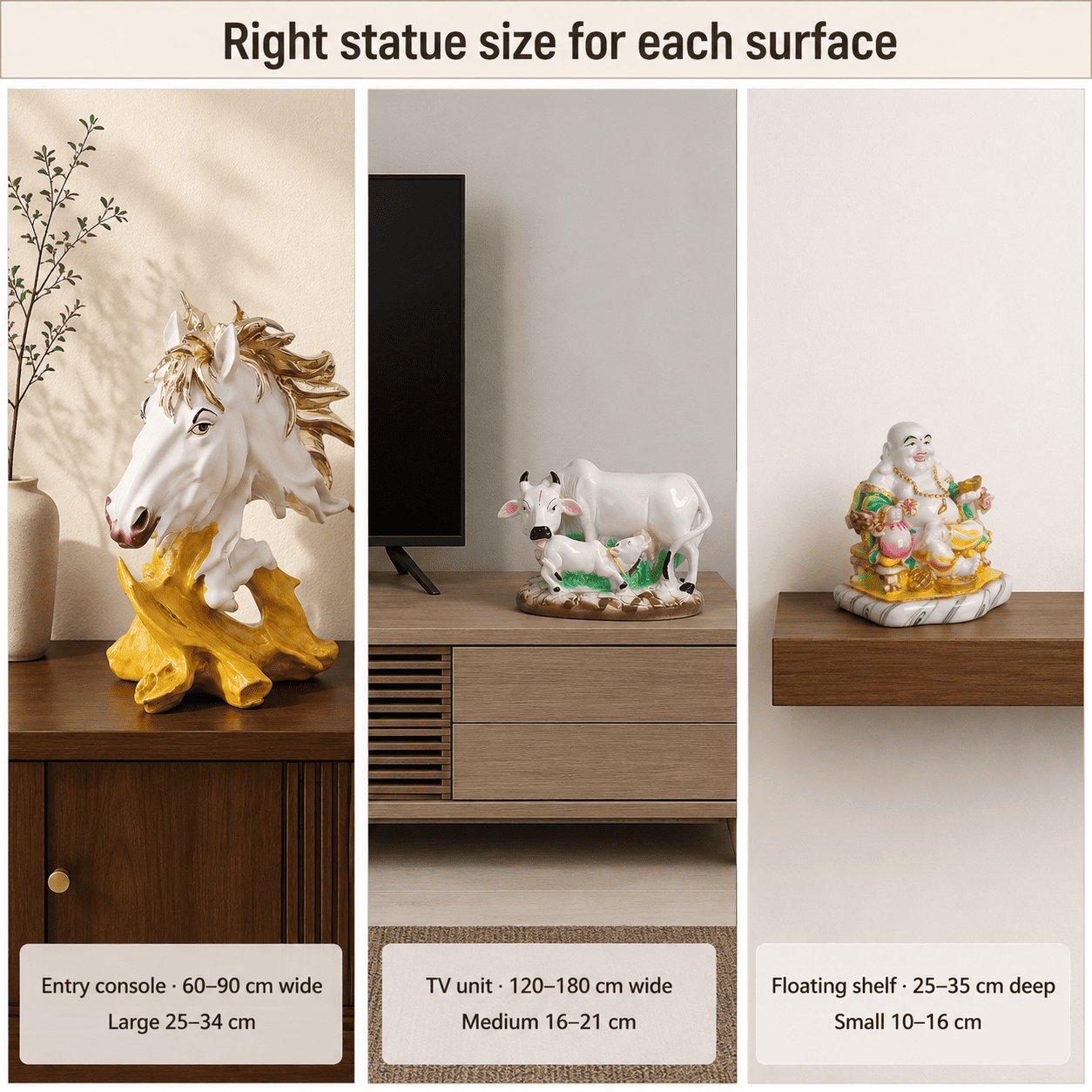
Entry consoles (60–90 cm wide, 75–85 cm tall) are the strongest placement surface in a small living room because they are the first surface a visitor's eye travels to upon entering — making a decorative statue here function as both a focal point and a spatial signal about the room's aesthetic register. A large showpiece (25–34 cm) is appropriate here because the entry wall typically offers 120–180 cm of uninterrupted visual space above the console, preventing the statue from competing with ceiling proportions.
Floating shelves (25–35 cm deep) are ideal for small decorative statues (10–16 cm) because the reduced depth naturally limits base diameter to under 12 cm, which keeps pieces proportionate to the shelf. The vertical stagger between multiple floating shelves also allows a cluster of small statues to build visual interest across a height range of 60–150 cm from the floor — a compositional technique that draws the eye upward and makes ceiling height read as greater than it is. TV units (120–180 cm wide) accommodate medium showpieces (16–21 cm) placed asymmetrically at one end, off-centre, because a centred statue competes directly with the screen's focal axis and fragments attention.
The coffee table, counterintuitively, is the weakest surface for a decorative statue in a sub-150 sq ft living room. Seated guests view a coffee-table object at near-eye level, and in a compressed room this places the statue directly in the sightline across the table, visually shortening the perceived depth of the room by approximately 15–20%. Moolwan's design framework consistently routes statement showpieces off the coffee table and onto elevated surfaces for this reason.
| Placement Surface | Typical Surface Width | Recommended Statue Height | Weight Range | Why It Works |
|---|---|---|---|---|
| Entry console | 60–90 cm | 25–34 cm (Large) | 400–600 g | First sightline on entry; wall above provides vertical breathing room |
| Floating shelf | 25–35 cm deep | 10–16 cm (Small) | 150–250 g | Limited depth enforces proportionate base; vertical stagger draws eye upward |
| TV unit / media console | 120–180 cm | 16–21 cm (Medium) | 250–400 g | Wide surface allows asymmetric off-centre placement away from screen axis |
| Coffee table | 60–120 cm | Not recommended (sub-150 sq ft) | — | Seated eye-level placement shortens perceived room depth; use tray only if room exceeds 150 sq ft |
Because sofa depth, TV-unit overhangs, and natural light direction introduce additional sizing and surface variables specific to each layout, browse the full size-band, finish, and material selection in Moolwan's decorative statues collection to verify the right piece for your surface.
Design Rule
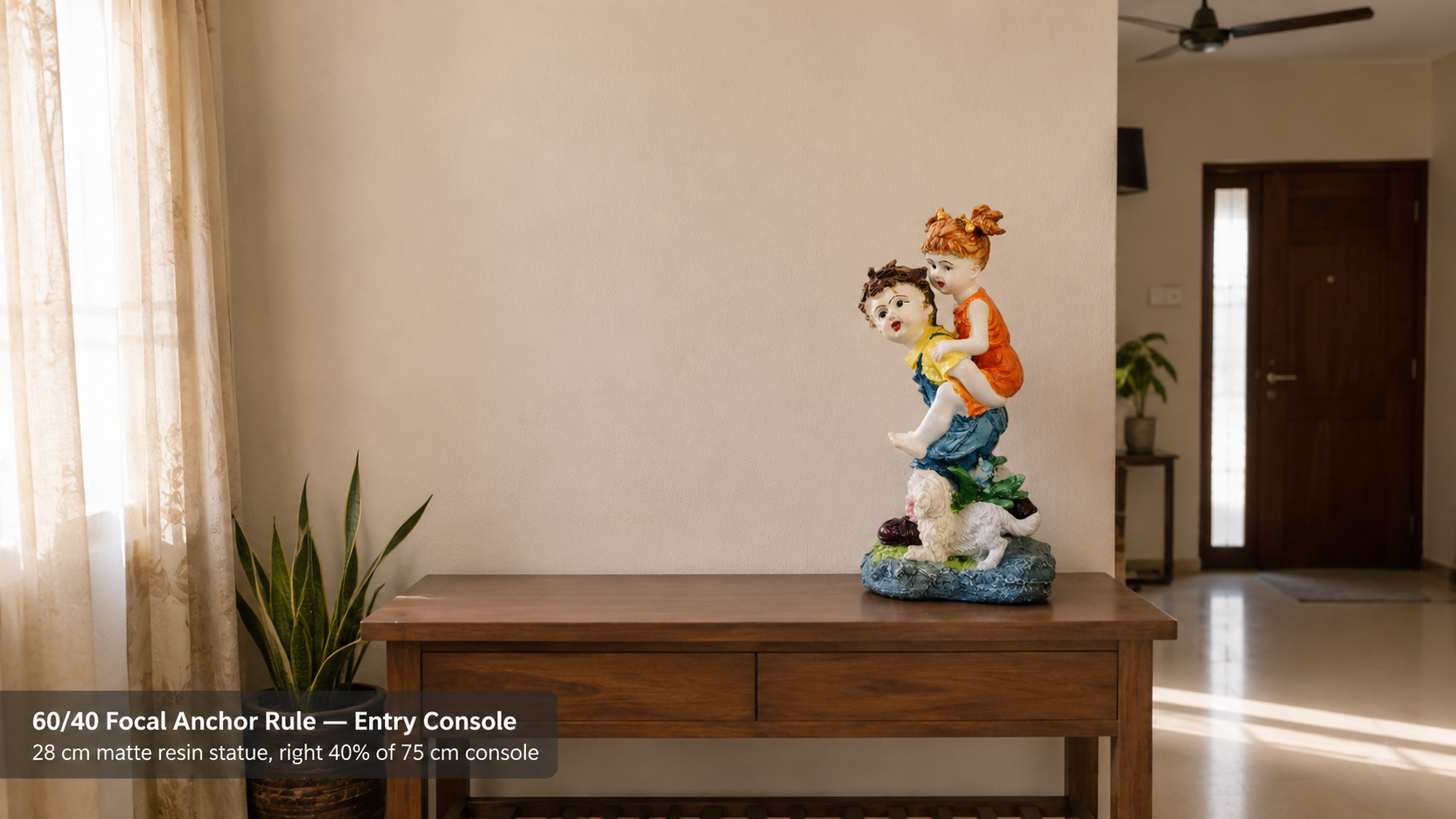
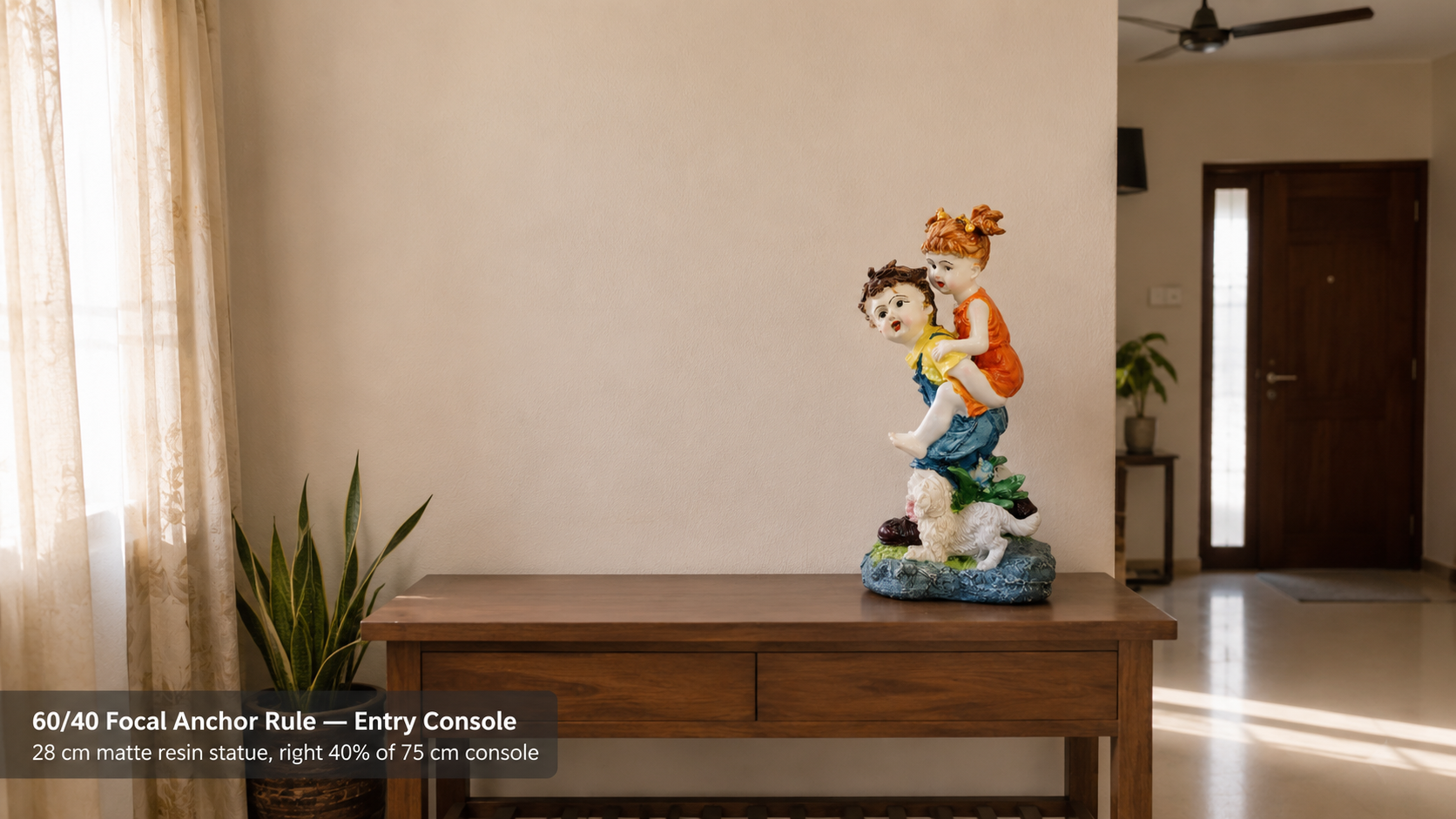
To prevent visual compression in living rooms under 150 sq ft, placement should follow Moolwan's 60/40 Focal Anchor Rule: position the decorative statue within the left or right 40% of the surface width — never centred — so that 60% of the surface remains visually clear, allowing the eye to travel across the surface rather than stopping at the object.
How Many Statues Can a Small Indian Living Room Hold Without Looking Cluttered?
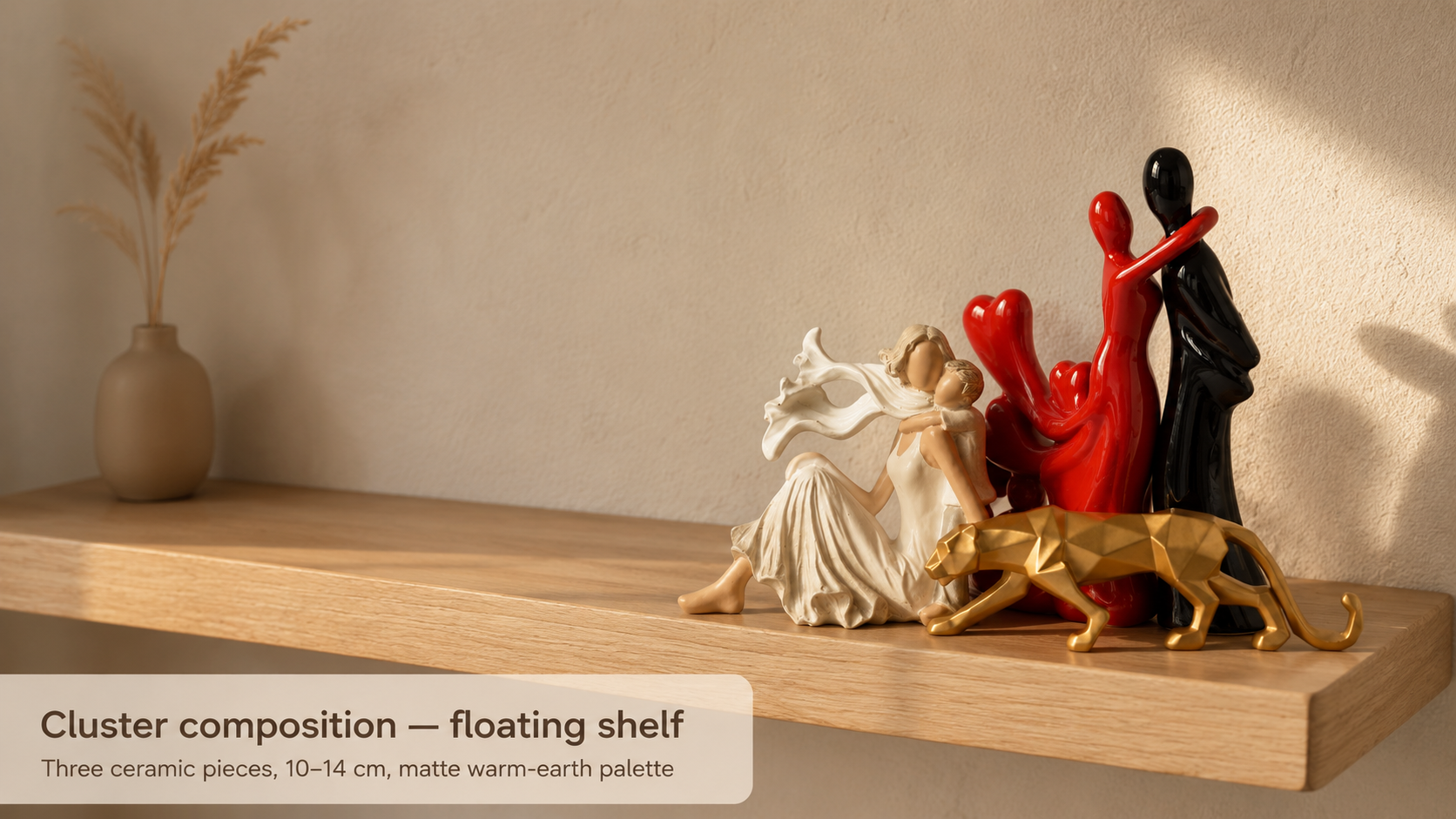
In a living room under 150 sq ft, the maximum number of decorative statues that can occupy a single surface without tipping into visual clutter is determined by the surface width divided by a spacing constant of 20 cm per piece — which means a 60 cm console accommodates a maximum of two statues, and only if they are grouped as a cluster rather than spaced evenly across the surface. Even spacing creates a row effect that reads as retail display rather than curated placement; clustering two or three pieces within the 40% zone of the surface (per the 60/40 Focal Anchor Rule) allows the grouping to read as a single composed unit.
Material consistency within a cluster also matters. Mixing ceramic and resin pieces of different finish types — for example, a glazed ceramic alongside a matte resin — creates surface-finish contrast that the eye reads as visual friction rather than intentional variety. Moolwan's showpiece collections are designed within coherent finish families (all matte-dominant or all glaze-dominant within a cluster range) precisely so that a buyer can combine two or three pieces from the same collection without needing to resolve finish conflicts independently.
Ready to bring home a statue that's sized, finished, and climate-rated for your specific living room surface? Shop the full Moolwan decorative statues collection now — manufacturer-direct, no middlemen.
Does Material Matter for Indian Living Room Conditions?
In Indian living rooms that experience seasonal humidity swings between 40% RH in winter and 85% RH during monsoon, material selection for a decorative statue is a durability decision, not just an aesthetic one. Resin pieces with a purity below 90% epoxy composition are susceptible to surface yellowing and micro-deformation at humidity levels above 60% RH because lower-purity resins contain plasticiser compounds that soften under sustained moisture exposure. At 94% epoxy purity, Moolwan's resin showpieces maintain dimensional stability up to 60% RH and a surface hardness of 3H pencil rating, which prevents surface scratching during regular dusting — the most common cause of finish degradation in living room décor pieces.
Ceramic pieces perform differently: the 92% clay composition used in Moolwan's ceramic showpieces achieves a vitrified density that resists moisture absorption up to 85% RH, making ceramic the stronger choice for rooms with poor cross-ventilation or prolonged monsoon humidity. Ceramic pieces are also heat-resistant to 60°C — relevant in west-facing living rooms in cities like Chennai, Pune, or Ahmedabad where afternoon sunlight raises surface temperatures significantly above ambient. The practical implication: for rooms with reliable air-conditioning and moderate humidity, either material performs over a 3+ year lifespan; for unconditioned or poorly ventilated rooms, ceramic is the more durable long-term investment.
Placement Rules for Gifting: When the Room Isn't Yours to Measure
When a decorative statue is purchased as a housewarming or Diwali gift, the buyer cannot pre-measure the recipient's living room surfaces. In this scenario, a medium-sized piece (16–21 cm, 250–400 g) is the safest choice because it occupies the widest range of viable surfaces — it is proportionate to a floating shelf, a TV unit end, a console, and a study desk — whereas large pieces (25–34 cm) require a surface of at least 60 cm width to read correctly and small pieces (10–16 cm) can appear token-sized on a wide console. A matte finish in a neutral warm palette (greige, warm white, terracotta) is also safer across the widest range of Indian interior colour schemes because matte surfaces absorb the surrounding palette rather than reflecting it back, making the piece integrate rather than contrast regardless of the recipient's wall or furniture tones.
Frequently Asked Questions
Can I place a decorative statue directly on the floor in a small living room?
Floor placement works only for large sculptural pieces above 40 cm in height — at floor level, a statue under 35 cm reads as misplaced rather than styled because the eye naturally seeks objects at waist height or above as intentional décor. In a living room under 150 sq ft, floor-level objects also reduce the perceived clearance between furniture and wall, making the room feel more congested. Reserve floor placement for rooms exceeding 200 sq ft where a large statement piece can occupy a corner without competing with the furniture's spatial footprint.
Does the colour of a decorative statue matter for a small living room?
In a compact living room, warm neutral tones (off-white, warm grey, terracotta, sand) on a decorative statue integrate better than high-contrast dark or bright pieces because warm neutrals harmonise with the widest range of Indian interior palettes — cream walls, teak furniture, and grey-beige sofas are all within the warm neutral family. High-contrast pieces (deep black, bright gold, cobalt blue) create a visual stop-point that is appropriate as a deliberate accent but risks visually shrinking the wall behind them if the surrounding surfaces are light, because the eye interprets high contrast at close range as spatial proximity rather than depth.
How do I prevent a decorative statue from toppling in a home with children or pets?
Surface friction is the primary anti-topple variable, not the statue's weight alone. A 400 g ceramic piece on a polished granite console has less resistance to lateral force than a 200 g matte-base resin piece on a wood-grain surface because high-gloss stone offers near-zero surface friction. Placing a small felt or rubber pad under the base of any decorative statue increases friction coefficient by approximately 3–5× on smooth surfaces. Moolwan's showpieces are drop-tested to 15 cm, which means the glaze and structural integrity hold through a typical shelf-edge knock at normal handling height — but anti-slip pads remain the correct first line of prevention, especially on glass or stone surfaces.
What is the correct eye-level rule for hanging wall art above a decorative statue on a console?
When pairing a wall-hung piece directly above a console-placed decorative statue, maintain a gap of 15–20 cm between the top of the statue and the bottom edge of the frame. A gap smaller than 15 cm causes the two pieces to merge visually into one dense block, eliminating the breathing room that makes each piece legible independently. The centre of the wall art should sit at approximately 145–155 cm from the floor — standard gallery-hang height — which means the bottom edge of a 40 cm tall canvas would sit at approximately 125–135 cm, comfortably above a 25–34 cm statue on an 80 cm console (statue top reaching roughly 105–115 cm).
A decorative statue that is correctly sized to its surface, finished to resist Indian humidity, and placed within the 40% focal zone of its surface will anchor a small living room's aesthetic for 5+ years without requiring seasonal replacement — the core promise behind Moolwan's climate-rated manufacturing philosophy. Ready to choose a piece built for your room? Order directly from the Moolwan decorative statues collection — no distributor margin, no compromise on material spec. If you are also refreshing other surfaces in the same room, consider browsing Moolwan's unique home décor items for accent pieces that pair with a statement statue, or explore the Moolwan living room collection for a fully curated surface-by-surface approach to the same space.


