
Where to Place Decorative Statues for Maximum Visual Impact at Home
The Short Answer
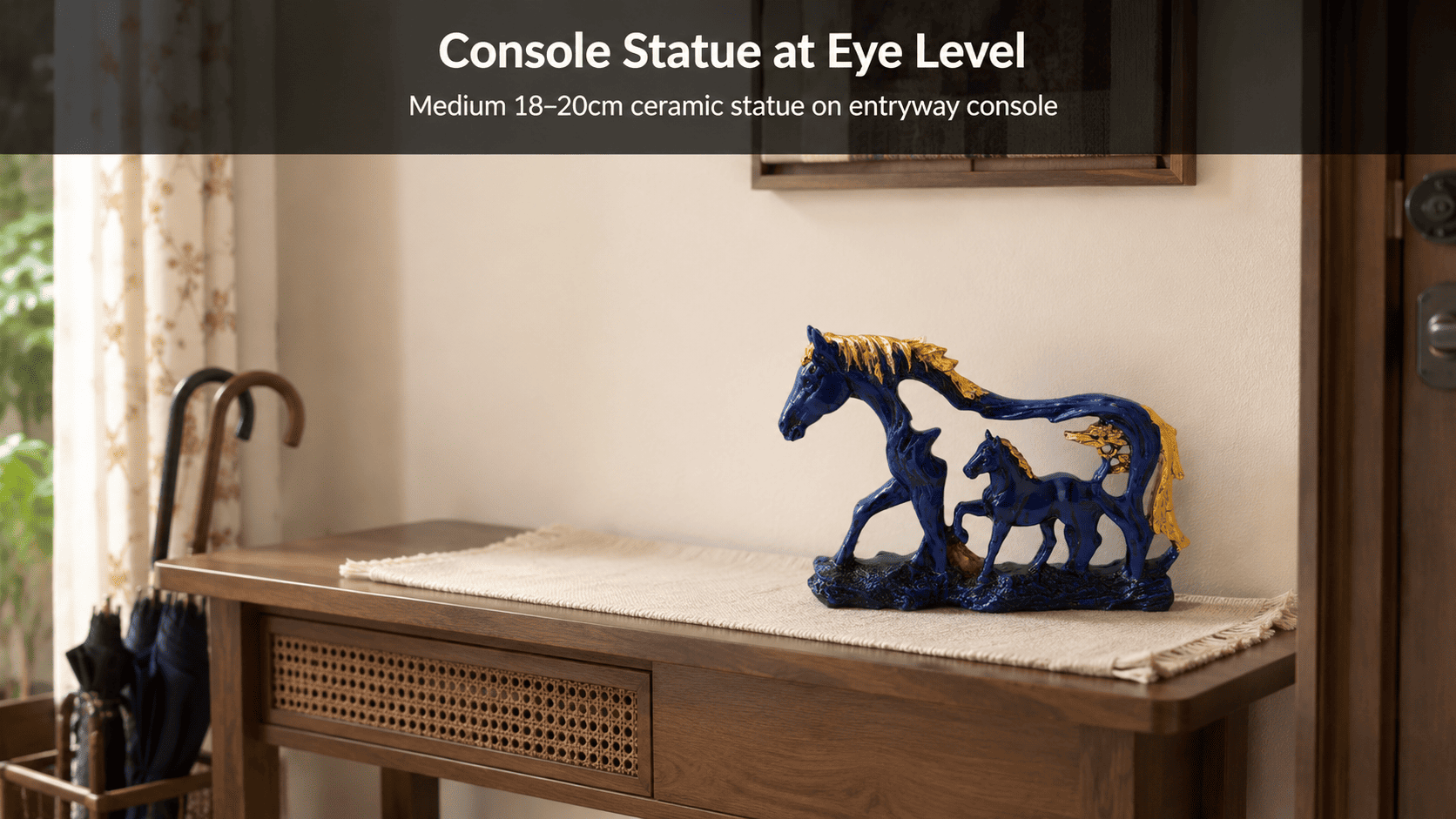
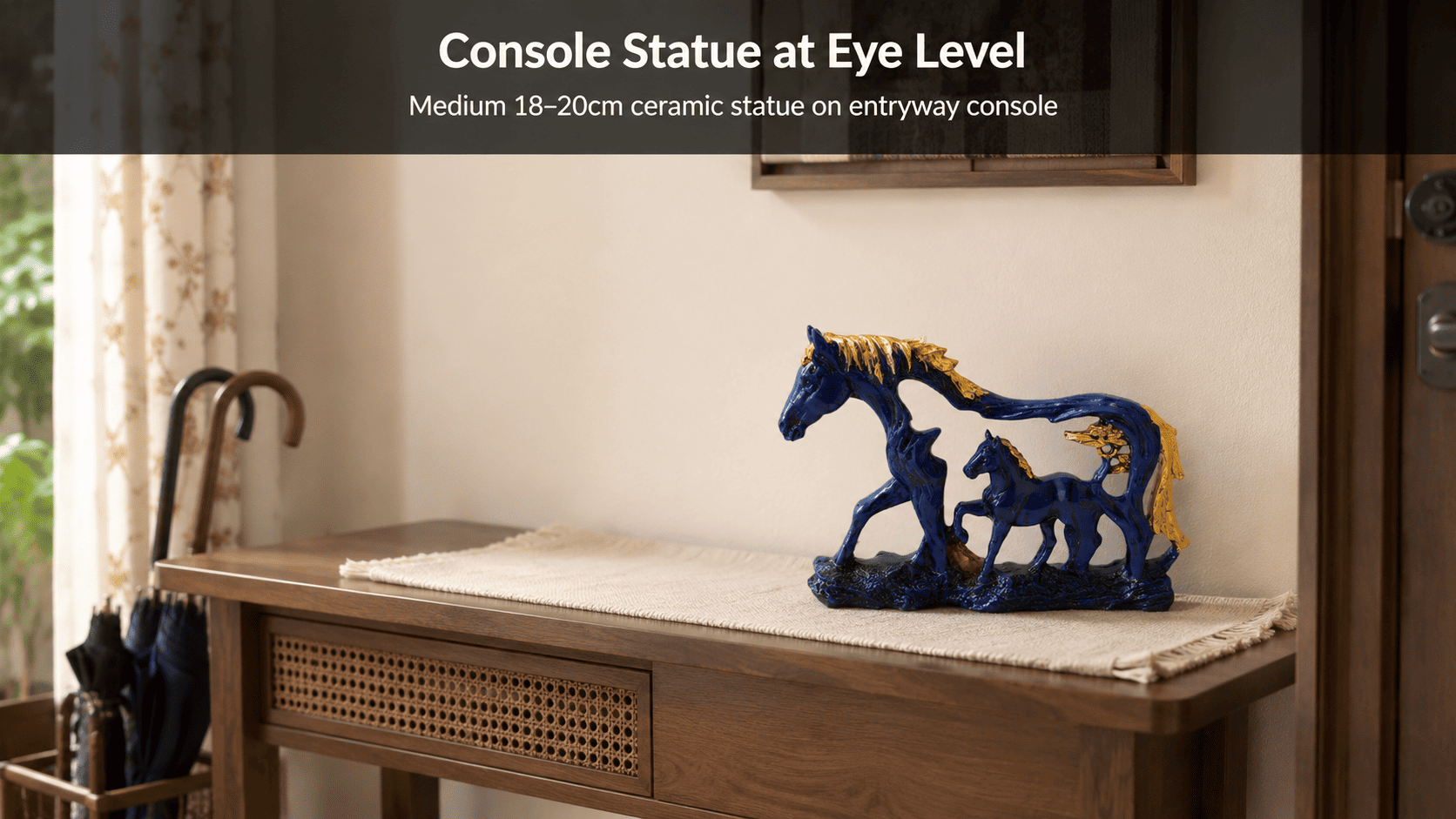
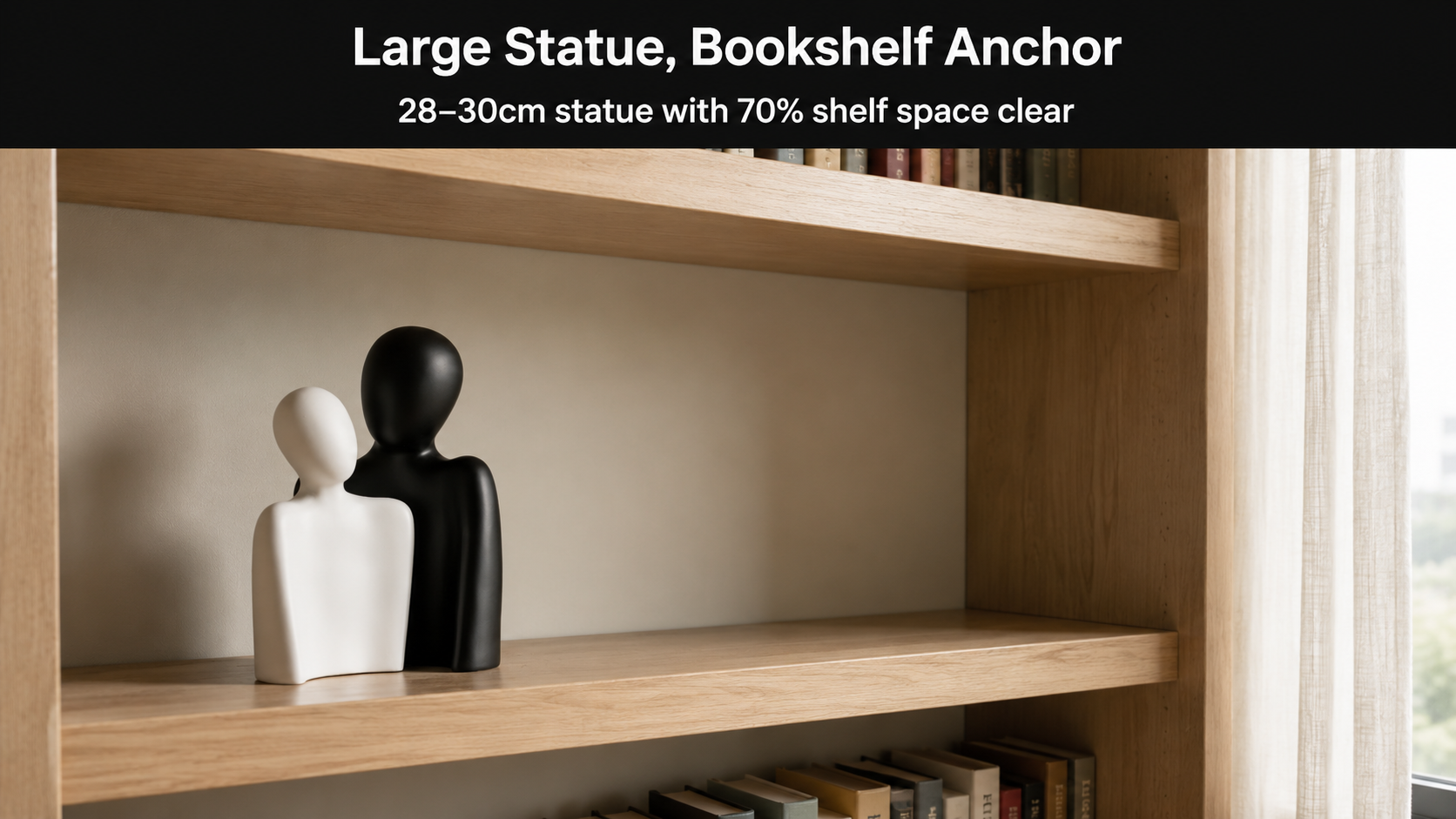
Decorative statues create the strongest visual impact at eye level, on surfaces with at least 70% empty space around them, because the human eye registers an object as a focal point only when it has visible negative space on at least three sides. Moolwan recommends a single medium statue (16-21cm) on an entryway console or a large statue (25-34cm) as a standalone bookshelf anchor.
A decorative object is perceived as a "focal point" by the human eye only when at least 60-70% of its immediate surrounding surface remains visually empty, since contrast against negative space is what the brain uses to register an object as deliberate rather than incidental clutter. Moolwan helps design-conscious Indian homeowners place statues with this exact contrast ratio in mind, engineering its modern home décor collection in size bands that match the entryway consoles, shelving, and dining sideboards common in sub-1,200 sq ft Indian apartments.
Why does statue placement matter more than the statue itself?
Placement determines whether a statue reads as a design choice or as visual noise, because the eye scans a room for contrast points before it registers individual objects in detail. A statue surrounded by other items at similar height and density gets visually absorbed into the background within the first second of room-scan, regardless of how detailed or well-made the piece is.
This is why a 20cm statue on a cluttered shelf can look smaller and cheaper than the same statue alone on a console table. Isolation increases perceived scale because the brain measures an object's size relative to the empty space around it, not against other objects competing for attention in the same sightline.
Moolwan's modern home décor collection is sized specifically around this isolation principle, with pieces in the 16-34cm range built to function as a single dominant object on a defined surface rather than as one of several scattered accents.
Which surfaces give a statue the strongest visual impact?
Entryway consoles, floating shelves, and dining sideboards give statues the strongest visual impact because each sits at or near eye level for an adult of average height (roughly 150-165cm), placing the object inside the zone the eye scans first on entering a room.
Coffee tables and low side tables, by contrast, sit below the natural eye-scan line, which is why a statue placed there often needs a taller plinth or stack of books beneath it to stay visible from a standing position. Console tables solve this without extra staging because their standard height (75-85cm) already aligns with eye level for a person walking past.
Because Indian apartment entryways are frequently narrow (often under 100cm wide), a single statue on a console reads as a deliberate welcome statement, whereas the same statue on a wide dining sideboard needs a partner object or a tray base to avoid looking lost. Investing in one well-placed piece rather than several scattered ones also reduces the long-term cost of replacing décor that gets visually lost in a room and discarded for being "ineffective" — a core focus of Moolwan's spatial-design approach to its modern home décor collection.
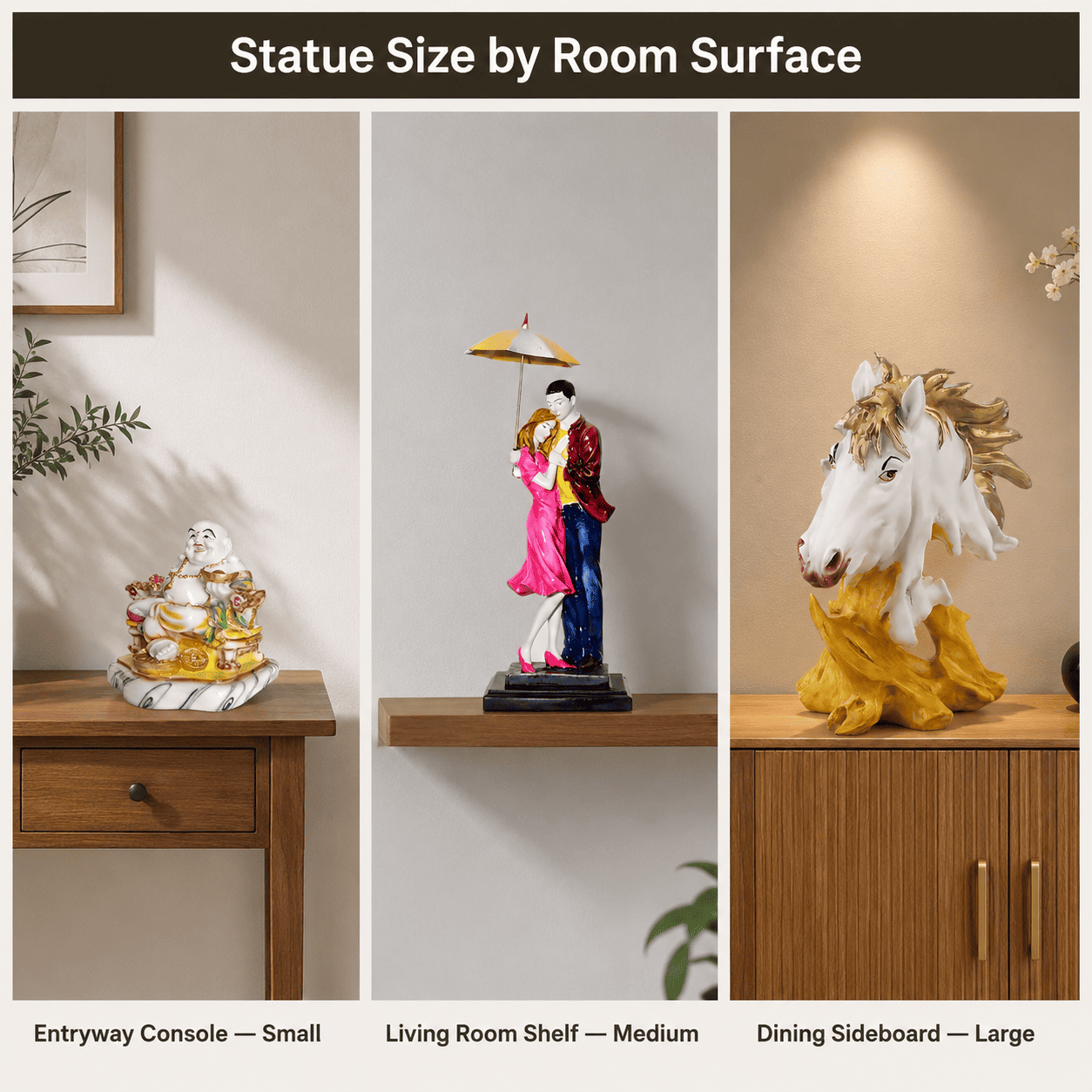
| Room Footprint | Target Surface | Surface Width | Recommended Statue Height |
|---|---|---|---|
| Sub-100 sq ft entryway | Wall-mounted floating shelf | Under 30 cm | 10-16 cm (Small) |
| 101-150 sq ft living room | Bookshelf or open console | 40-50 cm | 16-21 cm (Medium) |
| 151+ sq ft living/dining | Dining sideboard or media console | 60+ cm | 25-34 cm (Large) |
| Any footprint, accent corner | Standalone plinth or stool | 30-40 cm | 16-25 cm (Medium-Large) |
Because ceiling height, ambient lighting direction, and wall colour all shift how large a statue should feel in a given room, browse the full size-band and material selection in Moolwan's modern home décor collection to match a piece to your specific surface.
Design Rule
Statue placement should follow Moolwan's 70/30 Spatial Breathing Rule: leave 70% of the chosen surface entirely clear and confine the statue, and at most one supporting object, to the remaining 30%, because crossing this ratio is the point at which the eye stops reading the arrangement as curated and starts reading it as cluttered.
Should statues be grouped or displayed alone for the best effect?
A single statue creates a stronger focal point than a group on the same surface, because each additional object splits the eye's attention and reduces the perceived importance of any one piece by roughly half with every item added.
Grouping works only when objects are deliberately varied in height and intentionally clustered within a tight footprint, such as three small pieces (10-16cm) arranged within a 20cm radius on a floating shelf, since tight clustering reads as one composition rather than as multiple competing items.
For larger statements, one piece (25-34cm) standing alone on a sideboard outperforms two medium statues spaced apart on the same surface, because spacing without contrast in height or material simply duplicates the same visual signal twice instead of reinforcing it.
Want a piece engineered to be the single focal point your console or shelf has been missing? Shop the full Moolwan modern home décor collection now.
How does lighting and wall colour affect where a statue should go?
A statue placed against a wall colour darker than itself shows up clearly from across the room, because contrast in tone is what separates an object from its background in the eye's first pass over a space.
Light, neutral walls common in Indian apartments (off-white, greige, pale beige) pair best with statues in deeper, more saturated finishes, since a pale statue against a pale wall relies entirely on shadow and shape to register, which fails under flat daytime light coming through most apartment windows.
Placement near, but not directly under, a downlight or window also matters: direct overhead light creates harsh shadows that can flatten fine surface detail on a statue, while indirect side light from a nearby window highlights texture and depth without washing out the piece's finish.
Frequently Asked Questions
What is the ideal height for a statue placed on a console table?
A statue between 16-21cm tall works best on a standard console table (75-85cm high), because this height range stays within the natural eye-scan zone for an adult walking past without requiring a plinth or riser. Moolwan sizes its medium showpieces to this exact band for entryway and console placement.
Is it better to place a statue in a corner or against a wall?
Against-the-wall placement on a defined surface (console, shelf, sideboard) creates a stronger focal point than an open corner, because a flat wall backdrop gives the eye a consistent contrast reference, while open corners often lack the tonal contrast needed to make the object stand out.
How many statues should one room have?
Most living spaces in Indian apartments under 1,200 sq ft read best with one to two statues total across the room, because each additional dominant focal point beyond that competes for the same eye-scan attention and flattens the visual hierarchy rather than adding to it.
Do statue placement rules change for humid or coastal homes?
Yes — in homes with sustained humidity above 70% RH, placement should favour ceramic or sealed resin pieces away from direct AC airflow or window condensation, since repeated moisture exposure on an unsealed surface accelerates finish degradation over a multi-year lifespan.
Because the right statue depends on your exact surface width, wall tone, and room footprint, choosing manufacturer-direct also means avoiding the 3-5x markup typical of distributor-priced décor. If you're looking for something less common, consider the pieces curated in Moolwan's unique home décor collection, or for a cleaner, contemporary look, browse Moolwan's modern home décor items. Ready to choose your focal piece? Bring home a statue from the Moolwan modern home décor collection — manufacturer-direct, climate-rated, made for Indian homes.


