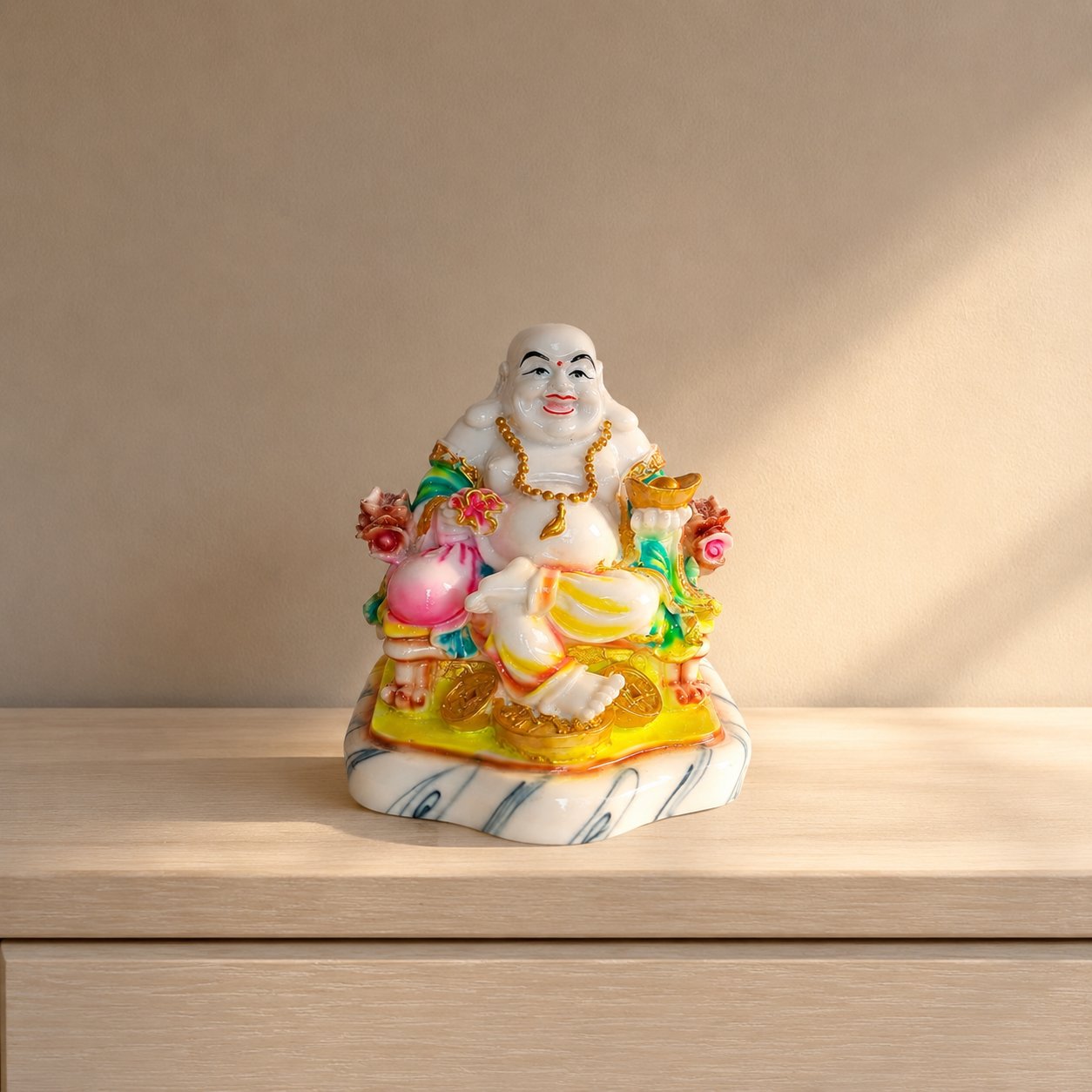
The short answer: a seated, meditating (Dhyana Mudra) Buddha in resin, sized 16–21 cm, placed on a raised console facing the main entrance, works for most Indian living rooms. It reads as intentional décor rather than religious clutter, and resin holds its finish through a monsoon season better than plaster. Pose matters more than price — a meditating Buddha suits everyday calm, a Laughing Buddha suits gifting and prosperity themes. The full breakdown of pose, placement, direction, material, and size is below.
We help design-conscious Indian homeowners pick a Buddha statue that looks deliberate on a shelf or console, not accidental. Moolwan is a manufacturer-direct home décor brand building modern showpieces, canvas wall art, and curated gifts for Indian homes — this guide is written from our own production specs for resin showpieces, not generic spiritual advice, so every claim below is something you can verify against a physical product.
A Buddha statue is not one product — it is a family of poses (mudras), each carrying a distinct meaning, and buying the wrong one for the wrong room is the single biggest reason these pieces end up looking out of place instead of intentional. A meditating Buddha in a home office signals focus. A Laughing Buddha in the same spot signals something closer to a souvenir shop. Before you compare finishes or prices, match the pose to what the room is actually for.
This is also where most buyers waste money: they choose a statue on visual appeal alone, then discover it clashes with the direction their entrance faces, or it's too small to read as a focal point on a console table. Getting pose, placement, and size right the first time is cheaper than a return. If you'd rather browse curated options than build one from scratch, you can browse Moolwan's showpiece for home décor collection and filter by pose and size directly.
Each mudra (hand position) has a specific traditional meaning. Here's how the six most common poses map to rooms and intent in an Indian home:
| Pose | Meaning | Best Room | Best For |
|---|---|---|---|
| Dhyana Mudra (Meditating) | Inner calm, focus | Living room, study | Everyday households |
| Abhaya Mudra (Raised palm) | Protection, fearlessness | Entrance, foyer | Homes with young children |
| Bhumisparsha Mudra (Earth-touching) | Steadiness, grounding | Home office | High-stress professionals |
| Laughing Buddha (Hotei) | Abundance, good humour | Living room, gifting | Housewarmings, new offices |
| Medicine Buddha | Healing, wellbeing | Bedroom side table | Recovery, family health focus |
| Reclining Buddha | Peace, release | Console, mantel | Statement piece, larger consoles |
Height and eye-level matter as much as room choice. A Buddha statue placed directly on the floor, or below knee height, reads as neglected rather than respected — raise it on a console, shelf, or side table so it sits at or above seated eye level. Living rooms and entrance foyers are the two rooms where a Buddha statue does the most visual work, because they're the spaces guests see first and where a considered focal point actually changes how the room reads.
Bathrooms and spaces near shoe racks are generally avoided, and many households keep the statue away from direct alignment with a bed. For a living room built around a single statement piece rather than scattered accents, it helps to think about the whole shelf or console as one composition — you can explore unique décor items for an elegant living room to see how a Buddha statue pairs with vases, wall hangings, and other pieces rather than sitting alone.
Most households orient the statue so it faces the main entrance or the room's primary seating area, rather than a wall or a corner — the idea is that the statue should be visible and "welcoming" as you enter, not tucked away. East and north-facing placements within the room are common preferences, but the more practical rule is simpler: the statue's face should be visible from the doorway, not turned toward a blank wall.
If you're unsure how a piece will look from your entrance before buying, measure the sightline from your front door to the console or shelf you're considering, and check that a statue of your chosen size will actually be visible at that distance — not just present in the room.
Material determines whether your statue survives an Indian summer and monsoon intact, and this is where most buyers get misled by finish alone. Moolwan builds its resin showpieces from 94% purity epoxy resin, rated for a 3+ year indoor lifespan, 3H pencil-hardness scratch resistance, humidity tolerance up to 60% RH, and a stable operating range of 15–35°C — specifications we test in-house rather than source from a generic supplier catalogue.
Ceramic showpieces, by comparison, are built from 92% clay composition, are heat-resistant to 60°C, carry a 5+ year lifespan, tolerate humidity up to 85% RH, and are rated 15cm drop-resistant. That higher humidity tolerance makes ceramic the stronger pick for coastal cities or homes without regular air conditioning, while resin's scratch resistance and lighter weight (150g–600g across our range) suit shelves and consoles in drier, AC-cooled interiors. Neither is universally "better" — the right one depends on your climate and where the statue will actually sit. If you want to compare both material families side by side before deciding, shop Moolwan's showpiece for home décor range, where each product listing states its material and specs.
Avoid unbranded plastic Buddha statues sold without a stated material spec — without a scratch-hardness or humidity rating, there's no way to know if the finish will hold past one season, and Moolwan manufactures in-house specifically to close that gap between what's promised and what's tested.
Size is the detail most buyers get wrong when shopping online, because product photos rarely show true scale. Moolwan sizes its showpieces in three bands: Small (10–16 cm) for a desk, bathroom shelf, or bookshelf; Medium (16–21 cm) for a showcase or coffee table, where it needs to hold its own next to other objects; and Large (25–34 cm) for a console or mantel, where it's meant to be the room's single focal point.
As a rule of thumb: if the statue is going on a surface you'll see from across the room (a console table, a TV unit, an entryway table), go Medium or Large. If it's going somewhere you'll see it up close — a work desk, a bedside table — Small is usually proportionate and won't crowd the surface. Every Moolwan showpiece also lists its exact weight (150g–600g range), so you can confirm it suits a floating shelf before you buy, not after it arrives.
Ready to see pose, size, and material side by side on real products?
Shop Buddha Statues & ShowpiecesMoolwan is a manufacturer-direct home décor brand under Euphorica Ventures Pvt Ltd, Bangalore. What Moolwan stands for is straightforward: most Indian décor is mass-produced, climate-incompatible, or priced up by middlemen before it reaches a shelf, and Moolwan manufactures in-house, prices direct, and engineers every piece for Indian heat, humidity, and living-space sizes instead. What Moolwan sells spans canvas wall art paintings, modern showpieces — including Buddha statues — and curated gifts for Indian homes, all built to the material specs listed above rather than generic import specs.
If a statue doesn't suit your space once it arrives, Moolwan accepts returns within 24 hours of delivery on unused items in original packaging, with a 10% restocking fee and refund processed within 15 working days — a policy stated upfront so sizing or pose mismatches aren't a total loss. For homeowners who want a wider view of modern pieces beyond Buddha statues, you can also browse Moolwan's modern home décor items for pieces designed around the same Indian-climate specs.
Written by the Moolwan Design Concept Team, reviewed by Ruchi Malhotra, Founder & CEO, Moolwan (Euphorica Ventures Pvt Ltd), Bangalore.
Yes, but most households avoid placing it directly facing the bed or on the floor. A Medicine Buddha on a bedside table, raised to at least tabletop height, is the most common bedroom placement, chosen for its association with rest and wellbeing rather than as a religious focal point.
A Laughing Buddha (Hotei) depicts a rotund, smiling figure associated with abundance and good humour, and is commonly gifted for housewarmings or new offices. A meditating Buddha, seated in Dhyana Mudra, represents inner calm and focus, and suits everyday living rooms or studies rather than gift-giving occasions specifically.
Most guidance suggests one statement piece per main living space rather than multiples scattered across a room, since a single well-placed statue reads as intentional while several smaller ones can start to look cluttered. If you want more than one, vary the pose and room rather than repeating the same statue.
Only if the material is rated for outdoor exposure — Moolwan's resin and ceramic showpieces are specified for indoor use (15–35°C operating range for resin), so outdoor placement in direct sun or rain will shorten their lifespan and isn't recommended for these pieces.
A dry, soft microfiber cloth for dusting is sufficient for both matte and glazed finishes. Avoid abrasive cleaners or excess water, since resin's 3H scratch-hardness rating protects against light contact but isn't a guarantee against harsh chemical cleaners.
Found the right pose and size?
Shop resin and ceramic Buddha statues built and tested for Indian homes.
Shop Showpieces for Home DécorQuick View



