
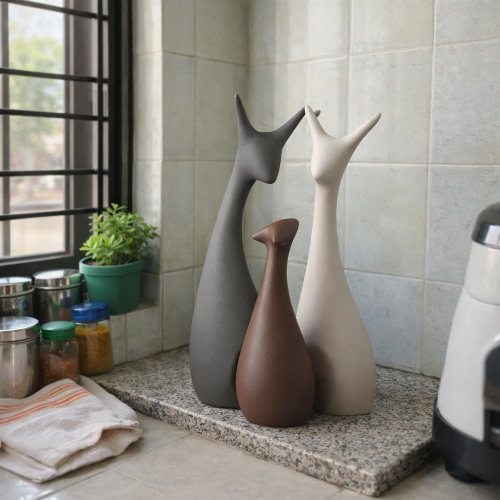
Which showpiece is best according to Vastu?
At Moolwan, we help design-conscious Indian homeowners choose showpieces that balance modern aesthetics with Vastu-aligned placement — so your décor does more than look good; it works with the energy of your space. The right showpiece, in the right zone, made from the right material, is one of the simplest Vastu upgrades you can make to any Indian home.
Vastu-Recommended Showpieces by Direction
Vastu Shastra assigns specific energies, elements, and meanings to each direction in your home. Placing the wrong showpiece in a zone — even a beautiful one — can disrupt the intended energy flow. Here is what each zone calls for:
North Zone (Lord Kubera — Wealth & Career)
The North is governed by the water element and the deity of wealth. Place a Laughing Buddha, a tortoise figurine (facing inward, toward the house), or a fish-motif showpiece here. Blue, green, or black finishes align with the water element. Avoid fire motifs, red-heavy décor, or heavy sculptural forms in this direction.
East Zone (Lord Indra — Health & Solar Energy)
The East welcomes the rising sun. Light-coloured ceramic showpieces, sun motifs, and birds in flight are Vastu-positive here. Green and white finishes support the wood element. Keep décor here airy and uplifting — heavy or dark pieces suppress the solar energy this zone is meant to channel.
Northeast Zone (Ishaan Kona — Spirituality & Knowledge)
The Northeast is the most sacred quadrant. Keep it uncluttered. If you place a showpiece here, choose something small and spiritually meaningful — a Ganesha idol, a lotus motif, or a crystal ball. Avoid metal-heavy items or bold dark colours. This is not the zone for dramatic focal pieces.
Main Entrance (North or East-Facing)
The entrance is the most commercially important Vastu placement. A pair of elephants with raised trunks, facing inward, is one of the most universally recommended showpieces in Vastu. They symbolise strength, prosperity, and welcome. Place them on either side of the door or on a console table just inside the entrance — always facing the interior of the home, never outward.
Living Room & Showcase (South or West Wall)
The South is governed by fire and ambition. Bold-coloured showpieces in red, orange, or maroon — horses, lions, or abstract sculptural forms — align well with the South wall of a living room showcase. The West wall, governed by the metal element, responds to white, silver, or grey finishes. Round or spherical showpieces suit the West naturally.
Vastu Showpiece Placement: At-a-Glance Guide
This table combines directional Vastu guidance with material and motif recommendations. It is intended as a practical reference for Indian homeowners choosing showpieces by zone.
| Zone / Direction | Ruling Element | Best Showpiece Motifs | Best Materials | Best Colours | Avoid |
|---|---|---|---|---|---|
| North | Water | Laughing Buddha, Tortoise, Fish | Ceramic, Resin, Glass | Blue, Green, Black | Fire motifs, Red, Heavy stone |
| East | Wood / Solar | Sun, Rising Birds, Floral | Ceramic, Light resin | Green, White, Yellow | Dark finishes, Metal-heavy |
| Northeast | Space / Ether | Ganesha, Lotus, Crystal sphere | Ceramic, Crystal | White, Light yellow, Transparent | Clutter, Heavy dark pieces |
| South | Fire | Horse, Lion, Abstract bold sculpture | Ceramic, Terracotta, Resin | Red, Maroon, Orange | Water motifs, Blue tones |
| West | Metal | Round/spherical forms, Abstract geometric | Resin, Ceramic with glaze | White, Grey, Silver | Earthy tones, Fire imagery |
| Main Entrance | Mixed | Elephant pair (trunks up, facing inward) | Ceramic, Resin | Ivory, Gold, White | Elephant trunks facing outward, Broken items |
Ready to place the right showpiece in the right zone? Shop Moolwan's full showpiece collection — filtered by motif, size, and material, all designed and manufactured for Indian homes.
Why Material Matters for Vastu Showpieces
Vastu assigns elemental properties not just to directions, but to materials. The material composition of your showpiece directly interacts with the zone's energy — which is why a resin elephant and a ceramic elephant do not carry the same Vastu weight even if they look similar.
Ceramic Showpieces — Earth Element
Ceramic is made from earth — clay, water, and fire-firing — which gives it a natural grounding quality aligned with Vastu's earth element. Moolwan's ceramic showpieces are crafted from a 92% clay composition, heat-resistant to 60°C, humidity-tolerant up to 85% RH, and rated for a 5+ year lifespan under standard Indian home conditions. This makes them ideal for humid climates and naturally suitable for zones governed by the earth element (Southwest, Center). A 15 cm drop-resistant finish also means they can sit on open shelves without anxiety.
Resin Showpieces — Fire / Transformation Element
Epoxy resin carries a luminous, semi-translucent quality that Vastu associates with the fire and light elements. Moolwan's resin showpieces use 94% purity epoxy resin, scratch-resistant to 3H pencil hardness, and temperature-stable between 15–35°C. This makes them excellent for living room showcases, the South wall (fire zone), or any area where you want a sense of warmth and movement. Resin showpieces in amber, gold, or rust tones especially suit the South and Southeast.
Size Guidance for Vastu Placement
Vastu is also about proportion. Oversized showpieces create energetic imbalance in small apartments. Moolwan categorises its showpieces into three sizes:
- Small (10–16 cm): Ideal for the Northeast corner, bathroom shelves, or study desks where Vastu calls for lightness and restraint.
- Medium (16–21 cm): Best for showcase shelves, the North wall, or entrance console tables — present enough to be noticed, proportionate enough to not overwhelm.
- Large (25–34 cm): Reserved for focal points: the South wall living room showcase, the main entrance, or the center of a dining table. These are the statement-makers.
You can browse the full range by size and motif in Moolwan's modern home décor collection, which includes showpieces, sculptures, and accent items sized and finished for Indian apartments and independent homes.
Vastu Motifs That Attract Positive Energy — and Why
Not all decorative motifs are equal under Vastu. Here are the most commonly recommended showpiece themes for Indian homes, with the reasoning behind each:
Elephant Pair (Raised Trunk, Facing Inward)
The elephant is Vastu's most universally auspicious showpiece motif. A pair with raised trunks placed at the entrance — always facing into the home — symbolises strength, protection, and prosperity flowing inward. Single elephants or elephants with lowered trunks carry different associations and are not recommended at the main entrance. The pair represents balance, which is central to Vastu's philosophy of harmonious energy.
Laughing Buddha
Placed in the North zone, the Laughing Buddha with a golden bag or raised hands symbolises abundance and contentment. His direction matters: he should always face the main door from a North position, so that wealth energy entering the home is immediately met with welcoming, expansive symbolism.
Tortoise (Kachua)
One of the most Vastu-endorsed showpieces in Indian homes. A crystal or ceramic tortoise placed in the North or East, facing the interior, is said to bring stability and longevity. Moolwan's ceramic tortoise showpieces — available in glazed and matte finishes — are among the most frequently purchased for housewarming gifting precisely for this reason.
Horses (Running, in a Group)
Seven running horses on the South or South-East wall of a living room is a highly regarded Vastu motif for ambition, speed, and career growth. The number seven holds specific energy in Vastu numerology. Avoid depicting horses in chains or in a downward pose.
What to Avoid Entirely
Vastu is as much about what not to place as what to place. Regardless of zone or direction, the following are consistently discouraged: broken or cracked showpieces, war or violent imagery, solitary figures in states of grief or isolation, and heavily dark or black-dominant décor in entrance areas. These create what Vastu practitioners call "stagnant" or "heavy" energy — the visual equivalent of blocked chi.
How to Choose a Vastu-Compatible Showpiece: Step-by-Step
- Identify the zone first. Stand at the center of your home with a compass. Note whether you are placing the showpiece in the North, East, South, West, or a corner (Northeast, Southeast, Southwest, Northwest).
- Match the element to the material. North/East → ceramic or resin in cool tones. South → resin in warm tones. Northeast → small ceramic, crystal, or light-coloured items only.
- Choose a motif with clear symbolic intent. Elephant for the entrance, tortoise for North/East, horse for South wall. Avoid motifs that lack a clear positive symbolism or that depict negative states.
- Size to the space. Use the 10–16 cm range for compact shelves and sacred corners. Use 16–21 cm for showcases and coffee tables. Reserve 25–34 cm pieces for entrance consoles and living room focal points.
- Check the finish for your climate. For humid cities (Mumbai, Kolkata, Chennai, coastal homes) choose ceramic pieces rated to 85% RH. For drier climates (Delhi, Pune) resin pieces rated to 60% RH work well. Both Moolwan material lines are manufactured for the Indian climate range.
- Place with intention. Once placed, a Vastu showpiece should not be moved frequently. Stability of placement is itself a Vastu principle.
For curated Vastu-compatible gifting options — especially for housewarmings and griha pravesh ceremonies — explore Moolwan's must-have home décor finds, which includes handpicked showpieces recommended for Indian homes by room and occasion.
Find your Vastu showpiece today. Every piece in Moolwan's range is manufactured in-house, priced direct-to-customer, and shipped pan-India with free delivery and Cash on Delivery. Shop Moolwan showpieces for home décor →
Frequently Asked Questions
Which direction should I place an elephant showpiece according to Vastu?
Place elephant showpieces at the main entrance, ideally facing inward toward the interior of the home. A pair of elephants with raised trunks is most auspicious when positioned on either side of the door or on a console table just inside it. Avoid placing elephants facing outward, which is considered to push prosperity away from the home.
Is a ceramic or resin showpiece better for Vastu?
Both materials have Vastu merit depending on placement. Ceramic — being an earth-derived material — is most aligned with earth-element zones like the Southwest and Center, and is the preferred material for sacred or spiritually significant motifs. Resin, with its luminous and transformative quality, suits fire-element zones like the South and Southeast. For the entrance and North zone, both work well — prioritise motif and colour over material in those zones.
Can I place a Laughing Buddha in the bedroom according to Vastu?
Vastu does not recommend placing the Laughing Buddha in the bedroom, as it is a figure associated with wealth and outward energy — not the restful, inward energy a bedroom requires. The ideal placement is the North zone of your living room or study, positioned so he faces the main entrance of the home.
How many showpieces should I keep at home according to Vastu?
Vastu prioritises intentional placement over quantity. Cluttered surfaces — regardless of how auspicious each individual piece may be — create energetic noise. The principle is one or two purposeful showpieces per zone, rather than a crowded showcase. For most Indian apartments, five to seven well-placed showpieces across the key Vastu zones is sufficient.
What is the return policy on Moolwan showpieces?
Moolwan accepts returns within 24 hours of delivery, provided the item is unused and in its original packaging. A 10% restocking fee applies. Refunds are processed within 15 working days. All showpieces are shipped pan-India with free delivery and Cash on Delivery available.


