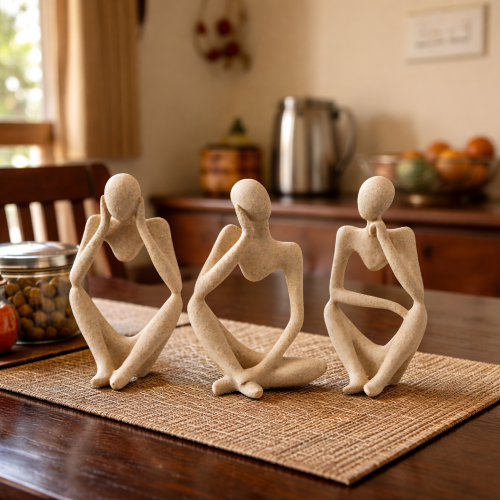
We help Indian homeowners choose showpieces that respect both design intent and Vastu placement rules, so your décor supports the energy of the room instead of working against it. This is where most buyers go wrong: they pick a showpiece for its look, then discover it sits in the wrong zone for its element.
In Vastu Shastra, each direction is governed by an element — earth, water, fire, air, or space — and the material of an object either strengthens or disrupts that element. Ceramic, being clay-based, belongs to the earth element and works well in the North and East zones associated with stability and health. Resin, when finished in brass, copper, or stone-like tones, mimics the metal and earth elements and suits the South-East (wealth) and South (fame) zones. This is why two showpieces that look similar on a shelf can have opposite effects depending on what they're made of and where they sit.
Moolwan's ceramic showpieces are made from a 92% clay composition, which is dense enough to hold the "earth" association Vastu practitioners look for, and is humidity-tolerant up to 85% RH — relevant because Indian homes near coastal or monsoon-heavy regions often lose showpieces to moisture damage within a year. You can browse Moolwan's showpieces for living rooms filtered by size and finish before you decide on placement.
Ruchi Malhotra, Founder & CEO of Moolwan (Euphorica Ventures Pvt Ltd), developed this simplified reference after fielding the same placement question from hundreds of customers designing Indian apartments where every wall serves multiple purposes. The formula maps material to direction in five zones:
| Direction | Element | Best Material | What to Avoid |
|---|---|---|---|
| North | Water / Career | Ceramic, glazed finish | Metal figurines |
| East | Air / Health | Ceramic, matte finish | Heavy resin pieces |
| South-East | Fire / Wealth | Resin in brass or copper tone | Water-themed decor |
| South | Fire / Fame | Resin, warm-toned | Dark or black finishes |
| South-West | Earth / Stability | Heavy ceramic, large size | Glass, fragile items |
Size matters as much as material inside this framework. A Small showpiece (10–16cm, 150–250g) suits a shelf or study desk in the East zone, while a Large piece (25–34cm, 400–600g) is better reserved for the South-West as a grounding focal point. For everyday styling beyond Vastu-specific pairing, you can also explore Moolwan's modern home decor items designed to fit Indian apartment proportions without overwhelming the space.
Resin showpieces carry a 94% epoxy purity and 3H pencil hardness, making them scratch-resistant and lighter to mount on higher shelves — useful for South and South-East corners that are often above eye level. Ceramic, heat-resistant to 60°C and drop-resistant from 15cm, holds up better in North and East zones near windows, where sunlight and humidity fluctuate more. Neither material is universally "better" for Vastu; the zone decides the choice, not personal preference alone.
Buyers renovating an entrance or pooja corner often default to traditional brass idols, but a well-finished resin piece in a brass tone delivers the same visual and elemental cue at a fraction of the weight and cost — relevant if you're mounting on drywall or a rented apartment wall.
If you're decorating for a gifting occasion rather than your own home, the same zone logic applies to the recipient's space — you can browse Moolwan's antique-style showpieces for pieces that carry traditional Vastu-favoured tones like brass and copper.
Glass is generally avoided in South and South-West zones because it's associated with fragility and instability. It works better in North-East corners tied to clarity and reflection, but ceramic or resin remain safer defaults for most rooms.
Not necessarily. Genuine brass and Moolwan's brass-toned resin pieces carry the same elemental association in Vastu practice. Resin is lighter, more scratch-resistant (3H hardness), and easier to mount, making it the practical choice for rented or wall-mounted spaces.
Small showpieces (10–16cm, 150–250g) are designed for shelves, study desks, and bathroom counters common in compact Indian apartments. They follow the same directional rules as larger pieces without overwhelming limited surface space.
Yes. Ceramic pieces from Moolwan are humidity-tolerant up to 85% RH and resin up to 60% RH, both engineered for Indian coastal and monsoon conditions. Wipe with a dry cloth and avoid direct water contact regardless of material.
Yes. Moolwan accepts returns within 24 hours of delivery if the item is unused and in original packaging, with a 10% restocking fee and refund processed within 15 working days.
Quick View



