
Cart
The Short Answer
The four showpiece types Vastu Shastra recommends for the home entrance are Ganesha idols, laughing Buddha figurines, elephant pairs, and tortoise showpieces — in that order of universal acceptance. Moolwan's modern home décor collection offers all four in 92% clay ceramic (humidity-tolerant to 85% RH), in sizes from 10 cm to 34 cm to suit any entrance console or niche.
Vastu Shastra treats the home entrance as the primary channel for energy flow — and the showpiece placed here either strengthens or disrupts that flow. Moolwan helps design-conscious Indian homeowners find entrance showpieces that honour Vastu principles without giving up a modern interior aesthetic. The question isn't simply which deity or symbol is auspicious: it's also which size fits your console, which material holds up to entrance humidity, and which finish works in a contemporary apartment.
A Vastu-friendly entrance showpiece must carry a positive symbol, face the correct direction, and be placed at the right height — visual appeal alone does not qualify it. Vastu Shastra identifies north, northeast, and east as the most auspicious directions for the entrance zone, so showpieces aligned with these directions on a console or in a wall niche are considered more effective. Pieces placed directly on the floor at the entrance are generally not recommended — the minimum is a console, plinth, or wall niche at standing height.
Moolwan's entrance showpiece range is designed with these constraints in mind: every piece in the medium and large size ranges (16–34 cm) sits at the correct visual height on a standard Indian apartment entrance console, which typically measures 75–90 cm from the floor. Finish choice matters here too — matte ceramic and earthen glazed tones are considered more grounding than highly reflective surfaces at a threshold zone.
Ganesha, laughing Buddha, elephant pairs, tortoise showpieces, and seven-horse figurines are the five types most consistently cited across Vastu Shastra texts for entrance placement, each with specific directional and positional rules. Moolwan's modern home décor collection includes contemporary interpretations of all five in ceramic and resin finishes, designed to work equally well in traditional and minimalist interiors.
Ganesha: The most universally accepted entrance showpiece. Should be placed to the right of the entrance door, back facing north, face turned toward the interior. Never at ground level — a medium piece (16–21 cm) on a console at 75–90 cm is the standard specification.
Laughing Buddha: Must face the entrance door directly — the direction toward the incoming energy is considered essential. A medium or large piece (16–34 cm) placed on the console facing inward is the recommended configuration.
Elephant pair: Placed flanking the entrance archway or atop a console, trunks raised for auspiciousness. Small pieces (10–16 cm each) work best so neither piece dominates the sightline of a narrow Indian entrance corridor.
Tortoise: Recommended for the northeast corner of the entrance zone, facing north or east. A small piece (10–16 cm) in a grounded, earthy finish is the correct specification — oversized tortoise pieces are considered excessive at a threshold position.
Seven-horse figurine: Specifically recommended for south-facing entrances and south entrance walls, horses running inward. A large piece (25–34 cm) carries the necessary visual weight for this placement.
A medium ceramic showpiece at entrance console height — scale, finish, and directional placement are what determine Vastu compatibility, not decorative complexity. See the full range of entrance-ready pieces in Moolwan's home entrance décor collection.
For most Indian apartments — entrance corridors under 8 feet wide with a standard 75–90 cm console — a medium showpiece in the 16–21 cm range is the Vastu-and-design sweet spot. It sits above the "too small to register" threshold without crossing into the oversized territory that turns an entrance accent into an altar. At 150–400g, pieces in this range are also stable on the lightweight consoles common in Indian apartments.
If your entrance has a floor niche or a dedicated Puja shelf rather than a console, step up to the large range (25–34 cm) — the added visual weight reads correctly in a recessed space. Finish-wise, matte and semi-gloss ceramic is the most forgiving choice for entrance conditions: the 92% clay composition holds through humidity swings at the door threshold without surface crazing, and earthen tones — ochre, ivory, terracotta — sit naturally against the widest range of Indian wall paint colours. To find the type and size that fits your entrance, browse Moolwan's home entrance décor collection to see the full range of Vastu-approved showpiece types discussed here.
Ceramic handles the Indian entrance better for long-term durability; resin is the better choice for intricate contemporary forms or lightweight placement on narrow niches. The entrance is one of the hardest environments in a home — it absorbs the worst of monsoon humidity, door-opening temperature swings, and accidental contact from bags and footwear. Moolwan's ceramic showpieces at 92% clay composition are rated humidity-tolerant to 85% RH and heat-resistant to 60°C, which covers the full range of Indian entrance conditions across all climatic zones.
Resin pieces at 94% epoxy purity offer 3H pencil hardness and a humidity tolerance of 60% RH — adequate for most indoor entrance niches not directly exposed to the door threshold. Their weight (150g–300g in the small-to-medium sizes) makes them better suited for floating shelves or wall niches where a heavier ceramic piece would stress the fitting. For a console placement or a floor niche with direct exposure to outdoor air, ceramic is the more resilient long-term choice.
Four showpiece types — Ganesha, laughing Buddha, elephant pair, and tortoise — shown side by side with size and placement annotations. Browse the complete entrance-ready options in Moolwan's home entrance décor collection.
Vastu Shastra specifies position as precisely as type: console height rather than floor level, right of the door for Ganesha, direct line of sight from the door for the laughing Buddha, northeast corner for the tortoise. For Indian apartments where the entrance is typically a 4–6 foot corridor, the console or wall-mounted niche is the only practical surface — a floor-level piece creates both a Vastu and a physical obstruction problem.
If there is no console, a wall-mounted niche at 4–5 feet from the floor is the correct substitute. The showpiece should not share its surface with keys, wallets, or everyday utility objects — Vastu convention treats the entrance showpiece as a dedicated focal object, and mixing it with clutter is considered to negate its purpose.
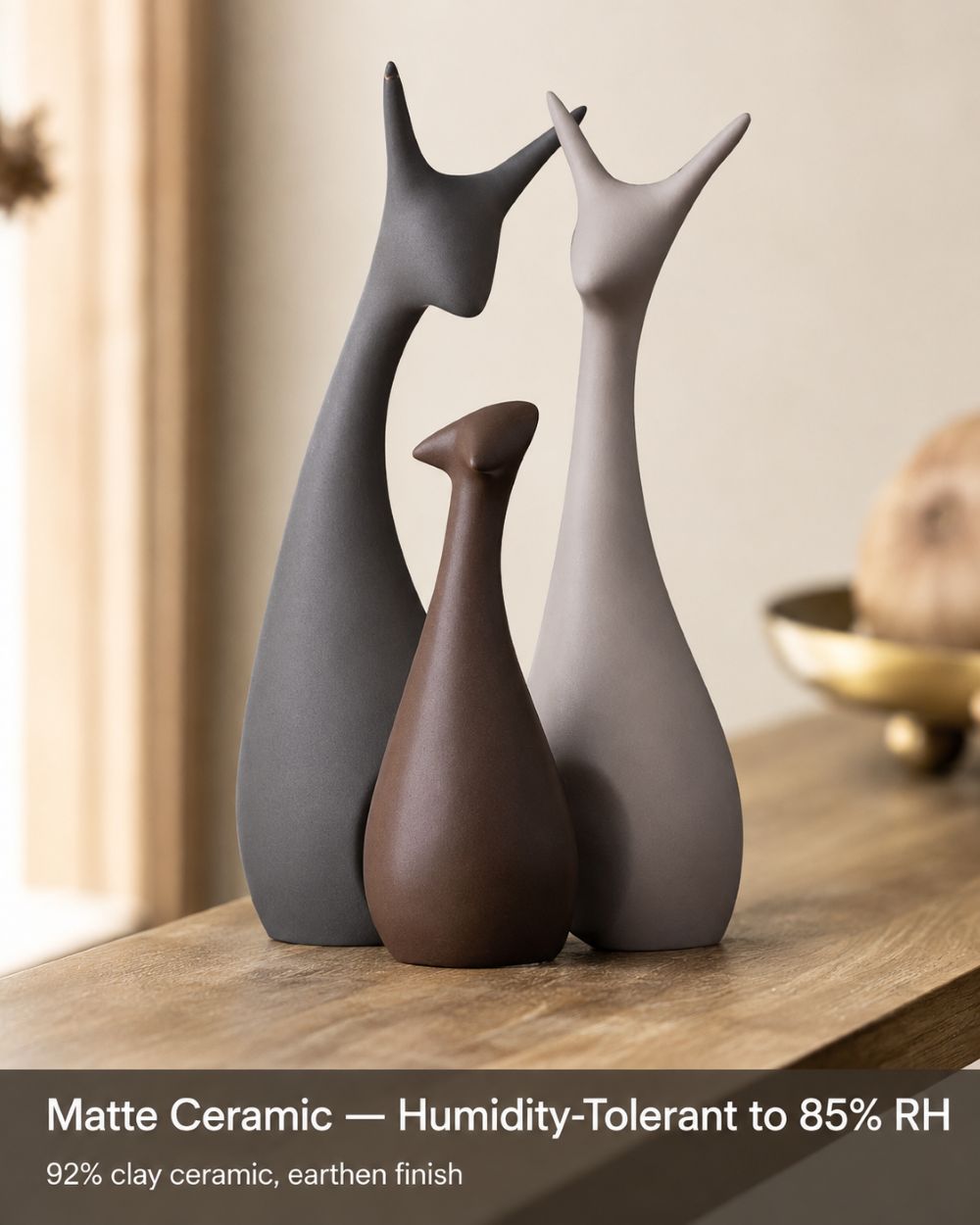
Ceramic finish detail — the matte surface texture and earthen tone palette that perform best at entrance placements subject to Indian humidity and temperature variation.
A Ganesha showpiece at the home entrance should face south — meaning the back of the idol is toward the north wall. In practice, this means placing it to the right of the entrance door on a console, with the face of the idol turned toward the interior of the home. The piece should sit at console height (75–90 cm from the floor) and should never be placed directly on the floor. A medium size of 16–21 cm in ceramic is the most widely recommended specification for this placement.
No — a laughing Buddha placed on the floor at the entrance is considered inauspicious in Vastu Shastra. The correct placement is atop a console or shelf at a height where the figurine faces the entrance door directly. The ideal position is roughly 75–100 cm from the floor, within the eye-line of someone entering the home. A medium-to-large piece in the 16–34 cm range is the appropriate size for an entrance console placement.
For a compact Indian apartment entrance — typically a 4–6 foot corridor with a narrow console — a medium showpiece in the 16–21 cm range is the right size. It is large enough to register as an intentional focal object without overpowering the space. At 150–400g, pieces in this range are also stable on lightweight consoles. Avoid pieces below 10 cm at the entrance: they are too small to carry visual weight in a transitional corridor and are considered energetically insufficient in Vastu Shastra.
Yes. Moolwan's modern home décor collection includes Ganesha idols, laughing Buddha figurines, elephant pairs, and tortoise showpieces in contemporary finishes — matte ceramic, stone-effect ceramic, and resin in marble and neutral tones — designed for apartments following a minimalist or modern interior language rather than a traditional devotional aesthetic. All pieces are available across the 10–34 cm size range in 92% clay ceramic or 94% epoxy resin, with material choice depending on entrance exposure conditions.
If your entrance refresh extends to wall art and console styling beyond the showpiece itself, Moolwan's entrance décor collection covers complementary accent pieces for the full entrance zone. For statement décor across every other room in the home, Moolwan's unique home décor range is the next place to explore. To find the Vastu-approved showpiece that fits your entrance size, material preference, and aesthetic, start with Moolwan's home entrance décor collection.
Written by Moolwan Design Concept Team. Reviewed by Ruchi Malhotra, Founder & CEO, Moolwan (Euphorica Ventures Pvt Ltd), Bangalore. Published 27 May 2026.


