
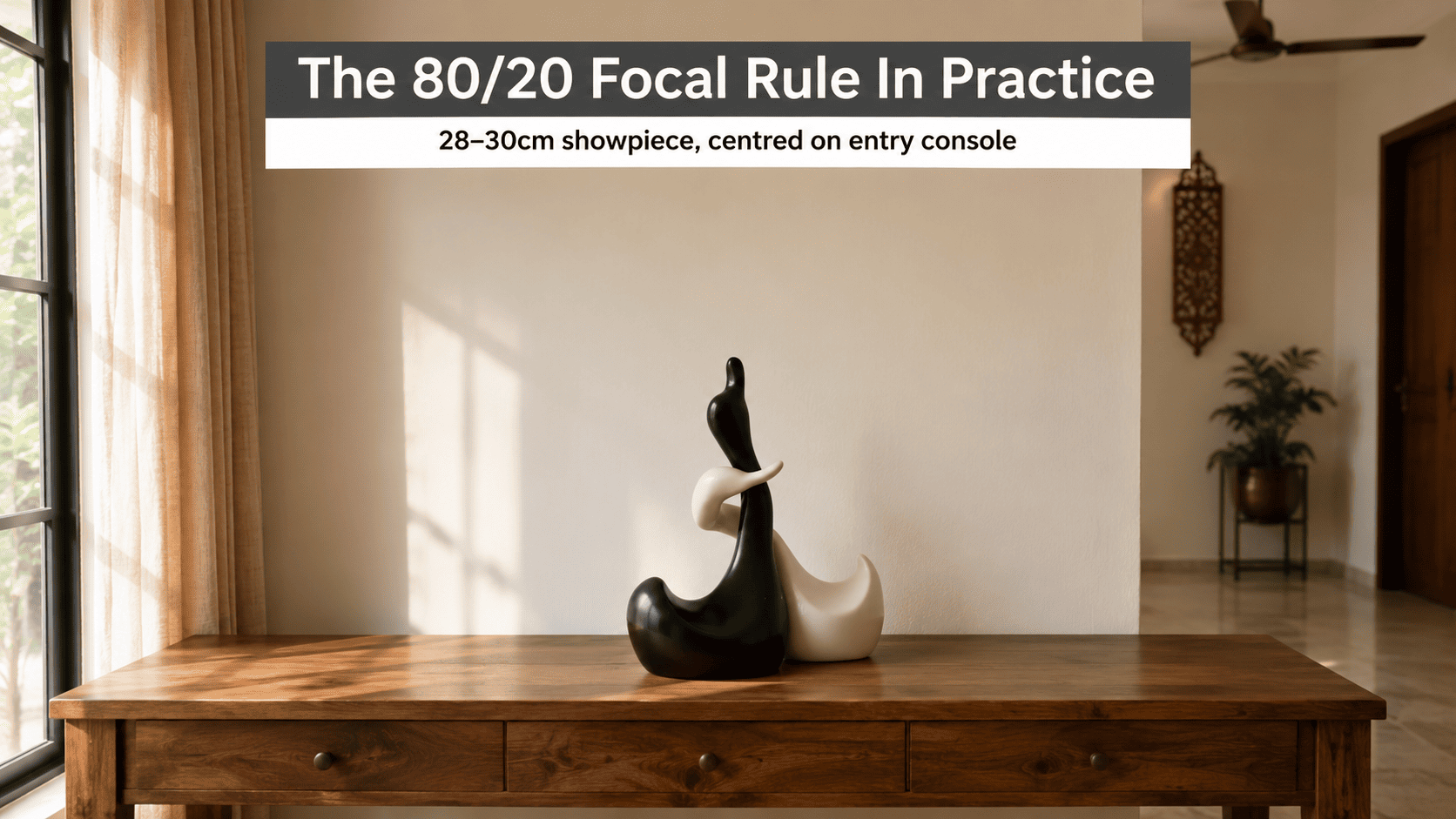
Which Single Decor Piece Makes the Biggest Visual Impact in a Room
The Short Answer
A single large-format showpiece (25–34 cm) placed alone on a console, shelf, or sideboard creates more visual impact than several smaller objects, because the eye fixates on the largest contrasting shape in a space before scanning anything else. Moolwan's modern home décor collection sizes large showpieces specifically for this single-focal-point role.
Eye-tracking studies on interior spaces consistently show that a viewer's gaze locks onto the single largest, highest-contrast object in a room within the first few seconds, then uses it as an anchor to read the rest of the space. Moolwan helps design-conscious Indian homeowners apply this principle without guesswork, engineering its modern home décor collection in three distinct size bands so one piece can be correctly scaled to function as that anchor — whether it sits on an entry console, a bookshelf, or a dining table.
Why does one object create more visual impact than many small ones
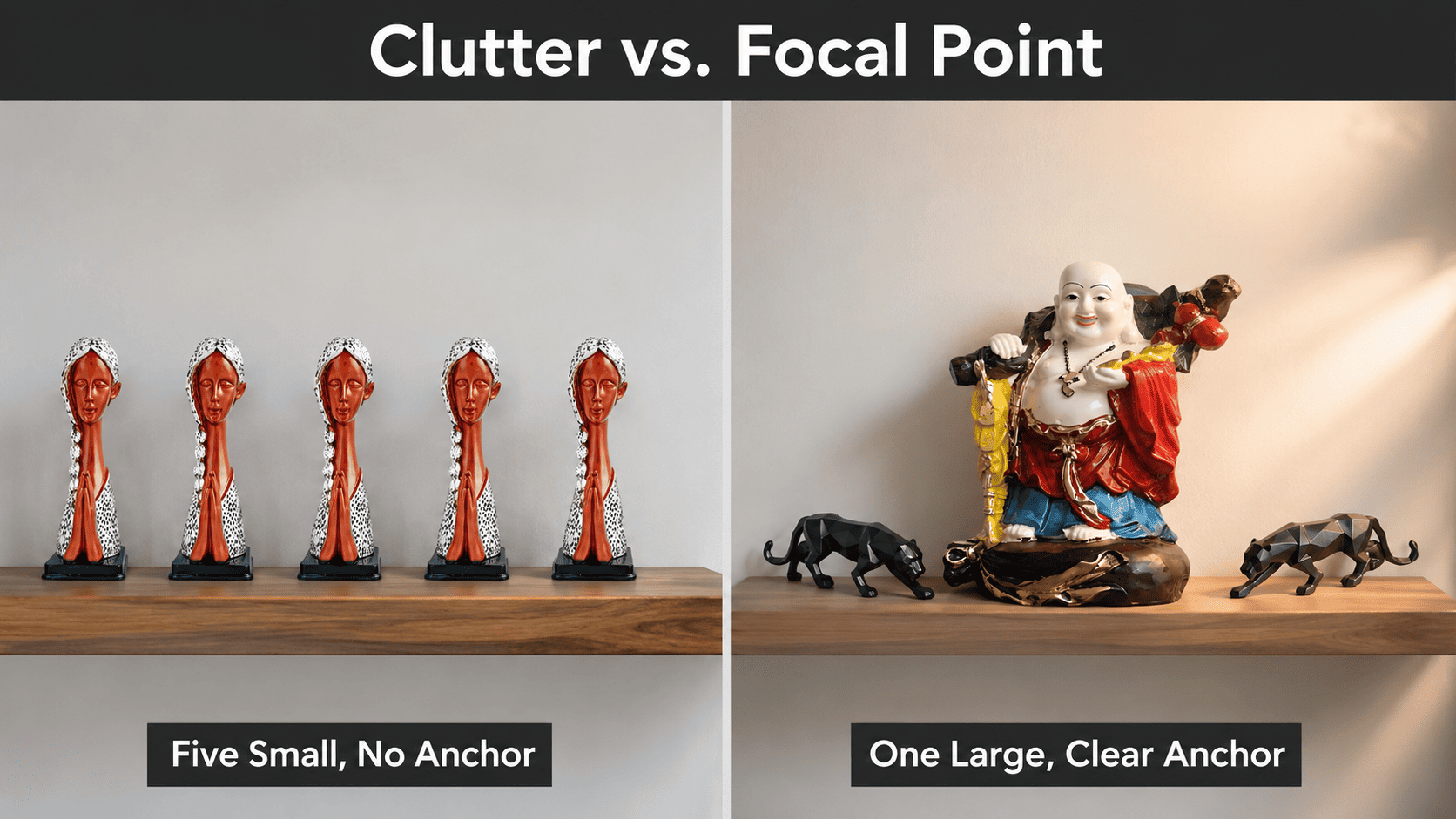
One large object reads faster than five small ones because the brain processes a single dominant shape in one glance, while a cluster of same-sized objects forces the eye to scan back and forth without settling. This scanning behaviour is what makes a shelf full of small trinkets look busy rather than styled, even when every individual piece is attractive.
Moolwan's large showpieces (25–34 cm, 400–600 g) are weighted and sized to sit as the single dominant object on a surface, with smaller accent pieces kept deliberately secondary. The size gap between the large piece and anything placed near it is what preserves the "one glance" effect — if two objects are close in size, the eye treats them as equals and the focal point disappears.
What size décor piece actually counts as a true focal point
A focal-point piece needs to occupy roughly the 25–34 cm height band to register as dominant on most Indian living room surfaces, since anything smaller blends into a grouping rather than standing apart. Below that band, an object functions as an accent rather than an anchor — it supports the room's styling but doesn't direct attention.
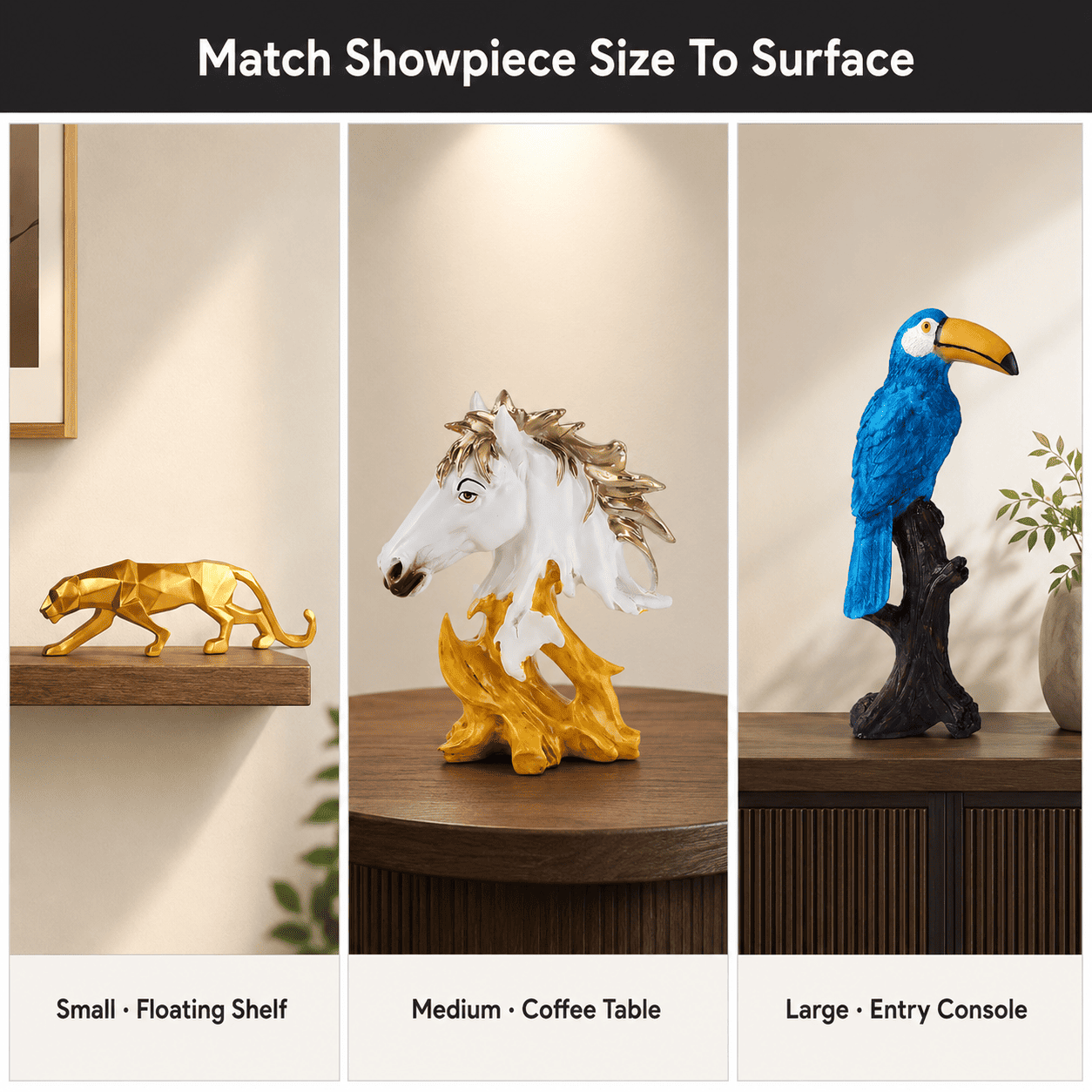
Moolwan's size guide separates pieces into Small (10–16 cm, shelf or desk scale), Medium (16–21 cm, coffee table or showcase scale), and Large (25–34 cm, focal-point scale), because each band is calibrated to a different surface width and viewing distance common in sub-1,200 sq ft Indian apartments. Choosing the wrong band — a Medium piece where a Large is needed — is the most common reason a styled surface still looks flat.
Ceramic or resin: which material holds visual impact for longer
High-fired ceramic holds visual sharpness longer in Indian conditions than resin because its 92% clay composition tolerates humidity up to 85% RH without softening or dulling, while standard resin objects are rated closer to 60% RH and begin to lose surface clarity in monsoon-heavy months. A focal piece that dulls or warps within a year stops doing its job as an anchor.
Because a glazed ceramic showpiece can hold its finish across a 5+ year lifespan against one heat- and humidity-tested standard, choosing ceramic for the single largest piece in a room is the more durable investment, even at a marginally higher upfront cost — the alternative is replacing a dulled resin focal piece every season, which costs more over time than buying once correctly.
| Target Surface | Surface Width | Recommended Showpiece Height | Weight Range |
|---|---|---|---|
| Floating shelf / bathroom shelf | Under 30 cm | 10–16 cm (Small) | 150–250 g |
| Bookshelf or study desk | 30–45 cm | 16–21 cm (Medium) | 250–400 g |
| Coffee table or showcase | 45–60 cm | 16–21 cm (Medium) | 250–400 g |
| Entry console or dining table | 60 cm+ | 25–34 cm (Large, focal point) | 400–600 g |
Because finish, palette, and material durability add further variables beyond size and surface width alone, browse the full size and weight selection in Moolwan's modern home décor collection to match a focal piece to your exact surface.
Design Rule
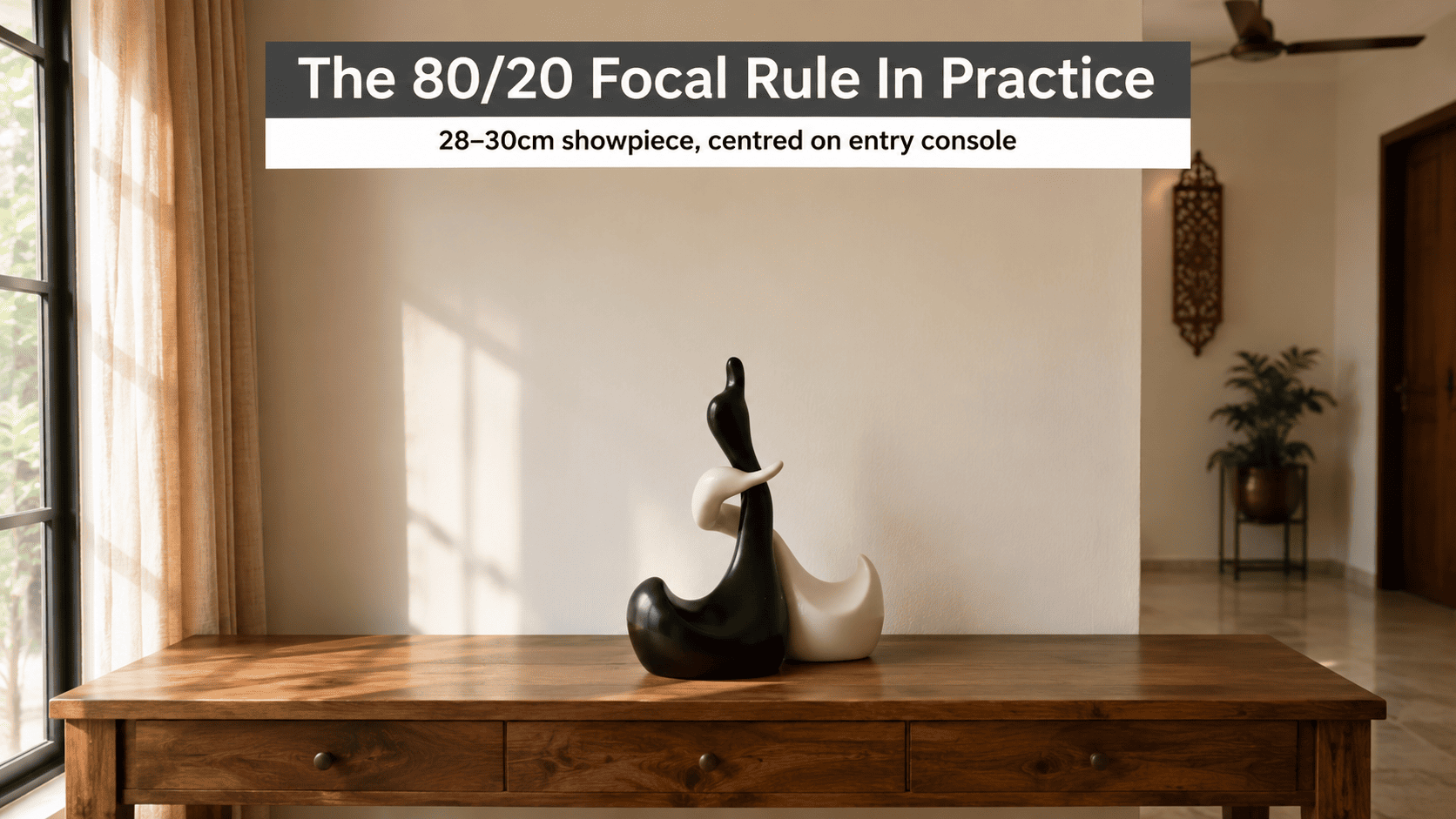
Moolwan's 80/20 Focal Rule holds that on any single visible surface, roughly 80% of the visual weight should sit in one large statement piece, with the remaining 20% spread across one or two small accents — because splitting visual weight evenly across several same-size objects removes the contrast the eye needs to identify a focal point at all.
Where should the focal piece be placed for maximum effect
A focal piece works best at or near eye level on the surface most visible from a room's main seating or entry sightline, since visual impact depends on how quickly an object is seen, not just how large it is. A striking piece placed in a corner outside the natural sightline loses most of its effect regardless of size.
On an entry console or dining sideboard, Moolwan's large showpieces are designed to sit centred or slightly off-centre with clear space on either side, because empty space around the object is what signals "this is the piece to look at" rather than "this is part of a cluttered display."
Want a piece engineered to hold its finish and dominate a sightline for years, not months? Shop the full Moolwan modern home décor collection now.
How many other objects can sit near the focal piece without competing
A focal piece can safely share a surface with up to two smaller accents before the eye stops treating it as singular, because beyond two competing objects the brain reverts to scanning behaviour instead of resting on one anchor. This is why minimal styling consistently photographs and reads better than fully "decorated" surfaces.
Pairing one Large showpiece with one or two Small pieces (10–16 cm) from a different but complementary palette preserves the size contrast that makes the arrangement work, rather than diluting it with several Medium pieces of similar visual weight.
Frequently Asked Questions
Does a bigger décor piece always create more visual impact?
Not automatically — visual impact comes from size contrast relative to what's around it, not absolute size. A 30 cm piece on a narrow 35 cm shelf looks oversized and cramped rather than impactful, while the same piece on a 60 cm console reads as a clean focal point. Moolwan sizes its large showpieces to the console and sideboard widths typical of Indian living rooms for this reason.
Should the focal décor piece match the room's existing colour palette?
It should relate to the palette without matching it exactly, because a piece that blends in tonally loses the contrast needed to stand out as a focal point, while one in a complementary but distinct tone reads clearly without clashing. Neutral or warm-earth finishes from Moolwan's collection are chosen for this reason — they coordinate with common Indian wall tones while still standing apart.
Can a piece of canvas wall art serve as the room's main focal point instead of a showpiece?
Yes — wall art can function as the primary focal point, particularly above a sofa or console, but it shouldn't compete with a large freestanding showpiece on the same sightline, since two large-scale focal elements split attention instead of anchoring it. Most Indian living rooms work best with one dominant element per visible wall-and-surface zone.
How often should the focal décor piece be changed or rotated?
There's no fixed schedule, but a durable focal piece — one rated for Indian humidity and heat — doesn't need rotating for finish reasons, only for variety if the homeowner wants a refreshed look. Ceramic pieces rated to 85% RH and 60°C hold their finish well enough that rotation becomes a styling choice, not a maintenance necessity.
Ready to choose the one piece that will anchor your room? Bring home a large-format showpiece from the Moolwan modern home décor collection — manufacturer-direct, climate-rated for Indian homes, and sized to hold a sightline for years rather than seasons. If you're weighing a more premium statement piece, also consider Moolwan's modern luxury décor collection, or for something less common on most shelves, browse Moolwan's unique home décor pieces.


