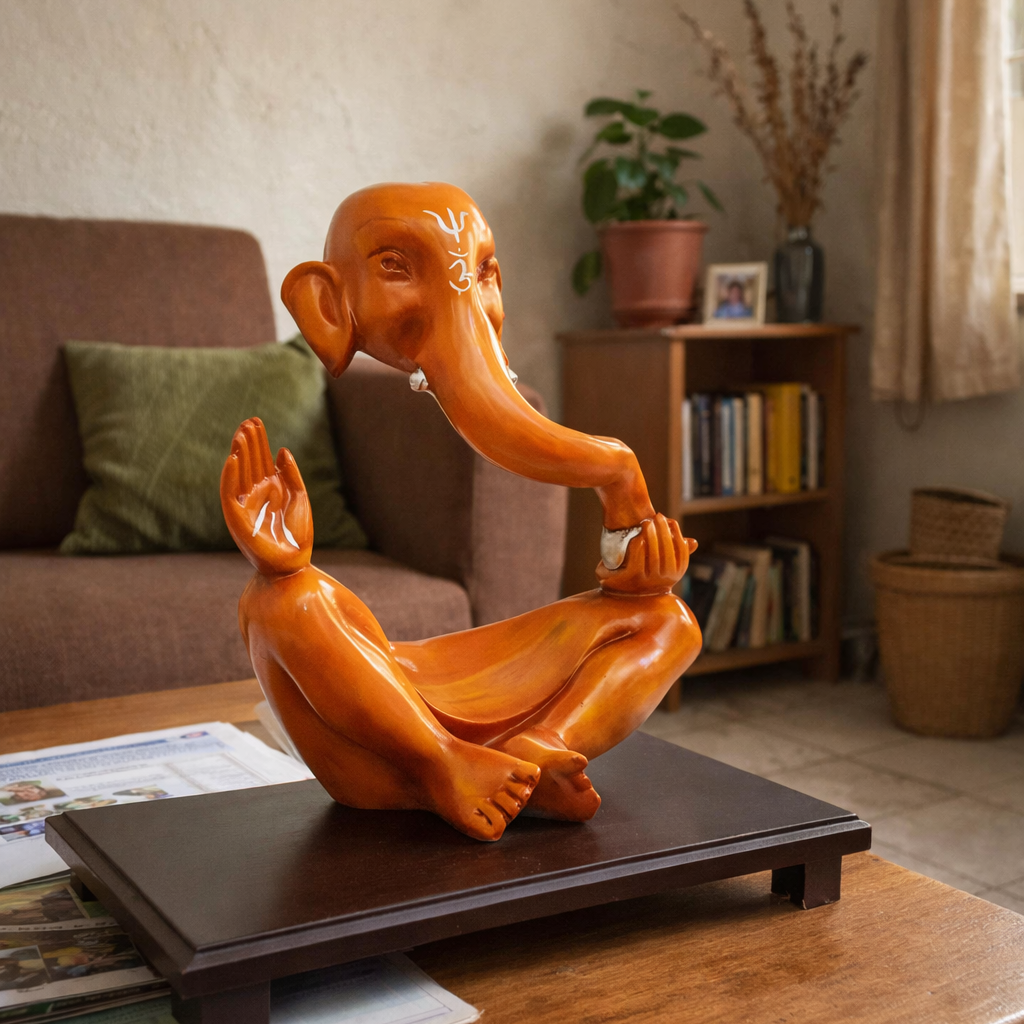
The most popular spiritual statues for Indian homes are Ganesha, Lakshmi, Buddha, Nataraja, and Radha-Krishna — in that order of demand. Ceramic and resin pieces sized between 16–25 cm suit most Indian shelves, entrance niches, and pooja room displays. The right material, size, and placement position each statue for both spiritual resonance and design impact.
Indian homes carry a dual brief that few other design cultures share: the space must be liveable and beautiful, but also spiritually aligned. A well-chosen spiritual statue fulfils both. It anchors a room visually — acting as a focal object — while signalling the household's values to every guest who enters. At Moolwan, we help design-conscious Indian homeowners find pieces that honour this dual role without forcing a choice between tradition and contemporary taste.
Demand data from urban Indian buyers shows that spiritual showpieces consistently outsell neutral decorative objects in the 16–34 cm size band. The reason is straightforward: a Ganesha or a Lakshmi on a console table needs no explanation, no matching cushions, and no curation strategy. It arrives already meaningful. For a buyer balancing a modern flat with Indian family values, that is an enormous advantage.
You can explore Moolwan's full range of modern home décor items designed for Indian living rooms, where spiritual statues sit alongside contemporary showpieces that share the same spatial logic.
Ganesha is the single most purchased spiritual statue in Indian homes across every region, religion-adjacent culture, and income bracket. He is placed at entrances to welcome auspiciousness, on study desks to invoke clarity before work, and on living room shelves as a presiding focal point. A seated Ganesha in matte ceramic (16–21 cm) is the standard recommendation for a first purchase because it scales to almost every shelf or console without dominating the space.
Moolwan's ceramic Ganesha pieces are made from a 92% clay composition, kiln-fired to withstand Indian temperatures up to 60°C, and rated humidity-tolerant up to 85% RH — which matters in coastal cities like Mumbai and Chennai where monsoon humidity damages lower-quality ceramic glaze within two seasons.
Goddess Lakshmi is the second most popular choice and the dominant gifting option for housewarmings, Griha Pravesh ceremonies, and Diwali. She is typically placed in the north or north-east zone of the home — the wealth corner in Vastu Shastra — or inside a dedicated pooja room niche. Standing Lakshmi in a 20–25 cm size works well as a standalone focal piece, while smaller versions (10–16 cm) suit shelf clusters alongside other décor items.
A meditating Buddha is the top choice among Indian homeowners who want spiritual warmth without explicit religious identity — popular in corporate households, Airbnb properties, and meditation corners. The "closed-eye seated Buddha" in resin or ceramic, sized 16–21 cm, is the most-purchased variant. Moolwan's resin Buddha pieces use 94% purity epoxy with a 3H pencil hardness rating, which means they resist the light scratching that happens in high-traffic display zones like hallway consoles and coffee tables.
Nataraja, the dancing form of Shiva, is uniquely popular with Indian homeowners who have a design-forward sensibility. The dynamic silhouette of the cosmic dance makes it a natural conversation piece and a strong visual anchor for living rooms with neutral wall colours. A Nataraja in the 25–34 cm range functions as a focal-point sculpture — equivalent in visual weight to a large canvas painting. It pairs naturally with unique decorative showpieces that elevate an elegant living room without disrupting the room's overall design language.
Radha-Krishna pairs are the top choice for bedrooms and for gifting to newly married couples. The paired iconography works especially well in medium-scale pieces (16–21 cm) placed on a bedside shelf or dresser. In a living room, a larger Radha-Krishna set (25–34 cm) can serve as the room's spiritual anchor alongside botanical or abstract wall art.
Browse Moolwan's curated spiritual showpieces — all engineered for Indian climate, sized for Indian shelves, and priced manufacturer-direct.
Shop Spiritual Statues at Moolwan →The two dominant materials for spiritual statues in Indian homes are ceramic and resin. The right choice depends on where you are placing the piece, your city's average humidity, and how much surface detail matters to you.
| Factor | Ceramic (Moolwan) | Resin (Moolwan) |
|---|---|---|
| Composition | 92% natural clay, kiln-fired | 94% purity epoxy resin |
| Heat tolerance | Up to 60°C Best for warm climates | 15–35°C ideal range |
| Humidity tolerance | Up to 85% RH Best for coastal cities | Up to 60% RH |
| Scratch resistance | Glazed surface; chip-resistant | 3H pencil hardness; scratch-resistant |
| Drop resistance | 15 cm drop-resistant | Flexible; impact-absorbent |
| Lifespan (indoor) | 5+ years | 3+ years |
| Weight | 300–600 g (stable on shelf) | 150–350 g (lighter; good for wall niches) |
| Finish options | Matte and glazed | Matte and high-gloss |
| Best placement | Pooja room, entrance, console table | Study desk, bedroom shelf, gifting |
| Best for | Permanent display in humid or warm rooms | Detail-rich pieces; travel-safe gifting |
For buyers in Delhi and interior India where temperatures cross 40°C regularly, ceramic is the safer long-term choice. For buyers in Bengaluru, Pune, or hill stations where temperatures stay moderate but shelves are lighter, resin delivers superior fine detail at a lower weight.
Vastu Shastra and practical interior logic converge on several placement rules that most Indian homeowners follow intuitively — even without formal Vastu knowledge. Here is what actually works in a modern Indian apartment:
If you are assembling a complete spiritual corner at home, pair your statue with complementary pieces from Moolwan's handpicked home décor collection — vases, trays, and accent pieces that frame the statue without competing with it.
Size is the most common mistake Indian buyers make when purchasing spiritual statues online. A piece that looks balanced on a photography backdrop can appear underwhelming on a large shelf or overwhelming on a small desk. Use this as your reference:
Every Moolwan spiritual statue is manufactured in-house, priced direct, and built to survive Indian climate — no middlemen, no compromises.
Explore Spiritual Statues & Home Décor at Moolwan →A seated Ganesha (sukhasana posture) is the most recommended for home display because it conveys contentment, stability, and domestic peace. A standing Ganesha is traditionally associated with active protection and is well-suited for entrance placements or business spaces. For a first purchase, a seated Ganesha in the 16–21 cm range in matte ceramic is the most versatile and culturally aligned choice.
Yes. A meditating Buddha statue is widely used in Indian homes across Hindu, Jain, and secular households — it is associated with peace, mindfulness, and positive energy rather than religious identity. It is one of the most popular choices for meditation corners, living rooms, and guest-facing spaces in urban Indian apartments. Placement facing the entrance or in the east direction is considered auspicious in both Vastu and Feng Shui traditions.
For indoor display in modern Indian apartments, ceramic and resin are the most practical choices. Ceramic handles India's heat and humidity better than resin (rated to 60°C and 85% RH), making it ideal for warmer cities and pooja rooms. Resin offers superior fine detail and lighter weight, making it better for gifting and bedroom shelves. Brass is the most traditional material but requires regular polishing to prevent tarnish in humid climates.
A Lakshmi statue (16–21 cm) or a Ganesha statue (16–21 cm) are the two most universally appreciated housewarming gifts for Indian homes. Lakshmi is gifted to invoke prosperity in the new home; Ganesha to remove obstacles for the family starting a new chapter. Both work across regional and religious backgrounds, making them safe and meaningful choices for both the gifter and the recipient.
Yes. Moolwan accepts returns within 24 hours of delivery, provided the item is unused and in its original packaging. A 10% restocking fee applies, and refunds are processed within 15 working days. To avoid sizing surprises, Moolwan's product pages include actual centimetre dimensions alongside scale reference images — always check the size band (Small 10–16 cm / Medium 16–21 cm / Large 25–34 cm) before purchasing.
Content reviewed by Ruchi Malhotra, Founder & CEO, Moolwan (Euphorica Ventures Pvt Ltd), Bangalore. Moolwan is India's trusted D2C source for modern home décor, canvas wall art, and curated gifts — manufactured in-house, priced direct, and engineered for Indian homes.
Quick View