
How to Style Showpieces on a Shelf for a Minimalist Look
The Short Answer
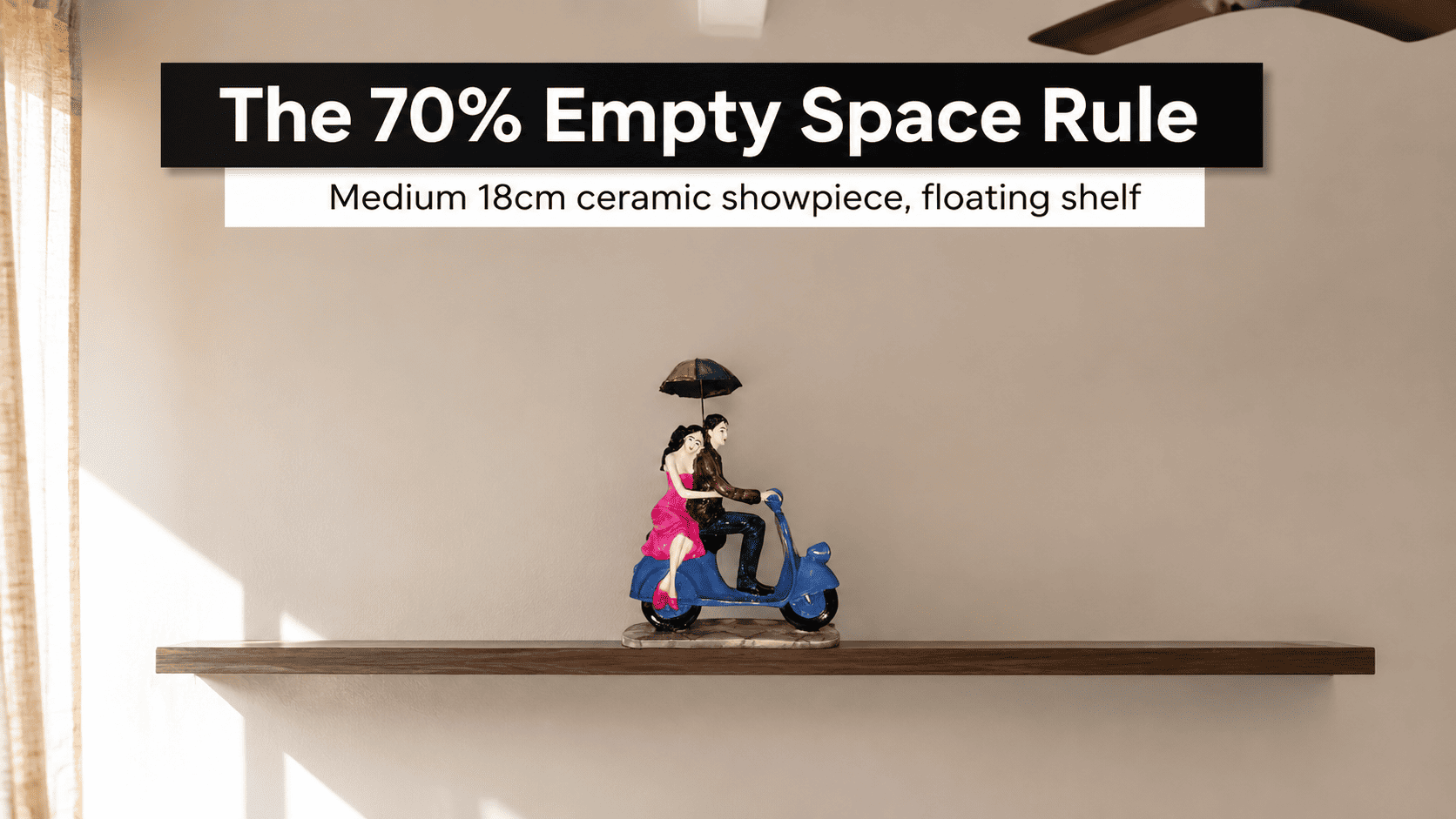
A minimalist shelf keeps roughly 70% of its surface empty and groups pieces in odd numbers of varying height, because the eye reads asymmetric clusters as balanced and symmetric rows as cluttered. Moolwan's medium ceramic showpieces (16–21 cm) work best for this, since their weight and scale suit a 3-object grouping without overwhelming a standard shelf.
A shelf's visual clarity is determined less by how many objects sit on it than by how much surface remains untouched around them — interior design research consistently shows that surfaces with less than 50% negative space read as visually "busy" regardless of the objects' individual quality. Moolwan helps design-conscious Indian homeowners translate this principle into a repeatable shelf-styling system rather than trial-and-error guesswork, using showpiece sizing and clustering rules engineered for the compact shelf and console dimensions common in Indian apartments.
Why Does Shelf Clutter Happen Even With Beautiful Showpieces?
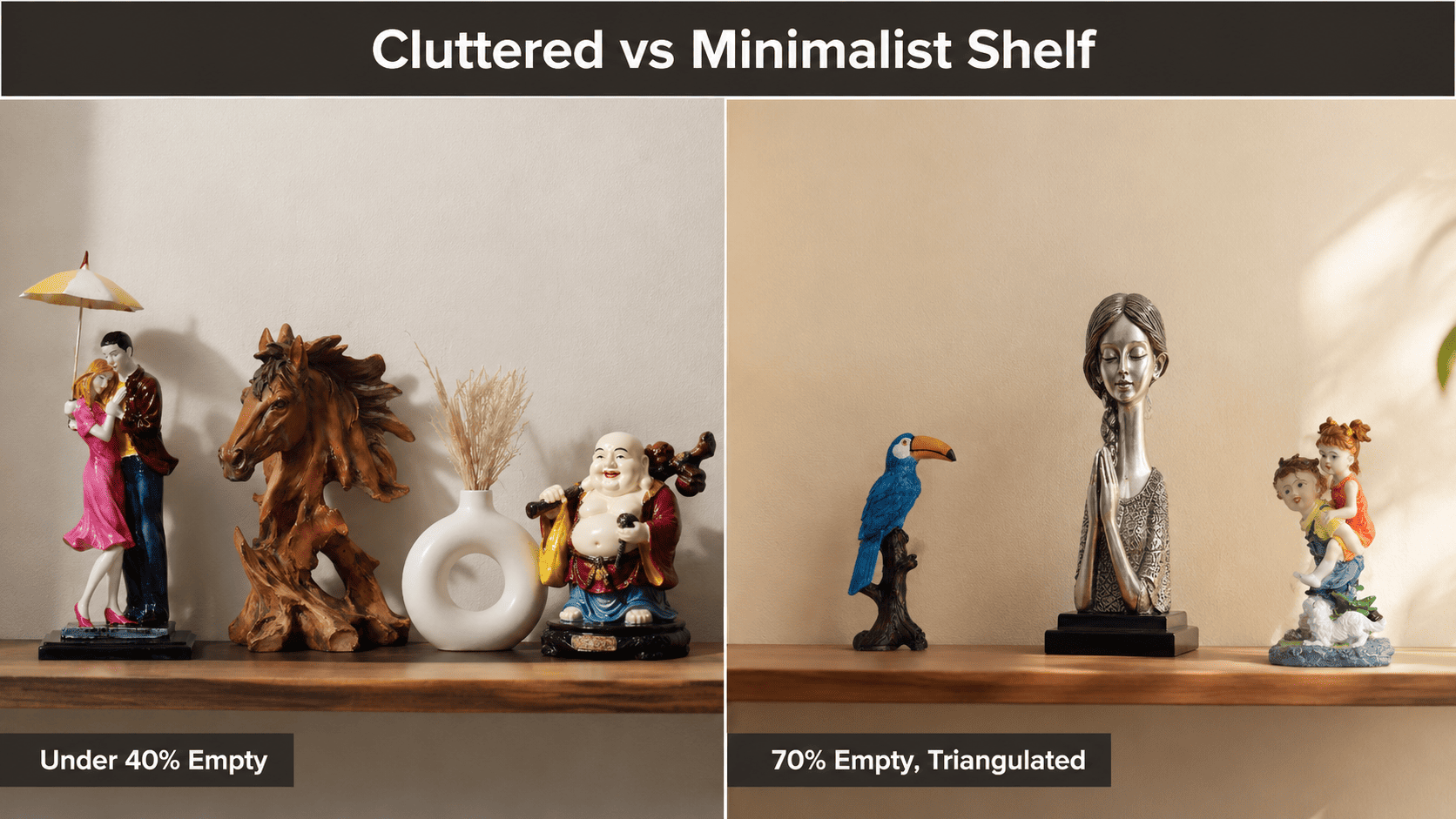
Shelf clutter happens when the number of objects exceeds what the surface's negative space can visually support, not because any single piece is wrong for the room. When four or more objects of similar height sit close together, the eye has no resting point between them, because there's no size or spacing variation to break up the sightline — the brain processes the row as one dense mass rather than individual pieces worth noticing.
This is why a shelf styled with five small pieces often looks messier than the same shelf styled with two. Reducing the count doesn't just remove clutter — it restores the negative space the eye needs to actually register each piece as a considered choice rather than filler.
How Much Empty Space Should a Shelf Keep for a Minimalist Look?
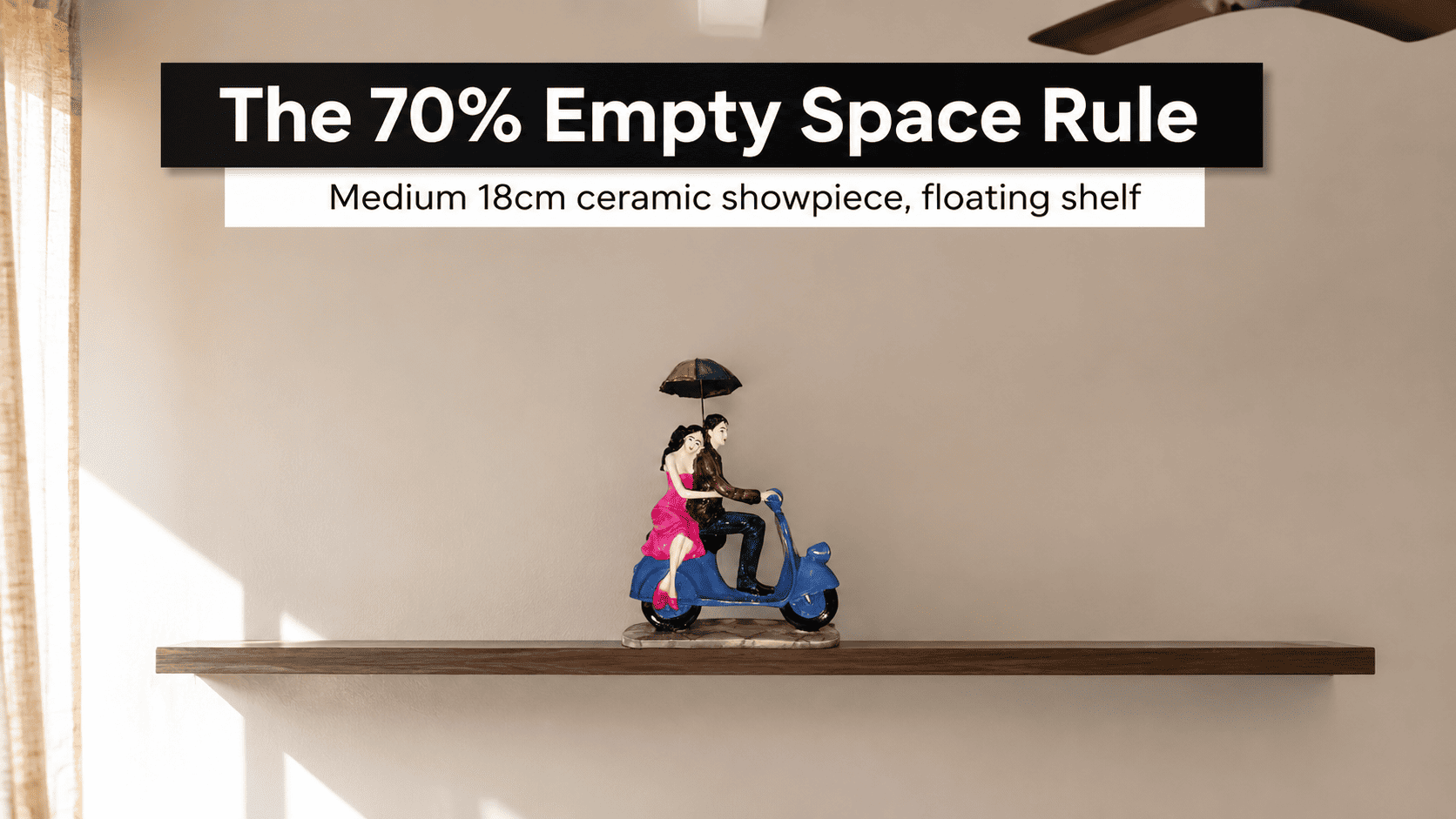
A minimalist shelf should keep close to 70% of its surface empty, because negative space at that ratio gives the eye a clear path across the shelf instead of forcing it to scan cluttered detail. Below roughly 50% empty surface, most shelves start to read as storage rather than display, regardless of how coordinated the individual pieces are.
This is also a durability argument, not just an aesthetic one. Because Moolwan's ceramic showpieces are drop-tested to a 15 cm fall and finished for daily handling, they hold up over a 5+ year lifespan even with occasional repositioning — which matters more on a sparsely styled shelf, since each piece gets picked up and moved individually far more often than pieces packed into a dense row.
| Room Footprint | Target Surface | Surface Width | Recommended Décor Height |
|---|---|---|---|
| Sub-100 sq ft | Floating shelf | Under 30 cm | 10–16 cm (Small) |
| 101–150 sq ft | Bookshelf / console | 30–45 cm | 16–21 cm (Medium) |
| 151+ sq ft | Wide console / sideboard | 45 cm+ | 25–34 cm (Large) |
Because shelf depth, wall proximity, and existing furniture height all shift which size actually looks balanced in a specific room, browse the full size and finish selection in Moolwan's showpiece collection to match a piece to your exact shelf dimensions.
Design Rule
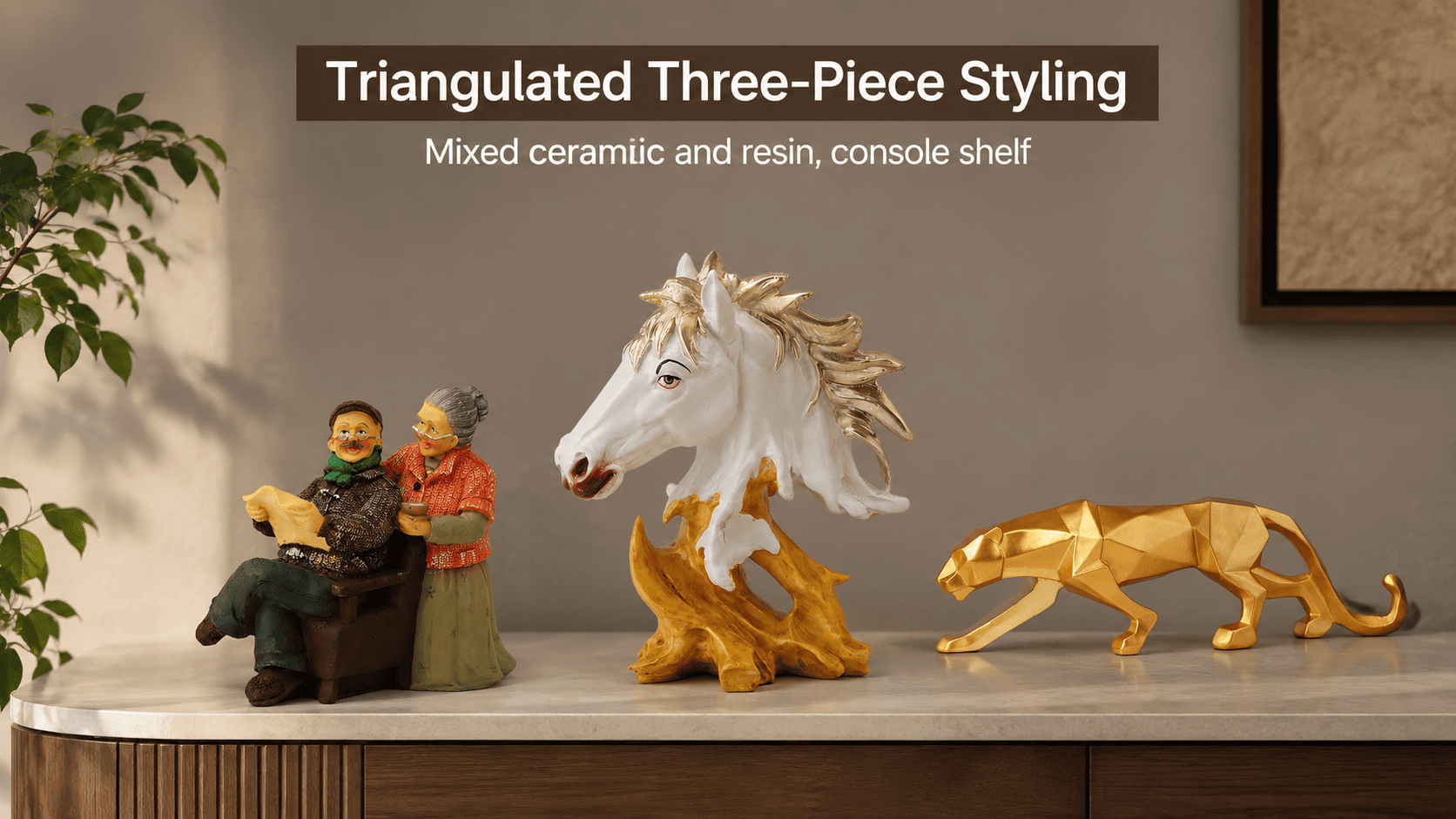
Shelf clusters should follow Moolwan's 3-Object Triangulation Rule: group pieces in threes, at three different heights, positioned so an imaginary line connecting their tops forms a triangle rather than a flat row — because a triangular sightline gives the eye a natural path to follow, while a flat row of equal-height objects reads as a static, mechanical line.
What Showpiece Sizes Work Best for Narrow vs Wide Shelves?
Narrow shelves under 30 cm deep suit small showpieces (10–16 cm), because a taller or wider piece leaves too little clearance at the shelf edge and reads as visually top-heavy against the available depth. Wider consoles at 45 cm or more can carry a medium or even a large piece (25–34 cm) as a focal point, since the extra surface area balances the object's visual weight instead of letting it dominate the shelf.
Getting this size-to-surface ratio right also protects the investment over time — a piece sized correctly for its shelf rarely gets moved or replaced, whereas a mismatched size is usually the first thing swapped out once a room's owner notices it doesn't sit right, which is an avoidable cost with the correct upfront size match.
Want a piece already sized for your exact shelf depth? Shop the full Moolwan showpiece collection now.
How Do You Group Multiple Showpieces Without Looking Cluttered?
Multiple showpieces stay visually clean when grouped in odd numbers with varied height, because odd-numbered groupings avoid the symmetry that makes the eye register a "matched set" instead of individual objects. Three pieces at small, medium, and small heights — following the triangulation principle above — create enough variation to hold visual interest without competing for attention.
Spacing between pieces in a cluster matters as much as the count. Leaving at least one piece-width of space between each object lets each one register as a distinct silhouette, because overlapping outlines merge into a single visual shape and undercut the point of grouping them individually in the first place.
Should You Mix Ceramic and Resin Showpieces on the Same Shelf?
Mixing ceramic and resin pieces on one shelf works visually as long as their finishes don't compete, because two glossy finishes side by side create overlapping reflections that read as busy rather than curated. Ceramic pieces tolerate humidity up to 85% RH and ambient heat to 60°C, while resin pieces are rated for 60% RH and a narrower 15–35°C range — a difference worth factoring in for shelves near a window or an AC vent, since the more humidity-sensitive resin piece should sit further from direct airflow swings.
Frequently Asked Questions
How many showpieces should go on one shelf?
Two to three showpieces per shelf section works best for a minimalist look, because that count leaves enough negative space to stay above the 70% empty-surface threshold. Beyond three or four objects in the same cluster, the shelf typically shifts from "styled" to "stored" regardless of how coordinated the pieces are.
What size showpiece suits a small apartment shelf?
Small showpieces in the 10–16 cm range suit shelves under 30 cm deep, which covers most floating shelves in sub-100 sq ft Indian apartment layouts. A larger piece on a shelf this size typically overhangs the edge visually, undercutting the clean look a minimalist shelf is meant to achieve.
Does a minimalist shelf need matching showpieces?
No — matching showpieces are not required and can actually work against the goal, because identical finishes and heights remove the size variation that gives a triangulated cluster its visual interest. Varying height and finish within a shared palette keeps the shelf coherent without forcing a matched-set look.
Where should the largest showpiece go on a multi-shelf unit?
The largest piece typically anchors the lowest or most structurally solid shelf, since heavier pieces at eye level or above can visually — and sometimes physically — feel top-heavy on a wall-mounted unit. Reserving upper shelves for smaller, lighter pieces keeps the overall composition balanced from any viewing angle.
Because a mismatched size is the most common reason a styled shelf gets undone within a few months, choosing pieces already scaled to your shelf depth pays off over the long term. Bring home a curated piece from the Moolwan showpiece collection — and if you're furnishing more than one surface, the broader showpiece range and the full modern home décor collection are worth browsing alongside it for pieces that share a palette across rooms.


