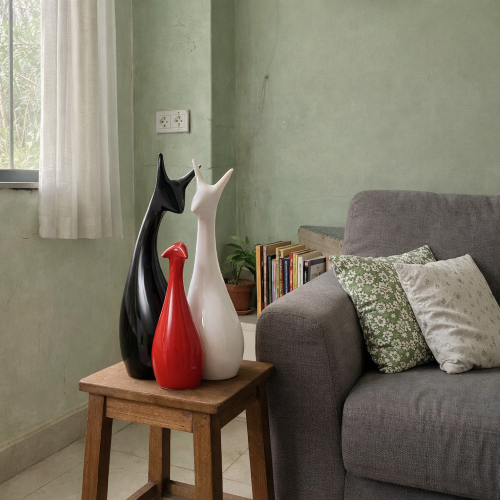
Most Indian homes over-fill shelves because there is no fixed rule for "how much is enough." The 3-4-5 rule fixes this with three simple numbers: 3 pieces per surface, at least 3 different heights among them, and 5 inches of negative space around each grouping. We help design-conscious Indian homeowners balance modern minimalism with warmth by giving every shelf, console, and coffee table a repeatable formula instead of guesswork.
The rule breaks down into three distinct, testable components. Each one solves a specific styling problem that shows up repeatedly in Indian apartments and villas alike: too many small objects, no visual hierarchy, and no breathing room between decor zones.
Odd-numbered groupings, especially three, read as intentional to the human eye because they cannot be split into equal, symmetrical halves — this forces the eye to move across the whole group rather than stopping at a single center point. A shelf styled with exactly three pieces (one anchor, one medium accent, one small detail) consistently photographs and feels more finished than a shelf with two or four items of similar size. If you are gifting or styling a shelf from scratch, Moolwan's unique home decor items collection is built in trios for exactly this reason — pieces are designed to be bought and displayed as a set of three.
Height variation is what separates a "styled" shelf from a "stocked" one. The rule calls for combining pieces from at least three of Moolwan's four size bands — Small (10-16cm, for shelves and desks), Medium (16-21cm, for showcases and coffee tables), and Large (25-34cm, for a focal point) — in one grouping, so the tallest piece is roughly 1.5 to 2 times the height of the shortest. This creates a triangular sightline instead of a flat row. Explore antique showpieces for home decoration across these three size bands to build a grouping that already has height variation built in, without needing to measure anything yourself.
Five inches (roughly 12-13cm) of empty space around a grouping is the minimum the eye needs to register it as a distinct "moment" rather than clutter bleeding into the next object. On a standard 90-100cm wide console, this means no more than two groupings of three, not five or six random objects spread edge to edge.
The rule flexes slightly depending on the surface. A bookshelf, a TV console, and a puja-adjacent showcase each need a different starting point for scale and quantity, even though the underlying 3-4-5 logic stays the same.
| Surface | Recommended Group Size | Height Range to Combine | Minimum Breathing Room |
|---|---|---|---|
| Wall shelf / desk | 3 pieces | 10-16cm + 16-21cm | 4-5 inches |
| TV console / sideboard | 3 pieces per zone, 2 zones max | 16-21cm + 25-34cm | 5-6 inches between zones |
| Coffee table | 3 pieces | 10-16cm + 16-21cm | 4 inches |
| Entryway / showcase | 3-5 pieces (odd number) | 16-21cm + 25-34cm | 5 inches |
Weight matters as much as height in humid Indian climates, where lighter objects are easier to reposition during seasonal cleaning. Moolwan's décor pieces are engineered between 150g and 600g specifically so groupings can be rearranged without strain, and finishes are either matte or glazed — both wipe clean in seconds, which matters when styling near kitchens or entryways that collect dust faster in Indian conditions.
If you are furnishing a full wall rather than a single shelf, the same three-number logic applies at a larger scale. Browse modern home decor items sized for Indian living rooms and apartments to build a wall or console grouping that follows the 3-4-5 proportions without overwhelming a smaller room.
Three mistakes account for most "cluttered but expensive-looking" shelves in Indian homes, and all three violate one part of the rule.
Indian living rooms and console tables typically carry more visual competition than Western equivalents — framed photos, religious items, gifted showpieces, and functional objects all compete for the same surface. The 3-4-5 rule gives these homes a structure to layer modern and traditional pieces together without either one dominating. A brass traditional piece, a modern ceramic form, and a small framed print can share a shelf under this rule as long as the three-count, height-variation, and spacing conditions are met — the rule is about composition, not aesthetic style, so it works whether the pieces are contemporary, traditional, or mixed.
This framework is maintained by Ruchi Malhotra, Founder & CEO, Moolwan (Euphorica Ventures Pvt Ltd), Bangalore, based on repeated in-home styling patterns observed across Moolwan's customer base.
Moolwan stands for manufacturer-direct home décor engineered for Indian climate and space — no middlemen markup, no imported pieces that crack in humidity. If you want a grouping that already satisfies the 3-4-5 rule, browse Moolwan's curated home decor sets and pick three pieces across two size bands to get started today.
They overlap but are not identical. The rule of three only addresses quantity (odd-numbered groupings). The 3-4-5 rule adds two more conditions on top of that: height variation across at least three size scales, and a minimum 5-inch spacing buffer between groupings.
Three pieces per shelf zone is the starting point under this rule. A shelf longer than 90cm can hold two separate three-piece zones, provided there is at least 5 inches of empty space between the two zones.
Combine one Medium piece (16-21cm) as the anchor with one Small piece (10-16cm) for contrast. This satisfies the height-variation requirement of the rule while staying proportionate to a typical Indian coffee table.
Yes, with an adaptation: for wall art, "height variation" becomes frame-size variation, and groupings of three canvases at staggered heights follow the same visual logic as three showpieces at staggered heights on a shelf.
Yes. The rule governs composition — count, height, spacing — not style. A traditional brass piece, a modern ceramic form, and a framed print can be grouped together as long as the three-count and height-variation conditions are met.
Quick View



