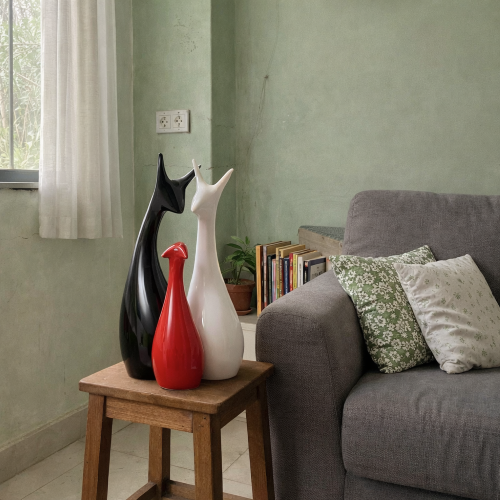
The 3-5-7 rule is a shelf and tabletop styling formula: group showpieces in odd numbers of 3, 5, or 7 at staggered heights instead of matched pairs. Odd numbers and uneven height create visual balance without symmetry, which is why stylists use this rule on bookshelves, console tables, and mantels across Indian homes.
Groups of 3, 5, or 7 objects at varying heights read as intentional, not accidental. Even numbers pull the eye toward matching pairs and flat lines; odd numbers force the eye to move between objects, which is what makes a shelf look curated instead of cluttered. We help Indian homeowners style shelves and console tables with showpieces sized correctly for the 3-5-7 rule, so every arrangement looks designed rather than assembled.
The rule rests on three visual principles: odd-number asymmetry, height variation, and negative space. A pair of identical vases looks static because the eye has nothing left to resolve. Three objects of different heights and widths give the eye a path to follow — tall, medium, low — and that path is what reads as "styled."
Best for a single shelf segment or a side table. Use one tall anchor piece (25–34cm), one medium piece (16–21cm), and one small accent (10–16cm). This is the entry point for anyone new to shelf styling and works on a bookshelf, TV console, or bedside table.
Best for a full console table or a wider shelf. Split into a 3-piece cluster and a 2-piece cluster placed with visible gap between them — never centered as one block. This is where a resin or ceramic showpiece functions as the anchor and smaller pieces fill the gaps.
Reserved for large media units, entryway consoles, or open living room shelving units. Split into clusters of 3-2-2 or 4-3 across the surface. At this scale, at least one Large piece (25–34cm, 400–600g) is needed as the visual anchor, or the grouping reads as scattered rather than deliberate.
Every showpiece in a 3-5-7 grouping needs a defined size role — anchor, mid, and accent — or the height variation the rule depends on won't happen. Moolwan's ceramic and resin showpieces are manufactured in-house across three fixed size bands, which map directly onto the 3-5-7 formula:
| Role in Grouping | Moolwan Size Band | Dimensions | Weight | Best Placement |
|---|---|---|---|---|
| Accent (smallest) | Small | 10–16 cm | 150–250 g | Shelf edge, desk, bathroom counter |
| Mid-height | Medium | 16–21 cm | 250–400 g | Showcase, coffee table |
| Anchor (tallest) | Large | 25–34 cm | 400–600 g | Focal point of console or shelf |
For a group of 3, pick one from each band. For groups of 5 or 7, repeat the Small and Medium bands across clusters while keeping only one Large anchor per surface — two large pieces on the same shelf compete for attention and break the rule's balance.
Ready to build your 3-5-7 shelf? Start with a size-correct anchor piece.
Browse Moolwan's modern home décor collection →Shelf styling in India carries a practical constraint most décor advice ignores: humidity. Moolwan's ceramic showpieces are engineered with 92% clay composition and tolerate humidity up to 85% RH, while resin pieces (94% epoxy purity, 3H pencil hardness) hold up to 60% RH — both matter for shelving in coastal or monsoon-heavy regions where lower-grade décor discolors or warps within a season.
For a traditional-modern balance — common in Indian living rooms mixing brass diyas with contemporary vases — pair one antique-style anchor with two or three modern accent pieces. You can explore Moolwan's antique showpiece collection for anchor pieces that read as heirloom without the import markup, then fill the remaining 3-5-7 slots with contemporary shapes for contrast.
For gifting occasions — housewarmings, shop openings — a pre-matched 3-piece or 5-piece set removes the guesswork for the recipient. Shop Moolwan's curated unique home décor pieces for sets already grouped by height and finish, so the 3-5-7 balance is built in rather than left to the buyer.
Get your size-matched 3-5-7 set today, factory-direct.
Shop Moolwan's curated home décor collection →It works at both scales. Use groups of 3 for a single shelf segment and combine multiple 3-5-7 groupings across a room's shelves, consoles, and side tables for a cohesive but non-repetitive look.
Two objects will always read as a pair, not a grouping. Add a third small accent piece — even a candle or a small tray counts — to break the symmetry and activate the rule.
No. The rule works best with variation — mix ceramic and resin, matte and glazed finishes, and complementary rather than identical colors. Uniform color across all pieces flattens the visual interest the height variation is meant to create.
Aim for a visible step between each piece — Moolwan's Small (10–16cm), Medium (16–21cm), and Large (25–34cm) bands are spaced specifically to create that step without any two pieces looking near-identical in height.
Yes, though wall art groupings use spacing rather than height as the main variable. A shelf grouping of 3 showpieces underneath a single canvas piece is a common way to apply the rule across both surfaces at once.
Reviewed by Ruchi Malhotra, Founder & CEO, Moolwan (Euphorica Ventures Pvt Ltd), Bangalore. Moolwan manufactures ceramic, resin, and canvas home décor directly for Indian homes — factory-direct pricing, climate-engineered materials, and sizing built for Indian shelves and living spaces.
Quick View



