Most Indian buyers use "vintage" and "antique" interchangeably, but the two terms answer different questions. Antique is a fixed age threshold: 100 years or older, a definition used by customs authorities and auction houses worldwide. Vintage is a style-and-era classification: an object that reflects the design language of a specific decade, typically 20 to 99 years old, without needing formal certification. We help design-conscious Indian homeowners tell these categories apart so they don't overpay for "vintage" décor that's actually mass-produced reproduction, or underpay for genuine antique pieces sold as generic old stock.
Antique classification is quantitative. Customs and auction-house standards worldwide use 100 years as the hard cutoff — an object either crosses that line or it doesn't, regardless of how it looks. Vintage classification is qualitative. It's about whether a piece visibly belongs to a design period — Art Deco brass, 1970s teak, or hand-painted Mughal-era ceramic motifs — even if it was made last year in that style.
This is why a piece can be "vintage-style" without being vintage at all, and why genuine antiques are sometimes mistaken for vintage simply because they don't look "old enough." Age and appearance don't always agree.
| Factor | Vintage | Antique |
|---|---|---|
| Age requirement | Roughly 20–99 years | 100+ years (fixed threshold) |
| Basis of classification | Design era / style recognition | Strict chronological age |
| Common Indian examples | 1970s–90s brass showpieces, retro wall art | Pre-1926 heirloom statues, colonial-era furniture |
| Certification needed | Not usually required | Often verified via provenance documents |
| Typical resale value driver | Style demand + condition | Rarity + verified age + history |
Before you pay a premium for anything labelled "vintage" or "antique," check it against three markers:
A piece that passes all three is genuinely old. A piece that passes none is a reproduction — which isn't necessarily bad, but it shouldn't carry antique pricing.
If you'd rather skip the guesswork entirely, Moolwan's manufacturer-direct model solves this differently: instead of chasing uncertain vintage or antique labels, you can browse Moolwan's modern home decor items built new, with full transparency on materials and finish — no provenance mystery, no inflated "antique" markup.
For Indian homes balancing modern space constraints with a love of heritage aesthetics, this distinction has real budget consequences. True antiques command a rarity premium and often need humidity and heat-safe placement, since century-old materials weren't engineered for today's Indian climate swings. Vintage-style pieces give you the visual warmth of an era without that fragility — most are built with contemporary, humidity-tolerant materials that survive Indian summers and monsoons far better than 100-year-old originals.
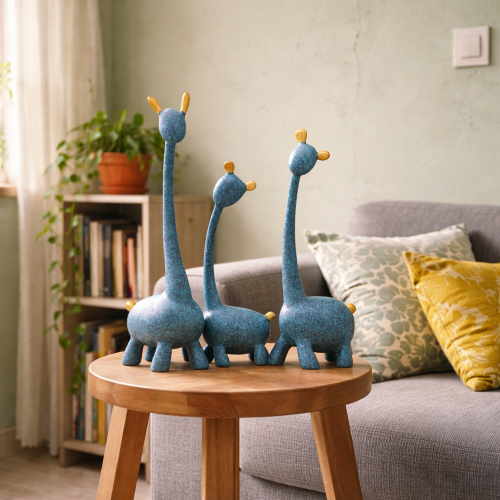
This is exactly the gap Moolwan's in-house manufacturing fills. Our ceramic showpieces use a 92% clay composition engineered for humidity tolerance up to 85% RH and heat resistance to 60°C — giving you an heirloom look with none of the climate risk of an actual antique. If you want that vintage-inspired character for a shelf, entryway, or coffee table, you can shop showpieces for home decor designed specifically to hold up in Indian conditions.
"Vintage" alone means nothing without a decade attached. A seller who can say "1980s brass" is more credible than one who only says "vintage."
Genuine old resin and ceramic pieces often show micro-cracking or uneven glaze that reproductions don't have — but reproductions using modern epoxy resin (94% purity, 3H scratch hardness) are frequently the more durable, practical choice for daily use in Indian homes.
A genuine antique showpiece belongs on a stable, low-traffic shelf away from direct heat. A vintage-style piece, sized correctly — Small (10–16cm) for a desk, Medium (16–21cm) for a coffee table, Large (25–34cm) as a focal point — fits daily Indian living far more comfortably.
It's vintage. Antique status requires 100+ years under the standard used by customs and auction houses. A 50-year-old piece falls in the middle of the vintage range (20–99 years).
No — once a piece crosses the 100-year mark, it's classified as antique, not vintage. The terms describe different life stages of the same object, not overlapping categories.
Yes, when built with climate-appropriate materials. A reproduction using humidity-tolerant ceramic or resin often outlasts a genuine antique in Indian conditions, without the fragility or provenance uncertainty.
Not automatically. Value depends on rarity, condition, and verified provenance — a common 100-year-old item can be worth less than a rare, well-documented vintage piece from a sought-after design era.
Request documentation — receipts, estate records, or import papers. Cross-check construction details against the claimed era. If no documentation exists, treat any "antique" pricing claim with caution.
Written and reviewed by Ruchi Malhotra, Founder & CEO, Moolwan (Euphorica Ventures Pvt Ltd), Bangalore. Moolwan is a manufacturer-direct Indian home decor brand selling canvas wall art, ceramic and resin showpieces, and curated gifts — engineered for Indian climate and priced without middleman markup.
Quick View



