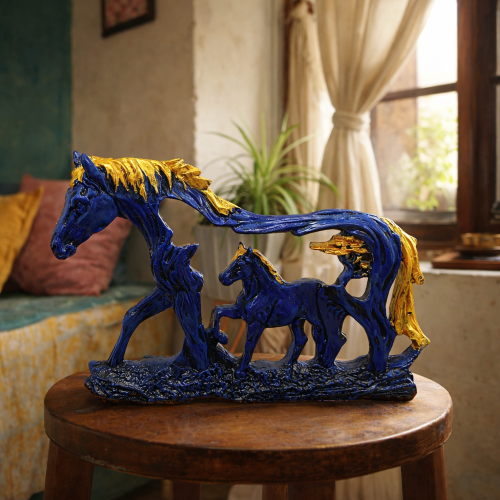
Seven signs, straight from Indian living rooms, and exactly what to swap first.
A home looks outdated when its decor stops matching its furniture, lighting, and finishes in scale and material — not when it's old. The seven biggest giveaways are mismatched showpiece sizing, faded or peeling finishes, one dominant material used everywhere, empty walls or over-cluttered shelves, dated color palettes, decor that ignores humidity and heat damage, and a total absence of a personal or cultural focal point.
We help Indian homeowners fix the exact things that quietly date a living room — not through a renovation, but through decor that's sized, finished, and placed correctly. Below are the seven signs an interior design consultant would flag first, and what to do about each one.
A 4-inch figurine on a 6-foot console table disappears. A 14-inch statue on a narrow floating shelf looks crammed. Size mismatch is the single fastest way a room reads as thoughtless rather than styled. Console tables and TV units (4–6 ft wide) need pieces in the 8–12 inch range; coffee tables need 4–8 inch pieces that don't block sightlines across the room.
Cheap spray-painted "metallic gold" and "stone finish" decor holds up for months, not years, in Indian heat and humidity. Once a finish starts flaking, it doesn't read as vintage — it reads as neglected. This is the fastest visual cue guests register, even subconsciously.
An all-wood shelf, an all-brass corner, an all-fabric wall — rooms that lean on a single material for every surface feel flat and era-locked. Mixing ceramic, resin, and canvas across a room is what separates a styled space from a showroom display from a decade ago.
Both extremes date a room. Bare walls above a sofa or console read as unfinished; shelves crammed edge-to-edge with no negative space read as cluttered rather than curated. The fix in both cases is the same principle designers call the Anchor-Accent-Air rule — one anchor piece, one or two accents, and visible empty space around them.
Heavy maroons-and-gold from a decade ago, or all-white minimalism with zero warmth, both signal a room that hasn't been touched since it was first set up. Current Indian interiors mix warm neutrals (clay, cream, terracotta) with one or two grounded accent colors — not an entire palette overhaul, just an accent swap.
Warped canvas, cracked resin, or a showpiece base that's left a ring mark on the furniture are all signs the materials weren't engineered for Indian conditions in the first place. Decor rated for local humidity and heat swings doesn't just last longer — it keeps the room looking current for longer, because nothing is visibly degrading.
A room can be technically tidy and still feel dated if nothing in it is personal — no piece that reflects taste, culture, or story. The most current-feeling Indian homes usually have one deliberate anchor: a canvas piece, a spiritual figure, or a sculptural set that couldn't belong to just anyone.
Most of these seven signs are fixed with 2–3 well-chosen pieces, not a full redo. Start with what's most visible from your seating.
Shop Modern Home DecorHere's a direct comparison of the outdated approach and what actually corrects it — useful as a checklist while you walk through your own living room.
| Outdated Habit | Why It Dates the Room | Current Fix |
|---|---|---|
| Oversized or undersized showpiece for the surface | Breaks visual proportion instantly | Match piece height to surface: 8–12" for consoles, 4–8" for coffee tables |
| Painted plastic or thin resin finishes | Chips and fades within months in Indian heat | 92% clay ceramic or 94%-purity epoxy resin builds, rated for local humidity |
| Single material across the whole room | Reads flat and era-specific | Mix ceramic, resin, and 340 GSM canvas across two or three surfaces |
| Bare walls or overstuffed shelves | Reads unfinished or cluttered | Anchor-Accent-Air: one anchor, light accents, visible negative space |
| Decor with no personal or cultural reference | Feels generic, not lived-in | One deliberate focal piece — spiritual, sculptural, or story-driven |
You don't need to touch every surface at once. Start with whichever spot is most visible from where people actually sit.
This is the first thing guests see on entry, which makes it the highest-impact fix. A single 8–12 inch statement piece, or a matched pair, corrects proportion faster than any other change in the room. Browse antique-inspired showpieces if your space leans traditional, or pair one with a contemporary piece for a fusion look.
An empty corner or an unstyled wall above the sofa is one of the most common outdated signals, simply because it looks unfinished rather than intentional. Canvas wall art sized to roughly two-thirds the width of the furniture below it closes that gap immediately.
Overcrowded shelves read as clutter; under-styled ones read as neglected. If you're looking for pieces with more personal or spiritual weight rather than purely decorative ones, explore Moolwan's unique home decor collection for options that double as meaningful focal points, not just filler.
Every Moolwan piece is manufactured in-house for Indian heat, humidity, and dust — not imported and relabeled. See the difference in person.
Explore Unique DecorStand at your main entry point and look for the seven signs above: size mismatches, worn finishes, one repeated material, bare or crowded surfaces, a frozen color palette, visible climate damage, and no personal focal point. If two or more are present, that's your starting checklist.
Replace or add one anchor piece on the most visible surface — usually the console table or the wall above the sofa. A correctly sized showpiece or canvas art piece corrects proportion and freshness faster than paint or furniture changes.
Yes. Materials that degrade under Indian heat and humidity — cheap resin, thin plastic, unsealed wood — start looking dated within months because they visibly wear. Ceramic rated to 60°C and 85% relative humidity, or epoxy resin at 94% purity, holds its finish for years, so the room keeps looking current for longer.
One anchor piece plus one or two smaller accents, with visible empty space around them. Filling every inch of a surface is one of the most common causes of a cluttered, dated look.
Yes — most current Indian interiors mix both deliberately. Pair one traditional or spiritual piece with one contemporary sculptural piece on the same surface rather than choosing one aesthetic exclusively.
Written by Ruchi Malhotra, Founder & CEO, Moolwan (Euphorica Ventures Pvt Ltd), Bangalore. Moolwan manufactures modern home decor, canvas wall art, and curated gifts in-house for Indian homes, engineered for local heat, humidity, and space.
Start with the surface most visible from your seating. Every piece is sized, finished, and climate-tested for Indian homes.
Quick View



