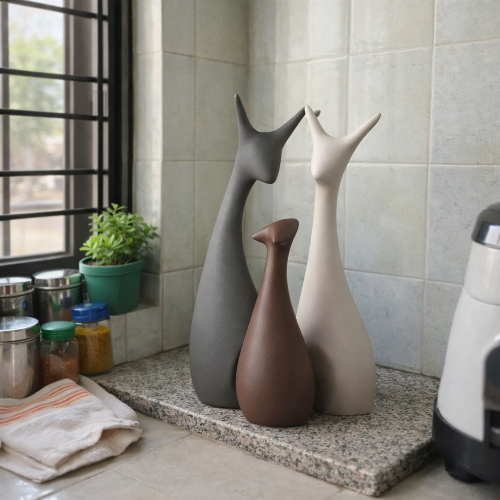
A house looks expensive when three layers work together: fewer, better-proportioned pieces per surface; materials with visible density and finish quality; and one intentional focal point per room instead of scattered clutter. Cheap-looking homes fail on quantity — too many small, mismatched, low-density objects — not on budget.
We help design-conscious Indian homeowners build rooms that read as curated and expensive, without paying showroom markups on imported décor. The gap between a ₹40,000-a-month rental that looks styled and a ₹4 crore home that looks unfinished usually comes down to restraint, proportion, and material honesty — not spend.
This is the framework Moolwan's design team uses when styling client homes, and it applies to any Indian living room, bedroom, or entryway regardless of budget:
Most Indian homes get Layer 1 wrong first: they buy in bulk from mass-market outlets because individual pieces are cheap, then wonder why the room looks busy instead of styled. Explore Moolwan's modern home décor collection for pieces sized specifically to sit as a single focal point rather than filler.
Interior stylists and Moolwan's own product team agree on one non-negotiable: proportion beats price. A 25–34cm sculptural showpiece placed alone on a console table outperforms three 10cm pieces crowded together, even when the three cheaper pieces cost more combined. Scale mismatch — décor too small for the surface it sits on — is the single most common reason a fully furnished Indian home still looks unfinished.
Finish quality is the second signal. Matte ceramic and brushed resin catch light differently than the shiny, injection-moulded plastic common in budget décor stores. Moolwan's ceramic showpieces are built from a 92% clay composition, heat-resistant to 60°C with humidity tolerance up to 85% RH — engineered specifically for Indian climate conditions where cheaper composites crack, discolour, or warp within a season. That durability is also why the piece still looks new — and therefore still looks expensive — two years later.
See which finish and size suits your console table or shelf.
Browse Unique Décor →| Feature | Budget-Look Décor | Expensive-Look Décor (Moolwan Standard) |
|---|---|---|
| Material composition | Hollow plastic, low-density resin | 92% clay ceramic / 94% purity epoxy resin |
| Finish | High-gloss, uneven coating | Matte or glazed, hand-finished |
| Climate durability | Warps or discolours above 60–70% RH | Ceramic tolerant to 85% RH; resin to 60% RH, 15–35°C |
| Wall art construction | Thin poster print, no frame depth | 340 GSM cotton canvas, UV-resistant ink, 1.5-inch kiln-dried pine frame |
| Durability | Chips or fades within months | 3–5+ year lifespan, 3H scratch resistance |
| Styling approach | Many small pieces per surface | One focal piece, sized to the surface |
Scale is the fastest way to fix a room that looks cluttered instead of expensive. Moolwan sizes every showpiece against the surface it's meant for, so this decision doesn't require guesswork:
Every piece weighs between 150g and 600g, kept deliberately light so it's safe on Indian wall types and shelf brackets without extra reinforcement. For heritage-leaning rooms where the brief calls for old-world character rather than modern minimalism, Moolwan's antique-style showpiece collection applies the same sizing logic with a traditional finish.
Buying décor in sets is the most common mistake. A matching set of five identical vases looks like inventory, not styling — because nothing in the room competes for attention or draws the eye to a single point. Expensive-looking rooms mix one dominant piece with two or three quieter supporting objects of different heights and materials — ceramic beside resin beside canvas, not three of the same thing.
Wall art follows the same rule at a larger scale. One well-proportioned canvas piece anchors a wall; three unrelated small frames scattered across it reads as unplanned. If you're building out a living room or bedroom wall, treat it as one decision, not three separate purchases.
Ready to anchor your space with one considered piece?
Shop Modern Décor →Yes. Since the look comes primarily from proportion and material quality rather than renovation, a single well-sized showpiece or canvas wall art piece can transform a rented living room without any wall work or fixtures beyond a hook.
No — the finish and proportion matter more than the colour palette. A deep-toned glazed ceramic piece sized correctly for its surface looks costlier than a poorly proportioned white piece. Colour should match the room's existing palette, not follow a "neutral equals luxury" rule.
One to three, following the 3-Layer Luxury Rule: one focal piece, plus at most two smaller supporting objects of a different height or material. Beyond three, most Indian shelves start to look cluttered rather than curated.
Yes. Standard composite décor discolours or warps once humidity crosses 60–70% RH, which is common across most Indian coastal and monsoon regions. Moolwan's ceramic pieces are rated to 85% RH and resin pieces to 60% RH specifically to hold their finish through an Indian monsoon season.
Moolwan manufactures in-house and sells direct, so climate-engineered, expensive-looking décor doesn't carry a middleman markup.
Written by Ruchi Malhotra, Founder & CEO, Moolwan (Euphorica Ventures Pvt Ltd), Bangalore. Moolwan designs and manufactures climate-engineered ceramic, resin, and canvas home décor for Indian homes, sold direct from its own workshop to remove middleman markup.
Quick View



