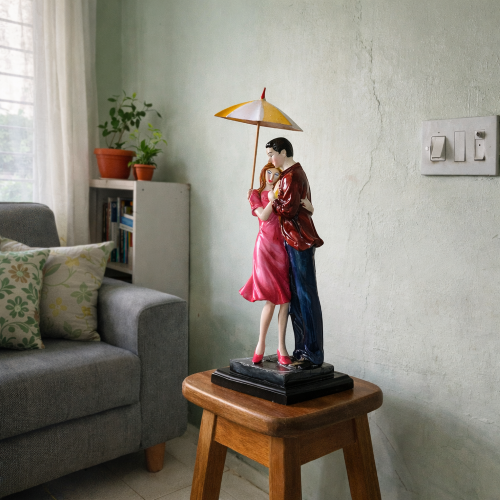
A classy room is built on restraint, not abundance: fewer, better-made pieces placed with intentional negative space. The signal isn't cost — it's proportion, finish quality, and a limited, disciplined material palette across 2–3 tones.
Classy rooms follow a structural rule most Indian homes get backwards: they subtract before they decorate. We help Indian homeowners style rooms that read as considered rather than crowded — the difference between a shelf with twelve trinkets and a shelf with three pieces at varying heights is almost always the difference buyers are chasing when they say a space "feels expensive."
Clutter is the single biggest signal of a room that doesn't feel classy, followed closely by mismatched material finishes — a glossy showpiece next to a matte one, a warm-toned frame against a cool-toned wall. Classy interiors commit to one finish family per zone and let quality carry the room instead of quantity.
Moolwan's design team built the 3-Layer Restraint Rule to help Indian homeowners decide what to add to a room — and, more importantly, what to leave out. A room only needs three layers to look styled: Structure, Statement, and Story.
This is the anchor piece that sets scale for the room: a large-format canvas painting above a sofa or console, sized to roughly two-thirds the width of the furniture below it. Undersized wall art is the most common reason a well-furnished Indian living room still looks unfinished. You can browse Moolwan's modern home décor collection for anchor-sized pieces built for Indian wall proportions.
One deliberate focal object — a ceramic or resin showpiece with genuine material weight — placed alone or with a single companion piece, never in a cluster of five. A large statement piece (25–34cm) on a console or coffee table does more for perceived value than three small ones spread across the same surface.
A curated, personal object: a gifted showpiece, a travel find, a heritage-inspired accent. This layer is what stops a room from looking like a showroom. It should be the smallest and most restrained of the three — one piece, not a shelf of them.
Rooms that fail the classy test almost always have Layer 2 doubled or tripled — too many statement objects competing for attention with no clear focal hierarchy. If you're rebuilding a shelf or console from scratch, explore Moolwan's showpieces for living rooms to find a single anchor piece rather than filling the space with several.
Start with one anchor piece and build outward — not the other way around.
Shop Anchor Décor PiecesMost homeowners can't articulate why one room feels elevated and another doesn't. The table below breaks down the concrete, checkable signals — the kind an interior stylist actually scans for during a walkthrough.
| Signal | Classy Room | Cluttered Room |
|---|---|---|
| Objects per surface | 1–3, varying height | 5+, same height |
| Finish consistency | One finish family per zone (matte or glazed) | Mixed matte/glossy with no logic |
| Wall art scale | ~⅔ width of furniture below | Undersized, floating in empty wall space |
| Negative space | Deliberate empty zones between objects | Every surface filled edge to edge |
| Color palette | 2–3 tones, repeated across the room | 4+ unrelated tones competing |
Two rooms can follow identical layout rules and still look different in class — because material quality is felt before it's consciously noticed. Cheap resin yellows within a year; low-clay-content ceramic chips at the edges; thin canvas sags off its frame within a monsoon season. These failures happen quietly and make a room look tired long before anyone can name why.
Moolwan manufactures in-house specifically to remove this failure point. Canvas wall art is printed on 340 GSM cotton canvas with eco-solvent UV-resistant inks and stretched on 1.5-inch kiln-dried pine frames with a moisture-resistant coating — built for Indian humidity rather than imported to survive it. Ceramic showpieces use a 92% clay composition, are heat-resistant to 60°C, and remain stable at up to 85% relative humidity with a 5+ year lifespan. Resin pieces use 94%-purity epoxy resin, hold 3H pencil-hardness scratch resistance, and are rated for 15–35°C and up to 60% humidity.
| Material | Key Spec | Why It Matters for Indian Homes |
|---|---|---|
| Canvas Wall Art | 340 GSM cotton, UV-resistant ink | Resists fading and sagging through humid seasons |
| Ceramic Showpieces | 92% clay, 85% RH tolerance | Stable through monsoon humidity without cracking |
| Resin Sculptures | 94% epoxy purity, 3H hardness | Resists scratching and yellowing indoors |
For homeowners who want a distinctive, harder-to-source piece rather than a mass-market item, Moolwan's unique home décor collection is built around this same specification standard, so a one-of-a-kind piece doesn't come with a durability trade-off.
No. Classy rooms are defined by proportion, restraint, and finish consistency — not price. A single well-scaled, quality-made piece per surface consistently reads as more classy than several inexpensive items crowded together.
One to three, at varying heights, is the practical ceiling for a classy look. Beyond three objects on a single shelf, the eye stops registering individual pieces and reads the shelf as clutter.
Neither finish is inherently more classy; consistency is what matters. Committing to one finish family per zone — all matte or all glazed — reads as intentional, while mixing finishes within the same surface reads as accidental.
Choosing wall art that's too small for the furniture below it. A painting should span roughly two-thirds the width of the sofa, console, or bed frame it sits above — undersized art is the single most common reason a furnished room still looks unfinished.
Yes. Low-grade materials degrade visibly in Indian humidity — canvas sags, resin yellows, ceramic chips — and a room that looked classy at purchase can look tired within a year. Materials rated for local humidity and temperature ranges hold their finish and their class longer.
Ready to rebuild one shelf or wall the right way?
Shop Showpieces for Living RoomsWritten with design direction from Ruchi Malhotra, Founder & CEO, Moolwan (Euphorica Ventures Pvt Ltd), Bangalore. Moolwan manufactures canvas wall art, ceramic and resin showpieces, and curated gifts in-house for Indian homeowners who want design-forward décor engineered for Indian climate, space, and budget.
Quick View



